I like to read other books about preparedness and share them with you all. I realize that I’m not all-knowing and I get a lot of great information from reading other authors. I mean, I’d get more from Mark Sibley if he’d ever finish the sequel to Mongol Moon, but that’s another story. On that note, if you want some fiction that will first give you chills, but then teach you a little about life in a divided America, I encourage you to read Blaine Pardoe’s Blue Dawn Series. Just click the hyperlink to learn more.
I was shocked to learn that Tactical Wisdom wasn’t a new idea recently. During the early days of World War Two, Japan and Germany were on the move. It looked like nothing could stop the Imperial Japanese Navy, especially after they destroyed the US Fleet at Pearl Harbor. Soon after, they began bombing and shelling attacks all along the northern Australian coast.
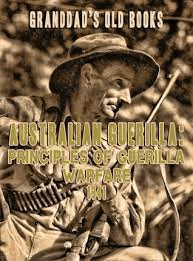
Fearing that an invasion was imminent, and knowing that the average Australian was ill-prepared, WW1 sniper Ion Idriess created a series of small, pocket-sized field manuals. They were geared at getting small resistance cells trained and ready in short order. He illustrated his ideas using his own stories from WW1 battles to highlight points. Here, we are going to go over them.
Let me first say that I highly recommend getting them all. The ideas contained in them are timeless, and designed to help a small, outgunned group mount an effective resistance. Man, that sounds like something we might need. I mean, if the Chinese invade, of course.
This is a no-nonsense book about marksmanship. By that, I mean combat marksmanship, not competition. He covers the basics of choosing a rifle, but keep in mind it was the 1940s, bolt actions mostly. He discusses various shooting positions and how to aim in combat. What’s amazing to me is that during that time, he discussed that riflemen should be able to shoot out to 600 or 1000 yards and now we’re lucky if anyone uses a service rifle beyond 300. That’s probably a function of the fact that he was dealing with bolt action hunting rifles.
He covers how to estimate range and how vital that is. On that note, go over to brushbeater.store and pick up one of his Range-R devices. You can thank me later. Get one with the bullet drop compensator for your platform (I have them both for 5.56 and 7.2×39). Idriess covers windage and leads, as well as night shooting. Unlike most of his contemporaries, he discussed “snap-shooting”, which is what we now call point shooting.
Here Idriess carries marksmanship out to sniping. In modern guerrilla warfare, nearly every person should be capable of at least being a designated marksman (hunting goes a long way to building this skill set). This book can help, especially with bolt action guns.
Idriess points out that most of sniping isn’t shooting. It’s observing and not being observed. Getting yourself into position is vital. The book covers camouflage and concealment, remaining motionless, building sniper hides, and the like. He mentions in detail how snipers are found, thus enabling you to avoid those mistakes. Some sniper strategy is discussed (targeting officers, technicians, and crew-served weapon crews) as well being able to adapt and get away.
The book closes with a tale from his time at Gallipoli facing off against a Turkish sniper.
Just like the name implies, this volume covers all there is to know about running a guerrilla band. He talks about organization and recruiting. Idriess covers the absolute importance of knowing every inch of the ground you operate on. He recommends familiarization patrols long before any contact.
The book covers how to hide and set up security on your base camp (sounds like TW-03 Defensive Operations). He covers how to get around to include vehicles, horses, and bicycles, which I think is way overlooked today.
When it gets into tactics it covers advancing to contact, conducting raids & ambushes, and how to break contact as a large group. Other tactics include stopping tanks (“You can’t fight the gubmint, they got tanks”, amirite?) and cutting lines of communication (convoys/telephones).

Look, I didn’t name it. It was a different time, OK?
This volume goes into more detail about how to lure an occupying army into your ambushes and traps. It talks about luring tanks into mud traps and the like. He also covers how to infiltrate and strike an airfield.
Tactics for dealing with trains are covered (ANTIFA is way ahead of you on this). He goes into detail on how to employ bombs and grenades (no, Feds, he doesn’t tell you how to make them. Really.). The dangers of minefields and how to turn them against the enemy are covered (maybe the UKR army should read this).
This book has two entire chapters explaining what a “beaten zone” and “cone of fire” are, and I’ll be honest, he did a better job than the USMC School of Infantry does. After describing these terms, he explains in great detail how to keep the enemy inside yours and keep your people out of theirs.
The book covers how to run intelligence operations as well.
This book is less about tactics but is a collection of stories from World War One, describing what campaigns looked like from the sniper/observer team standpoint. It covers operations in Gallipoli, the Sinai, and Palestine from both the Turkish and Commonwealth/ANZAC perspective.
It’s instructive as to how men react to battle and danger.
I loved this one, as it covered scouting skills. He started right off with a few chapters on land navigation. Remember, in WW2, there was no GPS. He discussed using a compass alone, using the terrain with your compass, and also using a map and compass together. Yes, you need all of these skills.
Idriess points out that man has navigated long before the magnetic compass was discovered, so he goes into more primitive navigation methods like the stars and the sun as well.
He reflects that the most important skill of the scout is to see without being seen. He provides tactics to improve your night vision (there were no PVS-14s) and how to use artificial skylines to find the opposition at night.
All in all, it’s a great series and I highly recommend it. Each of the books above has a hyperlink to buy the book. They are affiliate links and I’ll make a few pennies at no cost to you if you buy them, OK?

I know that I joked above about the Ukrainian army needing his manuals, but do you know whose manual they DO actually use? NC Scout’s Guide to the Baofeng Radio turned up in a photo of Ukrainian Army training briefing. If the book is good enough for dudes fighting the Russians, it’s good enough for you.
If you like my content and would like to support my work, sign up as a supporter at tacticalwisdom.locals.com. You can also make a donation below.
While you’re here, go check out T-Shirts.

Donation – August 2023
Donation to support content development.
$5.00
 Tactical Wisdom
Sibley should call it “Once in a blue moon”. Thanks for sharing the info on those books
LikeLiked by 1 person
Lol. Sure thing!
LikeLike
More reading into the library! I already have the Blue Dawn series. Good stuff!
LikeLiked by 1 person
NC Scout has book 6 in pdf
Click to access the-scout.pdf
LikeLiked by 1 person