
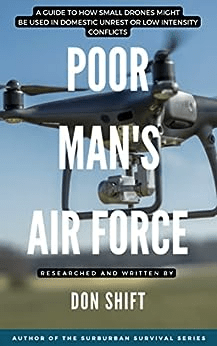
The rapid expansion and proliferation of drones across every spectrum of society has us now needing to understand their uses and implications from a preparedness perspective. I’ve touched on these topics briefly in my books, but we need to revisit it. My friend Don Shift has written an excellent book on drones that I will be reviewing, and there is an Amazon link to it below. As always, the Feds want me to tell you that if you make a purchase, I might make a few pennies and eventually have enough to buy a Diet Coke at McDonalds at no additional cost to you.
Drones were once the province of only the highest end nation states. Now, with relatively cheap commercial drones, about every 4th police car on the road has a drone and trained “Police Drone Operator”, fire departments use them, survey crews and literally every industry (especially construction). Being a commercial drone pilot is now a legit career and not just a hobby.
With them everywhere, we need to discuss the benefits of using them, as well as the risks related to others using them against us. There is danger in the form of drones, as footage from Ukraine shows us. There is some Tactical Wisdom we like to share on seeing danger:
The prudent see danger and take refuge;
But the simple keep going and pay the penalty.
Proverbs 22:3
Let’s be prudent.

Drones are everywhere. Even a cheap child’s toy drone can be weaponized or used for surveillance, but they have very limited range. The biggest risks are in larger commercial quad copter type drones. Any drones over 250 grams in weight are required to be registered with FAA. These drones have real time surveillance capability and can fly high enough that they are difficult to see and hear.
The most common sign that drones are near is the buzzing noise they make. Your team needs to be aware of that sound. In an emergency or disaster, it can mean help is on the way and you might want to have a signal flag or something available to make yourself known to it. On the flip side, in a full collapse type situation, it means that danger in the form of a sophisticated threat is nearby, and you need to upgrade your security posture.
There is a misconception that drones are hard to defeat. If you know the proper techniques, they are easy to defeat. As soon as you hear a drone, get under overhead cover. It’s really that simple. When planning patrol routes or movement paths, try to select routes with continuous overhead cover to limit your exposure to drones. Even drones with thermal viewers are defeated by overhead cover, especially vegetation.

Another tool is a thermal tarp. While this isn’t drone specific, sleeping under a camouflaged thermal tarp protects you from both drone and ground-based thermal detection. At his courses, NC Scout teaches you how to defeat ground-level thermal viewers and drones are no different. Take a Scout class. Just make sure there is at least 12 inches between your body and the tarp. Unlike when using one for warming, we want an air gap between the tarp and our body.
Another low-tech way to defeat drones is getting underground. The tried-and-true method of digging fighting holes with overhead cover will protect you. It’s VITAL though, that you have overhead cover. Putting your warm body in the cold ground will make you stand out. Cover the hole with logs covered in vegetation, and it’s best if you layer a thermal tarp among the vegetation.
We can use drones for scouting. Remember though, that drones are a SUPPLEMENT to foot patrols around your perimeter, not a replacement. Drones can be used to range farther faster and aren’t encumbered with gear and blocked by rough terrain. They can be a great force multiplier. You should consider having a serious drone operator on your team.
A good use is to bring one along on patrols. When you encounter a danger area or buildings/signs of an encampment, you can set up a hasty security perimeter and toss your drone up into the air to check it out from outside of small arms range. This keeps everyone safe and allows you to move away if it’s not safe.
Drones can be used to check your obstacles/fence line. Many drones can have flight paths preprogrammed and will fly them automatically, like a security guard patrol tour.
The danger in using drones for this is that if a hostile party sees your drone, all they have to do is watch the drone to see where it lands. That’s why I recommend leaving your perimeter before launching any. Why would they care if you were using a drone? Because you having a drone airborne means that you at least have the capacity to generate enough electricity to charge batteries and if you have that, you probably have other resources. When sending a drone operator out, send at least one person along as security. The drone operator will be focused on the drone and needs protection.

You can use a larger drone to either hold a small mesh network repeater aloft or to emplace one on a tall object, increasing your radio range. You can also type out a message, put your tablet/phone and radio on a drone, and raise it up high before it sends a scheduled digital burst transmission, drastically improving your range.
On that note, understand that drone use can be detected using radio intercept tools. They can be DF’d and the controller can be located relatively easily. That works both ways.
Drones are a double-edged sword. You should understand, but not overestimate the risk. Understand how you can use them, but also understand the risks in using them.
I will have more tips and tricks after I finish Don Shift’s book, “Poor Man’s Air Force”.
If you’d like to support my work, either make a donation below or become a monthly supporter at tacticalwisdom.locals.com. Watch me on the Council on Future Conflict every Monday, Wednesday, and Friday on YouTube.
BUY MY BOOKS.

Donation – September 2023
Donation to support website.
$5.00
 Tactical Wisdom
I’ve often wondered if a person could use FM capture to disrupt the RF control of a drone. Is that possible with common field gear, such as a 2m yagi and a 50W mobile radio? It’s a theory I’ve never had a chance to test out.
LikeLiked by 1 person
AHEM, I’ve heard of it being done.
LikeLiked by 1 person
RR.
In SAR ops we’ve dropped HT’s to individuals to facilitate our medical response once we’ve gotten a visual with a drone.
LikeLike