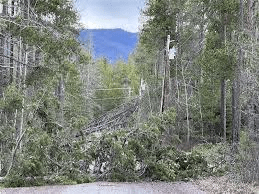
On December 17, NW Montana had a wind event. Kalispell had winds gusting to 90 mph, but here down the Swan, Mission, and Bitteroot Valleys, the wind had nowhere to go and gusted up to 105 mph in a straight line. This toppled trees like dominoes and led to massive damage to the electrical infrastructure and widespread power outages. Thousands were without power, and some still are today.
Now, we had the great misfortune of having our power go out about 12 hours before everyone else. Our power went down at 8 AM on the 17th, and the wind event began at nightfall the 17th. We lived out here at Camp Ponderosa for 5 and a half days without electricity during cold weather. Well, to be fair, me and the dogs did. Mrs. TW got a hotel room in town because she had to work (that’s her story anyway).
I’d like to go over our lessons learned, so that perhaps you can prepare a little better.
First, as I always say, don’t prepare for any specific event – prepare for the second and third order effects. For example, if you only prepare for widespread civil disorder, that 10,000 rounds of 5.56 ammo isn’t going to help you one bit if the power is out. If you’re only preparing for an epidemic, all the masks and chem suits in the world won’t help you when the food stops flowing to the stores. In any disaster or scenario, the loss of power, lack of fuel & food, and people behaving badly are second order effects – prepare for those instead.
The other thing I say is just to prepare to be self-sufficient. That means the abiltiy to generate heat and power on your own, the ability to feed yourself, the ability to treat your own injuries (minor and major), and the ability to provide your own security.
Here, when the power goes out, the generator automatically switches on and provides electricty and it is hooked up to a 500 gallon diesel bunker. The first priority with the generator is providing power to our water and sewage system (yes, we have our own waste water treatment plant) to prevent backflow of contaminated water, and powering the walk-in refrigerator and walk-in freezer in our dining hall. After that, the system branches off and I have the capability to shift the excess power to individual buildings through a panel.
The issue is that we knew from our last big power outage that there was a break in the line to the rest of the facility. After the last outage, we had someone identify where it was, but we did not expend the money or effort to fix it, because that power outage was in the summer and we had no budget for it. We definitely paid for that mistake this time. We will be prioritizing the repair ASAP.
So, because of our failure, we had to run the Starlink and router from our solar battery banks, which we rotated and recharged using the generator (much faster than the solar option). Why run Starlink and the router at all? Well, because we live where there is no cellular coverage at all for at least 10 miles in any direction. Starlink and WiFi calling become the lifeline. The lesson learned here was that we had used one of the power banks during a shorter outage and failed to charge it immediately after, so it wasn’t as ready as we needed. We also hadn’t checked our smaller power banks for charging phones and such, and needed to charge a bunch of those. I’ve now put battery banks on a weekly checklist.
This brings us to radio. In the area, there are several preparedness radio nets that we had participated in earlier in the year, but had fallen off of during the busy summer. I already all the frequencies and times in my communications binder, but regular participation would have kept me from needing to find the frequencies.
Another radio learning was that our repeater needs it’s own pair of battery banks to rotate and run on while the camp is occupied. At night we might be able to shut it down, but during the day with folks in various buildings, having the repeater working would help. Yes, simplex radio does work in the main base area (Admin Building/Shop/Dining Hall/Gym), but once you get to the back wooded area or down one of the roads, coverage gets spotty on simplex due to terrain and the repeater fixes that. Our temporary fix was for all radios to monitor the simplex channel and monitor the local GMRS repeater, once it got power back (which was days before us). Every handheld here can reach the repeater 30 mies away (so much for claims that baofengs suck) so in a pinch it would help. Having our repeater running on battery power would enable us to have a 10 mile radius of coverage (our 50 watt repeater isn’t working, so we’re running on a 15 watt one).
For radio charging, I knew that the water pumphouse had power and had multiple unused outlets, so I took spare radio batteries and chargers there and swapped batteries once a day.
We were actually pretty good for cooking. While the Admin Building (AKA – my house) stove is electric, everything in the Dining Hall runs on propane. We were able to heat food. The one mistake I made was more laziness than any else, but I should have taken everything from the Admin Building refrigerator and put it in the walk-in in the Dining Hall. Even without power, it is better insulated and would have kept food cool longer.
Another area that we were good in that can help others learn is chain saw availability. Even if you live in the city, you need at least one chain saw. We have several here, along with several pre-mixed 5 gallon gas cans. Yogi (our maintenace guy) and I were able to open our roads relatively quickly using chain saws and a mini-front end loader we have here. We also needed, on that first day, to first cut a path OUT from the main camp to the state highway, as it was blocked by trees to begin with. In an emergency, help could not have gotten to us.
While we had a Duramax propane space heater, we found out that it was missing the wick – so it was useless to us. The one heater could have heated the entire Admin Building. Instead, we used a Mr Buddy propane heater that takes the 1 pound tanks and only heated 1/4 of the building. My advice is to buy the adapter cable that lets you run the Mr Buddy off a 20 pound tank from your grill, unless you like getting up to change canisters every 3-4 hours.
Next lesson – keep track of your stuff. When I went to get the gasoline generator to run the Admin Building, I found that it was gone. After some checking and phone calls, I learned that we had loaned it out for a parade and that it wasn’t on the property. That’s information I needed. We have now created a critical equipment inventory and check-out system. The new check-out form has people signing off with a disclaimer that if we need it due to a power outage, it must come back immediately.
A side note to this is to make an actual inventory and consolidate things where they belong. In my constant searching of the property for more resources to improve our position, I entered the building we don’t use just to look and found a brand new in the box gas generator that someone had donated & put away and never told anyone about. I found it too late to be of use, but it has now been moved to where the other ones are stored. It’s also on the inventory list. We already had all of our fuel in it’s own storage building with a sign out system in place, so we have just adopted that with generators.
Something to think about in a prolonged situation like this is fire protection. You need the ability to fight a fire in a situation where the fire department will be much slower to get to you or unable to due to downed trees or road conditions. We’re fortunate here at Camp Ponderosa, as we have our own fire truck, but it was trapped in a building with electric roll-up doors. Our fix here was to make sure everyone knows where the manual override ropes for the doors are.
Another thing I was taught by this situation was that you don’t need to be out moving around during the event. I felt the need to patrol the large property just in case a tree fell on something critical and I needed to react to it right away. Well, God decided to warn me. Within a minute of me driving the side-by-side down a stretch of our perimeter road, 5 trees fell simultaneously across it. It was a very sobering reminder that in order to fix anything, I needed to be alive. I decided to wait for any further rides around.
As far as security, due to our remote nature and the abundance of large & hostile wildlife (bears, lions, and wolves), everyone already carries a sidearm everywhere. We simply added shotguns and rifles to the camp vehicles (they all aready have mounts) for the duration. For the record, we also do this in the spring when the bears first wake up. They tend to be hungry and aggressive. Security-wise, the radios help. We also monitor the local Sheriff dispatch for our county, as well as the county to the south. Both are on analog VHF so all of our handheld radios are capable of receiving them, as well as every vehicle radio. Due to the generousity of our donors, we have vehicle mounted (and thus FAR more powerful) radios in MOST camp vehicles. I’d like to outfit the tractor and the quad as well, but those are 2026 projects. We have them in the Explorer, the side-by-side, and the Element so far.
We had plenty of batteries for our lanterns, but I want to talk about those for a minute. A lot of folks push for their lanterns to be rechargeable, but this almost 6 day event convinced me that lanterns should all be traditional battery powered because you have to manage plug-in time to recharge things as well being cognizant of how many outlets you have access to and can safely use at one time. As a reminder, old-school propane or Coleman (white) gas lanterns serve two purposes – they will heat a room while also lighting it. There is a lot to be said for that.
Practice lighting your propane, kerosene, or Coleman gas items before you have an outage. This enables you to practice without the stress of survival or worrying about blowing something up by not knowing what you’re doing. Gathering gear and supplies is great, but PRACTICE with it.
As far as food, we learned that we are too reliant on the availability of fresh food. While we have decades of preparedness/dehydrated food, we didn’t have on hand much canned food in order to make meals. That was a simple fix.
I hope these learnings will help you.
I’ve attached the Camp Ponderosa and Tactical Wisdom Amazon lists below in case you want to help fill some of the needs we have identified. We update these lists regularly. Note that I have included no affiliate links or other advertising, because we could use the direct help instead.
Tactical Wisdom List: https://www.amazon.com/hz/wishlist/ls/225D7XIZ8R8LO?ref_=wl_share
Camp Ponderosa List: https://www.amazon.com/hz/wishlist/ls/1038N8GYHRWX8?ref_=wl_share
Donations to Camp Ponderosa: https://secure.lglforms.com/form_engine/s/BFW3LTd04QAl4HixiACmLg
Sign up as a supporter at tacticalwisdom.locals.com for more exclusive content or you cna make a donation here to support me.
 Tactical Wisdom
One thought on “Lessons Learned – Montana Wind Event”