Before I get started, let’s set some ground rules.
This is NOT a ham radio discussion. I will be saying things that ham radio “experts” will disagree with. If you are a ham radio purist, I highly recommend not reading. If you do, and I know you will, I give you this piece of Tactical Wisdom before you start banging away on the keyboard:
Do not let any unwholesome talk come out of your mouths, but only what is helpful for building others up according to their needs, that it may benefit those who listen.
Ephesians 4:29
OK, with that out of the way, let’s get started.
We all acknowledge that having UHF/VHF handheld radios like the ubiquitous Baofeng (pronounced Boo-Fwang) is a great idea. Living here in Montana has only affirmed that, as the 20 miles around me on all sides has no cell phone coverage whatsoever. We use radios to stay in touch. Analog radios, like most Baofengs, get the job done, for the most part.
So, then, why invest in and learn to use digital radios? Simple, digital radios give you the ability to send text messages, which can go farther than analog voice.
Before some “expert” decides to chime in with the inaccurate “BuT tHaT’s iLlEgAl”, let me explain a point about the FCC Rules (which aren’t laws). You can send data (text) via MURS (5 license-free channels in VHF) and licensed GMRS (yes, sad hams, even GMRS). The messages must be short and not interfere with anyone else. You cannot, according to overlords at the FCC, communicate via digital voice on either of those, for no other reason than because they said so.
We’ve found that the text messages travel much farther than analog voice, because they are a more efficient method of transmission. Far less bandwidth is used, enabling the signal to travel farther for the same energy expenditure.
A lot of you are thinking, “But isn’t DMR (digital mobile radio) complicated and hard to learn?”. Sure, if you want to do it like the hams, it is. But, if you just want to be able to send text messages, you don’t need to know all the different modes and programming. Just set up a digital channel, match color codes, and you’re in business. Text away via UHF/VHF radio. In all reality, you just need one guy in your group who can program the radios for you (you should already have a guy like this in your group). Heck, you can send your radios to me and for a small fee, I’ll set them up.
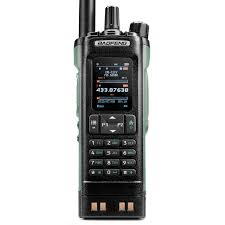
Since the Baofeng above (click the picture – it’s an affiliate link) allows you to monitor two channels at once, you can set the top to monitor your analog voice channel for regular communications and the bottom can be set on a digital channel to send and receive texts.
Brushbeater teaches the use of texting in his RTO and Advanced RTO courses, both of which I highly recommend.
Another thing you can do with the Baofeg DM-32UV, and many others, is send your location via APRS or Automatic Position Reporting. If I need to let someone know my location, I send it out as a digital message. I don’t recommend leaving this option on, but you can turn it on when needed.
A question we get comes from people confusing amatuer radio with preparedness. The question is, “But don’t I have to use a call sign as the radio ID?”. The answer is NO. Ham guys do, because their call sign is some sort of badge of honor, but the technology just requires an ID….it can be anything you want it to be. Just make sure that everyone in your group has a different ID in their radio. A side benefit to this is that you can address a message to a single radio, and none of the others will get it.
This is where a ham radio guy screeches that the DM-32UV isn’t type-certified by FCC for MURS or GMRS. That’s 100% correct, and it’s a violation of FCC rules to use them this way. Look, I said you were right. It’s just that I don’t really care and honestly, no one but you does. Not even the FCC. Seriously, go tell them you’d like to report someone using a radio that isn’t type-certified and see what happens.
This is where I also point out that the vast majority of businesses are out there using GMRS radios without a license at 4 or 5 watts every single day, as well as using non-type certified radios, and nothing every happens to them. As long as you aren’t interfering with others and acting like a decent human, you have nothing to worry about.
Use the best tools for the job – digital radio is a solid tool. You really don’t have to understand the science behind it to use it. It is helpful if you do, but it’s not required. Don’t be daunted by DMR.
If you like this content, become a monthly supporter at tacticalwisdom.locals.com, where we share book & gear reviews, intelligence reports, and exclusive video content. You can also make a donation below.


Other than the APRS feature, if one is already invested in Baofeng’s DM-1701 is there a reason to step away from them and upgrade to the DM-32UVs?
LikeLike
Not really.
LikeLike
Thanks JD. DMR also never, ever breaks squelch unless it’s no kidding being opened by another transmitting radio in its talk group. Might not sound like a big deal but that base station you have on at the house 24/7 will never wake your spouse up in the middle of the night with a squelch blast (and get shut off).
LikeLike
Great point
LikeLike
It is all about “able versus allowed”. What I’m able to do rarely is the same as what I’m allowed to do. This keeps it in perspective.
LikeLike