Mark the day… July 4th, 2020. The day we start the movement to take back our country. Extremist in our nation have begun to mobilize and systematically destroy our nation one violent act at a time. The media has propagated an extremist ideology to burn our nation to the ground, forcing us the PEOPLE to […]
ITS TIME TO GET OFF THE BENCH
Lessons Learned: Power Outage

I’m currently about 36 hours into a power outage in Metro Detroit, or as I like to call it, the “Boogaloo Dry Run”. I’ve learned a few things about my own preparedness, and an awful lot about the preparedness of others.
I have a thing about lights. I buy flashlights like crazy (mostly from http://www.olight.com). People close to me chuckle about it, but being inside a commercial building in Detroit with no power and no light is not something you want to ever have happen in an emergency situation.
So I buy lights. I have a few angle head flashlights, several EDC tactical flashlights, some large law-enforcement type lights, a spotlight, you get the idea.
But what I learned on hour 8 of the Boogaloo Dry Run was that I have exactly ONE lantern-type light. One. All the batteries in the world won’t help light more than one room with only one lantern. Now, I know I can point any flashlight at the ceiling and get it lit, but that’s not an efficient use of a hand-held flashlight and it eats batteries like crazy.
The next thing I learned was that no matter how long we’ve all been doing this, normalcy bias causes us all to make rookie mistakes. For example, when the lights went out, I only had one of my three power banks charged up. The one that was? The solar powered one that holds the least charge. We were able to keep a phone partially charged overnight and use the alarm, but the lesson there was keep them all charged at all times. I had used the other two and said “I’ll get to charging that later”. Two weeks later I needed them and they were dead.
When the sun came up, I decided to take a drive and use the vehicle system to charge up my phone and power banks. And, since I’m being honest, BUY ANOTHER LANTERN. I found a good rechargeable one at Menard’s that has a built in power bank for phone charging for $20.
I first drove to conduct a recon of the extent of the outage, using my BattleBoard (www.battleboard.us) to document the affected areas, and noticed that the affected area had actually grown overnight, most likely due to areas I thought had grid power the day before running out of gas for their generators.
That’s an important point, because in metro Detroit, a lot of local people keep their cars on an 1/4 of a tank, or 1/8 a tank. Imagine doing that, and then sitting in your driveway with the engine running to charge your phone. In the morning, the nearest gas station may not have electricity.
During the 2003 massive outage, there was only one small local area about 30 miles away that still had power, and as we drove out there to get food, there were cars lining both sides of the road where they had run out of gas. I never let my car get below 3/4 or at worse, 1/2 a tank.
The next lesson I learned was about believing official estimates. Last night, DTE power informed me that they would have the power restored by 11:30 PM tonight. About 2 hours before that deadline, they sent out an “update” advising that it would be another 48 hours before power was restored. I had accepted their pledge of 24 hours on day one and planned off of it, and that was a mistake. Fortunately, I know that less than a mile away, there is power and I can get things if I need to, but I’m trying to use this as a training and preparation run, without relying on running out for every little thing.
I learned that my fellow residents of Western Wayne County are mostly thoroughly and woefully unprepared and unknowledgeable. The mere act of negotiating a 4 way stop on a multilane road was far beyond the ability of most people to navigate. I’m not exaggerating here…6 lanes on one road and 4 on the other and people have no idea what to do. Thank God we have the ridiculous “Michigan Left” thing, preventing people from turning left at major intersections or we’d have lost a lot of people today.
The other error I made was in deciding where my generator was best stored. The average power outage in Metro Detroit is less than 30 seconds. Since 2003 I can’t recall any that lasted a full hour. With that in mind, my small generator, which could have powered at least my refrigerator, sits 3 and a half hours away in the garage at the cabin. Outstanding. Experience is the best teacher, so they say.
I did learn something different about retailers, though. Normal power outage protocol is to close the store immediately if the power doesn’t come back on right away. During my morning recon trip, I found that most major retailers were actually open, running on generator power, with limited lighting and limited registers open, and not selling refrigerated items. That’s good to know, but as a retail loss prevention executive, I’m curious to see what their liability numbers look like next month, as people file claims for tripping or bumping into things/people in the limited light.
It’s especially surprising since we are allegedly in the midst of the most dangerous pandemic in the history of mankind, but retailers are perfectly fine with letting customers blunder into each other in darkened stores.
I also noticed that all of the smaller retailers and local stores were fully staffed, just not open for business, obviously in anticipation of opening as soon as possible after the power comes back on and for securing the business. Most of those people, though, were standing in the back alley behind the strip malls, chatting with each other, with their back doors wide open. None were armed. While I know that this is a localized and short-term (in all reality) issue, in a true grid-down disaster, that would be highly dangerous for them to do.
I also used the situation to scope out my own neighbors for potential allies, and potential threats.
On the allies side, my neighbor two doors down, I’ve always suspected was into preparedness, based on how he acts. He’s always aware of his surroundings; he always sees others before they see him, and he is also polite, but never overly friendly. As darkness fell last night, I heard a generator start up and sure enough, he was the only one in the neighborhood who had been prepared (including me, as I kick myself in the rear). He’s now solidly in the my ally column, since when he rolled through the neighborhood very slowly this morning, obviously scoping out the neighborhood himself, he saw that I was openly armed and gave a quick nod. That’s the longest conversation we’ve ever had, but I assure you we will be seeking each other out soon to plan.
Also, my next door neighbor, who I interact with much more, sought me out first thing this morning seeking advice. He’s new to this, so I gave him a couple of pointers. Just like that, we have a 3 house network for defense. I know the neighbor behind me very well, and could quickly expand the network to 4 houses (mostly because they have adorable kids and their dog comes to visit my dogs daily).
On the threats side, I had already identified two houses where the local police have made more than one visit and sure enough, as darkness fell, from one of those houses, people emerged to “go for a walk”. I know that the kind of folks that detectives show up in full tactical gear to look for don’t just “go for walks”, so I made sure everything was secure and that defensive tools were ready for use and staged in key areas.
To recap, here are the best pointers I can offer for an unknown-term power outage:
- Have sufficient emergency lighting available as well as batteries.
- Keep all power banks charged at all times.
- If you have a generator, have it AVAILABLE for use.
- Know routes around your area avoiding major intersections where traffic will back up and tempers will flare.
- Avoid grocery stores…If you don’t already have food, you are behind the game and a lot of nervous and agitated folks will be at the grocery store.
- Know where the potential bad actors are in your neighborhood or area and maintain a watch.
- Know where your potential allies are and get to know them now.
- Keep your vehicle fueled at all times.
- Have non-perishable food on hand for at least week.
- Have adequate water on hand for at least a week for everyone you are providing water for.
- I say it like that, because I keep an extra case on hand to hand out to at-risk people I know or encounter. During Hurricane Sandy, a work partner and I encountered an elderly couple panicking because nothing was open and they didn’t have water. We gave them a case.
- Maintain an alternate method of communication (like radio) and a network to communicate with (have a tribe).
- During an emergency, even you are “bugging in”, get out and conduct patrolling. Gather information on what’s going on locally with your own eyes, rather than relying on the rumors and social media hype. You are responsible for your safety.
- Remember that the first responders are busy…You are your own fire department, EMS, and police.
- As soon as the power goes out, ready all defensive firearms or other tools (here that ranges from an expandable riot baton to swords).
- Keep multiple fully stocked first aid kits on hand.
Hopefully, being open and sharing some of my mistakes will help you.
Leave any other ideas you have in the comments.
Weapons Training For Self Defense
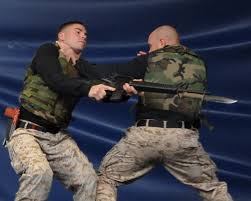
When most people talk about preparedness and self-defense, they immediately start talking about their guns. Guns are not the only tools you should have and in fact, in some situations, a gun can cause more problems than it is worth.
There are a multitude of places you can’t carry a gun and there just as many situations in which firing rounds is not the best idea.
With that in mind, what other training tools can we consider for self-defense?
Well, when the Disciples first went out, Jesus told them each to take only a staff:
These were his instructions:
Take nothing for the journey
Except a staff….
Mark 6:8a
Train in stick fighting; many martial arts teach stick fighting skills. Most of these skills are pirated from Filipino Martial Arts such a Escrima or Arnis.
I recommend learning at least the 12 basic strikes from Modern Arnis (see photo), and the blocking techniques to counter them. Learn a few disarms and train on them relentlessly.
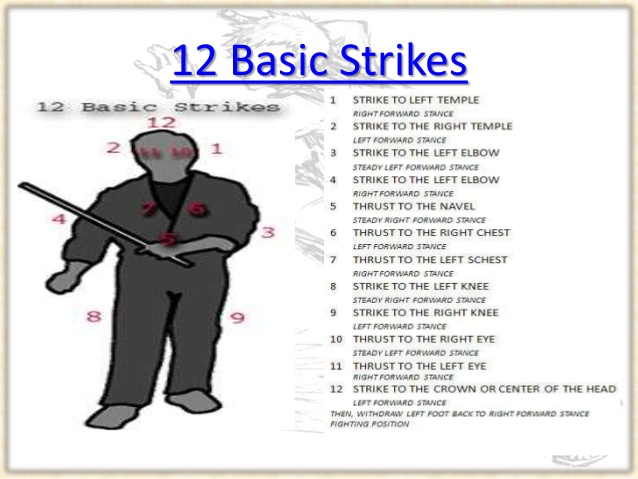
You don’t need thousands of techniques, you need a few solid techniques and thousands of repetitions.
Why do I suggest stick fighting? Because can you think any situation in which you can’t quickly come up with a 2-3 foot long object? You can find a suitable stick in nearly any environment, including an office (there’s a broom or a mop somewhere).
The US Marine Corps, in their Marine Corps Martial Arts program, teach combative stick as their improvised weapons program, because the skills translate into any handheld item used for self defense.
Also, commercially available expandable batons fall into this category, but check local laws on carrying them first. I have a Military Police issue expandable riot baton, but it’s not exactly subtle or concealable.
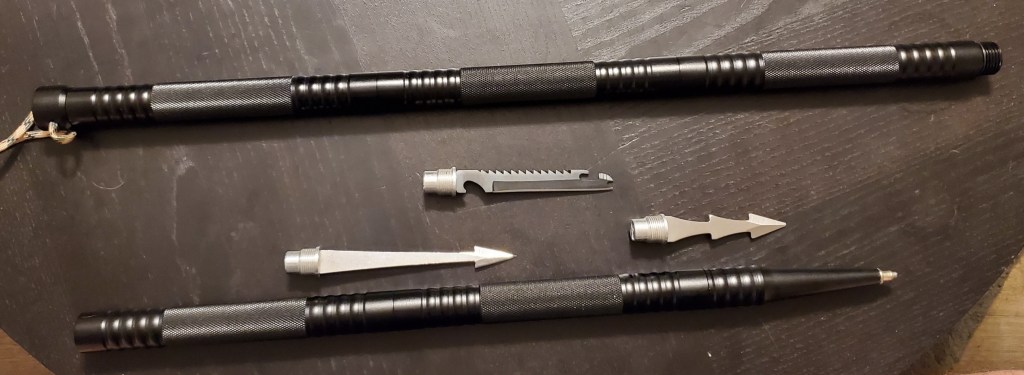
Below is a picture of my “walking stick”. It’s an alloy walking stick made of short sections, so that you can adjust the length from 8 inches to about 40, and it has several attachments for use, like a knife blade, spear point, and an ice breaker. It also has a compass, whistle, and fire starter rod in the handle cap. If I’m going hiking or for a walk in an urban area, there is nothing at all illegal about using a walking stick. In the words of Gandalf the Grey, “You would not part an old man from his walking stick?”.
“…and if you don’t have a sword,
Sell your cloak and buy one…”
Luke 33:36b
It seems Jesus, the Ultimate Prepper and Tactical Guru, was all about being armed. I make jokes, but He was sending his best friends out on a dangerous road, full of thieves, robbers, and government agents seeking them (yes, the Bible is way cooler than you thought it was), so He wanted them to be able to defend themselves.
Take His great advice and train in edged weapons. The same skills developed from stick fighting are used in knife fighting. In fact, that’s where stick fighting comes from. The Spanish banned Filipinos from possessing edged weapons, so they trained with sticks instead.
I recommend the 3 blade rule. This means having three different types of tools available at all times: a small folding-blade knife, a fixed blade knife, and a multi-tool. There aren’t too many situations that this combination can’t solve. I know, many of you will say you can’t just walk around with a fixed blade knife, but I said AVAILABLE. I keep two fixed blade knives in bags in my vehicle. One is in my patrol bag, the other in my gear bag.
I challenge you to seriously look at local knife laws yourself. Most people ask around and get near-truths, rather than THE TRUTH. As an example, here in Michigan if you ask around, everyone, including police, will tell you that you can’t carry a knife with a blade longer than 3 inches. That’s a mis-interpretation. What the law says is that you can’t carry CONCEALED a knife with a blade greater than 3 inches. WITH THE INTENT TO USE IT UNLAWFULLY AGAINST ANOTHER PERSON. Notice the HUGE difference? Self-Defense isn’t unlawful. Also, it says absolutely nothing about OPEN CARRY of knives. Under US law, anything not specifically illegal, is therefore inherently legal.
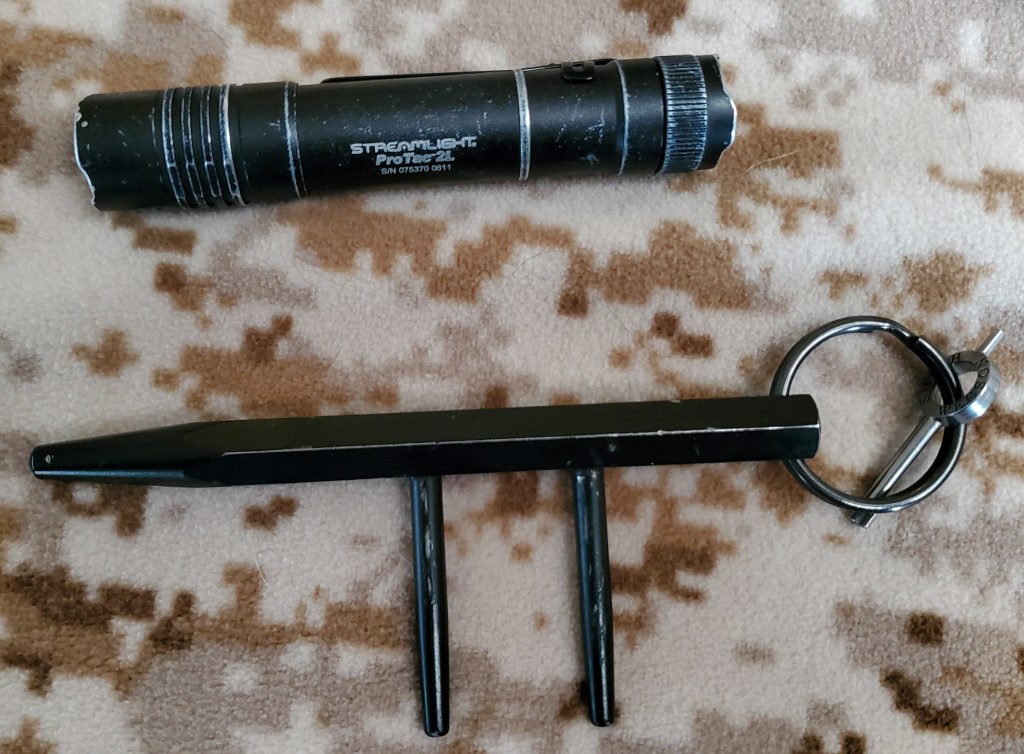
Additionally, I train with a tactical pen. You can take a pen literally everywhere. Below, you’ll find a sampling of my pens. First is the true tactical pen, but sometimes it’s questioned (never been told I couldn’t take it anywhere). The second is a Rite-In-The-Rain pen, made of all metal, which functions great as a self-defense pen. The third is a Zebra G-301, which is also a great self defense pen because of the steel body. Zebra also makes a steel body mechanical pencil, which can be used for self defense.
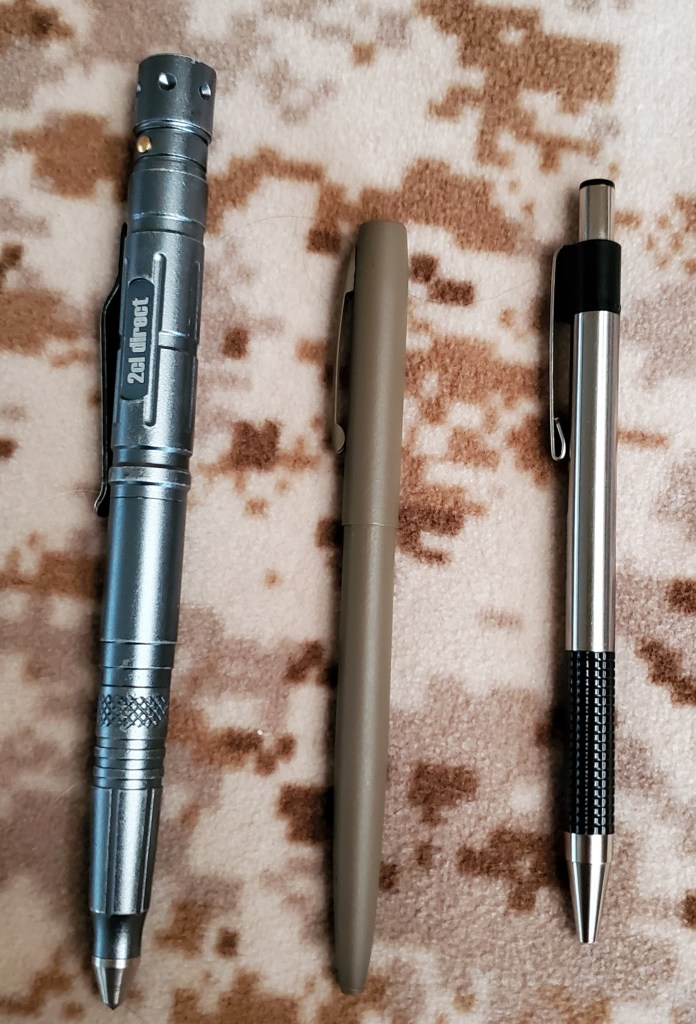
With a tactical pen, you’re never completely disarmed. Train with the tactical pen for strikes to the eyes, throat, or neck. I’ve used them effectively with resistive subjects by applying a tactical pen to pressure points on the neck and the hands.
To recap, develop skills with weapons other than firearms, because you may not always have a firearm with you or it may not be the best tactical or legal option. Seek out a qualified instructor and TRAIN, getting in a lot of reps. Warning – You Tube is not a substitute for qualified, hands-on instruction.
Train as if your life depended on it…because it does.
Kneeling to the Mob

The violent mobs in the streets have been able to force concessions from states, counties, and cities, and have even gotten federal legislators to propose legislation to appease the mob and try to stem the violence.
But should we be bending the knee to these protests?
The Department of Defense Dictionary defines terrorism as:
Terrorism – The unlawful use of violence or threat of violence, often motivated by religious, political, or other ideological beliefs, to instill fear and coerce governments or societies in pursuit of goals that are usually political.
Department of Defense Dictionary
These protests and riots certainly meet that definition, since they involve the use of violence against anyone who disagrees with their demands or positions. They’ve gone so far as to get people fired from their jobs for simply not mouthing the words they demand. THAT’S SCARY.
However, many people claim that appeasement will get the violence to stop and that it’s worth it.
I find a lot of guidance in God’s Ultimate Tactical Handbook. In Proverbs 25:26, it says this:
A righteous person who yields to the wicked
Is like a muddied spring or a polluted well
Well, that seems pretty unambiguous…don’t yield to the violent rage-mob, or the cancel-mob, or any mob.
If you study the results of the current protests, every single time that a jurisdiction has yielded to the rioters and gave in to a demand, it has immediately led to more demands, which are usually even more extreme than the previous ones.
As an example, once one jurisdiction agreed to drop charges against the arrested rioters, thinking it would stop further protests, the next night they had even more violent protests with the new demand being release EVERYONE from the jail.
It will never stop, now that they’ve gotten a taste of victory.
The President missed an opportunity to shut this all down with the Capitol Hill Autonomous Zone. As I wrote previously, the proper response would have been the immediate application of federal force to end it immediately. Instead, he relied on the local governments to resolve it to try and win points from them. The situation ended with 2 dead and 5 wounded from lawlessness that the Mayor, Governor, and President all had a duty to stop, by force if necessary, but none did. It also gave a huge strategic win to the organized revolutionaries who are leading this.
And what did the President gain from letting the Mayor handle it? She blamed the entire debacle on him.
In Atlanta, the Prosecutor caved to the rioters within hours, but what did he gain? A wide lawless zone, many deaths, a 400% increase in shootings, and a police force that is afraid to do their jobs (rightfully so).
When a small child was killed there by armed revolutionaries (call them what they are), the Mayor vowed to make the area safe immediately. Exactly 24 hours later, there had been 2 more shootings with 3 victims within feet of the location of the girl’s murder.
In Portland, every night for a month ANTIFA forces have tried to barricade the police inside a police station and light it on fire. The police rush out and battle them, arresting dozens. Every morning, the prosecutor caves to the crowd and orders all rioters released without charges. The violence starts again the next evening. It’s like Groundhog Day in Portland, every single day.
Has appeasement and yielding to the violent mobs gained us any safety? Do you feel like this is getting any better?
So, since this is Tactical Wisdom, what can we, as ordinary citizens, do in this situation? A few things.
First, be vocal with your elected representatives, letting them know how you feel about appeasement. I know, they probably won’t listen (mine is Rashida Tlaib, so I get it).
Second, communicate your support to local law enforcement, every chance you get. They get precious little positive reinforcement and these days they’ll appreciate it. They may even remember it when you need their help.
Third, build a local mutual aid group. Find a tribe of like-minded individuals who can work together should any unrest come to your neighborhood. This is vital, because of the issues the McCloskey situation highlighted.
The McCloskey’s rushed out and confronted a massive crowd alone, which could have went bad, but the aftermath was worse. Their neighbors immediately turned on them, offering an appeasement letter to the rioters (think a surrender note), saying that they disagreed with the McCloskey’s and essentially begging the rioters not to come back. Did it work? Nope, the rioters were back the very next day, in larger numbers. Had the McCloskey’s set up a mutual aid group ahead of time, they would have had people to call on to help defend their property and not been left alone.
Fourth, and it’s a common theme on this site, BE AWARE. Don’t just watch the news for information; they only report what’s already happened and most of it isn’t true anyway. Scour the internet for posts about protests in your local area. Most local police departments produce a local crime map, updated regularly, so that you can see where hotspots are. If your employer has a security department, stop by and ask them for information. Many security departments are part of working groups with federal or local authorities that share non-public information about local threats.
Fifth, carry emergency supplies. See any of my posts for more information on that area.
Lastly, understand that, as my friend Ivan Throne says in his philosophy best-seller book, The Nine Laws, Concealment is The Second Law. Not everyone needs to know every detail of your day. Not everyone at work needs to know your political leanings. Your vehicle doesn’t need bumper stickers about the guns you own, your favorite candidate, what you think about their favorite candidate, or your support of causes. These things can cause you to be targeted.
Now, I’m not saying hide or cower in fear. Not at all. I’m just saying don’t make yourself a target by proclaiming everything to the world, every minute. As an example, let’s say I’m a thief, considering going through cars in the parking lot. Will I pick the car with the “peace” symbol sticker or the one with the “Glock” sticker? I think we know. Also, if you’re at work and a protest group passes your building, and sees your 5 Trump/MAGA stickers on your car, what do you think will happen? And how much investigation are the police going to do? Be smart about it.
When the time comes, do not yield in the face of wicked people. Be firm, stand fast, and make your stand. Just make sure it’s on your terms, with your mutual aid group and your gear, not on their terms, with you alone and unprepared.
Every single time a prepared group has stood up to these people, they have moved on to other targets. Saint Louis still stands on his pedestal. The Minneapolis businesses that the Oath Keepers stood in front of are still there. Teddy Roosevelt has not fallen to ANTIFA (Although he may to the Mayor).
The key point is this….When we decide to stand up, do so with a strong group, fully prepared, and never, ever yield.
Just make sure you don’t ever let the enemy decide when or where that will be. As Sun Tzu said, “If you know yourself and know your enemy, you need not fear the result of 100 battles”.
Stay safe, and stay prepared.
Be Alert

What are you doing RIGHT NOW, to prepare yourself for increased civil disturbance or a major upheaval? No, not what you ARE GOING TO DO, I mean what are you DOING RIGHT NOW?
It’s time for a little tough love. So many people talk about their plans, and what they are going to do, but when you challenge them to show you what they’ve done or to describe their current readiness, they’ve actually done very little.
You are never more than 72 hours from a complete collapse of society. Let me say that again….Our entire system can go from status quo to absolute anarchy in less than 72 hours.
By all accounts, in February of 2014, the Ukraine was a modern Western nation. The morning of February 18, 2014, a large group of protestors began advancing on the Parliament. By the morning of February 21, 2014, the government had been overthrown, Russian troops had invaded and seized an entire region, and two separate groups had set up independent nations in Donetsk and Luhansk. At the end of the three days, there were at least 113 dead and 1,300 wounded. The nation is a failed state with open warfare and people scavenging for food to this day.
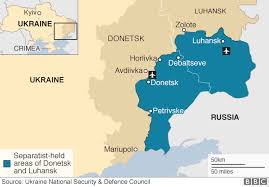
Many people point to the capitol, Kyiv, and tell me I’m wrong, but everywhere outside of the capitol is a dystopian nightmare, with people scavenging in the woods for food, negotiating minefields and passing through checkpoints at the constantly changing front lines.
Only the areas under direct Russian control, Crimea, are stable.
In late July 2008, while relations were strained, the South Ossetia region and the Republic of Georgia were stable. The first shelling began on 1 August, and full scale war broke out on 7 August. By 12 August, just 5 days later, 350 troops were dead, alongside at least 500 civilians and unspeakable atrocities had been committed. Just 5 days. (For a great telling of this story, watch 5 Days of War).
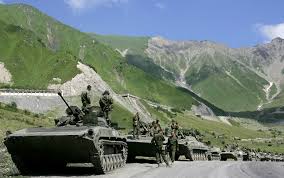
At this point, I usually get the tired, old response, of “Yeah, but that’s in Europe, not here”. I’d challenge that the average Ukranian Interior Ministry police officer felt the same way on the morning of February 18, 2014. Widespread civil unrest is increasing in the US.
The truth is, you don’t know what’s going to happen, and neither do I.
I can point out that there are larger forces at play and the same person who is alleged to have financed a group called the “Right Sektor” in the Ukraine, is alleged to be financing ANTIFA, and the flags of ANTIFA and Right Sektor are nearly identical.
One of the most common phrases in the Bible is “Be Alert” or “Be Aware”. There is a reason for that….There is evil in the world.
Here’s my favorite:
Be alert, stand firm,
Be courageous; be strong.
1 Corinthians 16:13
Being alert means being ready for whatever happens.
What things should ALREADY be in place for a prepared person?
There is no reason that you shouldn’t already have at least 96 hours of food and water ready. That means food that doesn’t require refrigeration and is simple to prepare. I keep MRE’s or camping food rations always ready.
You should have an EDC (Every Day Carry) bag with you, an emergency/get home bag in your vehicle, and a 30-minute bag ready to go at home.
As you all know, I’m a huge believer in having first aid kits stocked and ready. I have several, fully stocked, and put where I can get my hands on them quickly. Note…a first aid kit should always be something you can pick up and manipulate with one hand. I’ve seen some people with full-sized EMT bags, but what if my left arm is severely injured? I need to be able to treat it with my right, including manipulating the first aid kit.
If firearms are part of your personal safety plan, at the current risk level in our country, there is no reason that your personal defense firearms are not fully charged and ready for use, and within arms reach at all times.
A guy I follow, Viking Preparedness (Pastor Joe Fox), mentioned his idea of the “MinuteMan Bag”…it’s a small bag that contains spare ammo, a light, a first aid kit, and some optics that you can throw over a shoulder in less than 10 seconds and walk out the door ready to fight. I’ve added a couple of items to mine like a fixed blade knife, a multi-tool, and some emergency rations. Not a bad concept for immediate defense.
You should be keeping your vehicle fully fueled and maintained.
Most importantly, you should be GATHERING INFORMATION. Every morning, before I even jump in the shower, I do these three things:
- Check the 48 hour weather forecast (forecasts beyond 48 hours are wishes).
- Search for protests in my local area via the internet.
- Check the social media of known agitators in the local area.
- If you haven’t identified these people, why not?
- They’re very vocal and easy to find.
Armed with this information, I’m much better prepared to plan my day and know what extra risks the day may carry.
There may come a time when you don’t have the vast information powerhouse that is the internet, but that’s not today…use what’s available while it is.
If you haven’t already conducted an area study, why haven’t you?
If you haven’t already done a paper map recon of alternate routes to and from work, for emergency use, why haven’t you?
We are living in period of normalcy bias, where even those who KNOW something bad is coming, for some reason believe that they will have plenty of notice before the next bad thing happens. WHY?
Start acting as the risk level dictates. Doing otherwise puts you in jeopardy.
Be alert and of sober mind;
Your enemy the devil prowls around
Like a roaring lion,
Looking for someone to devour.
1 Peter 5:8
First Aid Skills
Too often in the preparedness community, everyone wants to talk about guns and gear, but not skills. When they do talk about skills, it’s usually firearm skills.
I’ve had firearms and firearm skills just as long as I’ve have first aid supplies and first aid skills. Guess which one I’ve used the most? Like almost every month of my life?
Most people figure that buying a tourniquet and a pressure dressing is enough first aid supplies and that the ability to apply both is sufficient first aid skills.
All of the tacti-cool gear in the world won’t help you if you die from a cut you didn’t properly treat and let get infected.
What does God’s Tactical Handbook say about first aid? (I bet you thought it’s not mentioned….it is)
He went to him and bandaged his wounds,
Pouring on oil and wine…
Luke 10:34
Now, we’ve come a long way in medical skills and knowledge since Jesus told the Parable of the Good Samaritan, so let’s discuss a baseline level of skills and gear that you should possess.
Obviously, any first aid kit should contain bandages. My kits contain a large assortment of band aids, as well as gauze bandages and 5×9 combine pads for major trauma, trauma pressure bandages, and wrap-type bandages.
When stocking your kit with band aids, get multiple sizes and don’t overlook knuckle & fingertip bandages; they are essential items. I place bandaids of similar sizes inside zip-lock bags.
Gauze pads of various sizes are great for use in bleeding control or covering wounds. 3×3, 4×4, and 5×9 sizes should all be stocked.
A pressure bandage is designed for major trauma, like gunshot or stab wounds and generally has a large gauze pad attached to a bandage that can wrapped around the wound, to apply pressure and stop bleeding. They are a must-have item.
I keep a few different sizes of ace bandage-type wraps, because they are excellent for holding a gauze pad on a wound or for bandaging sprains/strains. I try to keep mine stocked in darker colors. Understand that self-adhering bandages can rarely actually be re-used.
Another excellent bandage to keep on hand is a triangular bandage. It has tons of uses, including bandaging, being used as a sling, or a bandana, or even as a tourniquet. Again, I go with dark colors (green or black).
Owning bandages is not the same as knowing how to bandage wounds. Take a serious, legitimate first aid class and then PRACTICE the skills. First aid classes can be found with the local community education department, your local Red Cross, or your local Fire Department. Take a CPR/AED course as well, to include infant CPR; you never know who you might be able to help.
I keep packets of Cellox or Quick Clot in all my kits, for the control of serious bleeding. Spend the money…it may save a life, including your own or someone you love.
When I was younger, tourniquets were considered a last resort, but recent studies indicate that early use of a tourniquet saves lives. They are relatively inexpensive and every kit should have one, preferably either a CAT tourniquet or a SWAT-T tourniquet. Both can be applied with one hand, but the SWAT-T can be used on people with very small limbs.
Triple anti-biotic cream is included in all of my kits to apply to wounds to prevent infection. Alcohol wipes are also a good cleaning item to keep stocked.
For medication, I keep a small supply of OTC anti-inflammatory/pain reliever and fever-reducing medications in the kit, as well as anti-histamines in case of an allergic reaction.
A small roll of duct tape is absolutely invaluable in a first aid kit. Duct tape can used for many things, and most importantly, it will stick to wet surfaces, creating an air-tight seal.
A small notebook is an often-overlooked item. I use small Rite-In-The-Rain notebooks because they, well, write in the rain, and they are virtually indestructible. You can note times and information such as when a tourniquet was applied or when medications were given for later use.
Other items in my kits include EMT shears, tweezers, hemostats, nitrile gloves, a CPR mask, and a 14 gauge needle (for the relief of tension pneumothorax, an advanced skill – do not attempt untrained).
They time to acquire the skills and gear is well before an emergency occurs. It seems like a lot of stuff to buy, but if you are on a limited budget, buy the items one or two per week and eventually, you’ll have a fully-stocked kit.
After you’ve built the kit, keep acquiring supplies and build up a reserve. That way, as you use things from the kit, you can re-stock it, and not run into a situation where you’ve used up things from the kit.
Another note on this is that if you have a home kit and a car kit, don’t borrow items between kits. What I mean is, don’t stock them from each other, stock them both from the reserve and keep them both fully supplied. Otherwise, when an emergency comes, the car or home kit might be empty when you need it full.
I can’t stress enough how important it is to go out and get real first aid training, and then practice it.
It’s also vital to know that of all your survival and preparedness skills/gear, first aid is the one you’ll use most often.
In a true grid-down/Without Rule of Law situation, you won’t be running to the doctor or ER; you’re all you’ll have. In that situation, a broken arm or leg can become deadly. Get trained, get supplied.
Please leave a comment below with any items you think I’ve overlooked; I’d love new ideas.
Training in Kicks

In training for real life self-defense, a common question that comes up is, “Should I train in kicks or not?”. Many schools of thought claim that being left on one leg is something to be avoided, but it’s also telling that those same voices advocate taking every fight to the ground and going for a “submission”…so, draw your own conclusions.
In my opinion, kicks are absolutely invaluable in your self-defense skill set. There are several reasons for this:
- Your quads are your biggest muscle group
- Legs have much longer range than hands
- I may need my hands to do something else (open the car door, draw a firearm)
- Legs are more resilient than fingers
That having been said, relying mostly on kicks (Tae Kwon Do, we’re looking at you) is also not a good strategy. You need a well-rounded skill set. Any real-life self defense program should encompass a 50/50 approach, 50% hands, 50% feet.
Bruce Lee once said, “I do not fear the man who was practiced 10,000 kicks one time, I fear the man who has practiced one kick 10,000 times”. Learning a large number of kicks is not necessary. Doing a very high number of reps of the basic kicks is far better and much more realistic.
What basic kicks do I recommend mastering?
- Front Kick
- Side Kick
- Roundhouse Kick
- Knee Kick
- Back Kick
When learning these, learn all the variations, such as front leg, rear leg, fade in/fade out, step forward/step backward.
These are the kicks that will give you the most benefit for self-defense training. Every training session, no matter the belt rank, should include some repetitions of these kicks to develop MASTERY, not just SKILL.
At PKSA Karate (www.pksa.com), where I train, we say “Practice, Practice, Practice, leads to mastery”. It’s not just a fancy set of words we make people learn, it’s a true philosophy. Everyone wants to learn the “next kick” or the “next form” or the “new weapon” before truly mastering the basics. It’s VITAL to do thousands of reps of the BASIC kicks. That way, the skill will be there when you need it.
“How high should I practice kicks?”, is another common question. That’s an interesting question. When doing general repetition training, I recommend kicking as high as possible, head level. This is to develop flexibility, endurance, strength, technique, and (most importantly) CONFIDENCE. When practicing self defense combinations, I recommend kicking no higher than the solar plexus.
A great kicking drill that is common at PKSA Karate is using one leg to kick at all three levels before setting the foot back down. For example, let’s take the front kick. Chamber, then kick at knee level, re-chamber, kick at solar plexus level, re-chamber, then kick at face level, setting the foot back down after re-chambering.
Notice I mentioned chambering between each kick. Many in the real-life self-defense community teach not to chamber on kicks. That’s silly. Yes, always chamber. Chambering allows you to generate maximum power. I know that they say it telegraphs the kick and that they say it’s slower. If you’ve trained properly and with enough repetitions, it’s not any slower. If the attacker notices a chamber, all they really learn is that A KICK is coming, not specifically what kick or where. Always chamber for maximum power and effectiveness.
If you stand there with a kick chambered like Daniel-San in the All-Valley Tournament in The Karate Kid, you deserve to have your leg caught or your kick blocked.
The reason for tactically practicing at the lower level is that there is less risk of falling on the uncertain ground you will be defending yourself on. It’s easy to kick high in the dojang (or dojo) on soft mats; it can be deadly on pavement, icy or uneven ground.
Kicks that have limited real life application, but should be trained on are:
- Crescent Kicks (both inside and outside)
- Ground Front/Side/Round/Back Kicks (kicking from the ground)
- Spin Hook Kick
- Spin Back Kick
- Front Push Kick
The reason why I say limited application is that in each of these kicks, there is a trade off of risk for potential benefit. On the spin kicks, it’s turning your back on the attacker. On the crescent kicks, it’s balance. Ground kicks, it’s the loss of mobility. For the front push kick, it’s the fact that it can be grabbed because it’s obvious from the start (although I have, in recent history, used it for self defense to keep someone away).
Any kick with the words “jump”, “jump spinning” and “flying” have exactly NO real world self-defense value. (I can already hear Sabomnim Prosch handing out 500 push-ups to me for that comment and Sabomnim Lisa would just kick me for it.)
Nothing that requires you to leave the ground has any real-life application for defending your life. Yes, Jet Li made it work in the movies, but those were MOVIES filmed in a controlled environment on level ground.
Now, I didn’t say don’t train on them. They are valuable for learning coordination, developing flexibility, developing strength, and overall athletic ability; as well as honoring the tradition. What I am saying is realize that while they have training value, they have no real life value, and when you have limited training time, the first thing to remove is the Super Flying Jump Spinning Dragon Tornado kick, which probably was never really part of the traditional martial art to begin with.
In firearms training, there is a saying, “Slow is smooth, and smooth is fast”. The same principle applies to learning kicks. Spend a lot of time doing the kick very slowly, learning & developing muscle memory perfect the kick. You will notice speed developing on it’s own. Once you’ve mastered the technique, speed it up.
As with every physical skill, learning something isn’t enough. Training and practice are required to retain physical skills. Devote time every single week to training in your martial arts skills. Yes, even on vacation.
Get out, find a qualified instructor (www.pksa.com has schools all over), and TRAIN.
Train as if your life depended on it, because it does.
Normalcy Bias Will Kill You

Normalcy bias is the tendency to not believe that an event is occurring, because “It couldn’t happen to me”, or, on a larger scale “it can’t happen here”.
We’ve all heard stories of people standing still while an active shooter begins attacking, or people not defending themselves during a home invasion, because “that won’t happen to me”.
Every time we see it, we log on to Twitter or FaceBook and give all the things we would have done and ridicule the people involved for not taking action.
And yet…
Our nation is falling quickly down the path to either Balkanization or total socialist control, and we’re all sitting here saying “just wait it out, that can’t happen here”. They thought that in South Ossetia, Yugoslavia, and the Ukraine, too. Inevitably, despite overwhelming evidence of the danger, we are waiting too long to react.
I recommended an immediate law enforcement or military response to CHAZ, because it was direct challenge to the sovereignty of the United States and would lead to more autonomous zones. I was told by virtually everyone, “No, too soon. Just wait it out”. There have now been 5 people shot, 2 killed, and autonomous zones keep popping up everywhere.
People said “let them starve”, but the vast majority of the people inside CHAZ aren’t there voluntarily…they live there and are being denied the equal protection under the law that the US Constitution guarantees via the 14th Amendment.
We’ve been told, “these protests are scattered and disorganized; they’ll die down”. They aren’t; they are getting worse and the police aren’t engaging.
For the last few weeks, I’ve decided to take a more active role and get out and observe the protests. What I’ve witnessed first hand is detailed in several of my blog posts, but I have a few more observations from today that complete the picture. Despite appearing decentralized, I keep seeing the same key personnel everywhere I go, no matter what “group” puts on the event, there are designated HEAVILY ARMED security teams, they employ professional counter-surveillance, and are given free reign by local government (police stand down).
Today, openly armed personnel took up positions on the grounds of the state capitol, which I have no issue with, given the Second Amendment. Where the situation took a turn is when those heavily armed personnel began intimidating anyone that they thought wasn’t from their group and they began following people, openly brandishing their arms as they did so.
At the protests to open the state back up a few weeks ago, while armed protestors were present, they didn’t try to force anyone else away from the capitol. See the difference?
These people went the extra step of using heavily armed personnel to follow people all the way to their cars and then visibly writing down their license plate numbers. The implication was that the group would track you down. Every citizen has an equal right to be on the capitol grounds, without fear of intimidation.
We’re seeing this kind of behavior all over the country.
We’re seeing these formations of protestors, some of which are openly armed, travel out into the suburbs and marching down our streets, with police nowhere in evidence or just clearing traffic for the protestors.
What happens when the police do happen to make arrests? The protesters threaten violent action and the charges get dropped, so there is absolutely NO CONSEQUENCE for rioting.
Rioters in Portland have TWICE tried to barricade the police inside their station and set the station on fire. That’s not protest, that is WAR.
They are trying to stage additional incidents to further inflame their base into open rebellion. Last night, in Detroit, one of the groups I monitor surrounded some Detroit Police scout cars, and began beating on the cars. When the officers drove through the crowd to escape, the “protestors” (instigators) immediately took to social media with the video of the incident to proclaim their victim status and accuse the police of trying to kill them. Not one of them mentions what would have happened to the police if they hadn’t driven away through the crowd. The intent was obviously to provoke a violent reaction from the police, but the left’s base doesn’t care about that.
I’ve been saying for a few days that the left has been waging a civil war for weeks and the right is not showing up. “Being the bigger person” isn’t going to win us any points, it’s going to get us a socialist regime with almost no resistance.
Normalcy bias can kill you.
Our politicians are tripping over each on both sides of the aisle to offer as many concessions to the protestors as they can, just to be seen as “woke” or “understanding of their plight”, but that only leads to more and more demands from the protestors to push our system of government further to the left and to erase more and more of the Constitution.
Yes, it CAN happen here. Yes, it REALLY IS happening here.
Normalcy bias will kill you, if you let it.
What does God’s Ultimate Tactical Handbook have to say about normalcy bias? Alot. You don’t remember the Bible mentioning normalcy bias? Let me give you a direct quote about normalcy bias:
The prudent see danger and take refuge,
But the simple keep going and pay the penalty.
Proverbs 22:3 & Proverbs 27:12
It was so important that David put the exact the same wisdom in the Proverbs twice. It’s directly speaking about normalcy bias.
The question then becomes, what do we do about it?
First, look to your own safety:
- Ensure that your vehicle has emergency supplies in it
- Ensure that you have 72 – 96 hours of food and water at home
- Develop a communication plan with your friends and family that doesn’t rely solely on cell phones
- Develop an emergency plan and a home defense plan
- Develop a tribe – a group of like minded individuals that will mutually support each other
- Decide RIGHT NOW what you willing to do to defend your life and property
- Sign up for Nixle or whatever local emergency notification service is in your area
Then, look to your community:
- Call your elected representatives and let them know how you feel about concessions
- Speak to your local law enforcement and let them know your expectations
- Get out and find out what is going on in your community and what the opposition is saying/demanding
- Let your government representatives know where you stand on those issues.
I know, many of you will say that talking to government representatives does you no good…but that’s exactly what the other side is counting on. Why are we letting them only hear what the protestors want, which has nothing at all to do with police brutality, and everything to do with a leftist agenda? Let them hear you, too.
Most importantly, understand that normalcy bias will kill you, and GET PAST IT.
It can indeed happen here, and it is. Choose to see reality.
Hope is not a successful strategy.
Be safe. Be aware.
Gray Man Tactics

Based on some of my other articles, I have had a few people either ask me what the Gray Man principle is or people give me their interpretation, which isn’t the same as mine. Ask 10 people, and you’ll get 10 different answers, but I thought I’d give my take on it here, and explain how I apply it professionally.
The Gray Man concept owes it’s roots to the intelligence and counter-intelligence community, as well as the executive protection world. The way best to protect someone is not be seen until you need to be seen. As an example, watch the video from this week when Andrea Mitchell was nearly attacked by a transexual activist and her executive protection team swooped in out of nowhere and dealt with the threat.
Another historical reference for the Gray Man is the Apostle Paul of Tarsus, the Original Gray Man:
To the Jews I became like a Jew…
To those under the law, I became like one under the law…
To those not under the law, I became like one not having the law…
To the weak, I become weak…
1 Corinthians 9:21-22
I say that a bit tongue in cheek, but think about it…in order to move freely among people who could immediately turn him in if he was found, he blended in to every sector of society, and at it’s heart, that is what the Gray Man principle is.
Study the area and people you want to blend in with, and then make yourself as nondescript as possible among them. The current pandemic requiring masks in public is a Godsend for this kind of cover. The masks also hide our surveillance radio earpieces.
To illustrate it, let me just give an example of how I do it, as I enter the current protests and crowds to gather evidence and conduct risk assessments for my clients. Everyone has seen the protests on media, so black clothing is a must. When venturing out among a crowd like that, I wear a black hoodie or pullover type shirt over a black t-shirt with some kind of writing or logo on it (that’s important, I’ll explain in a second). I also wear blue jeans because pretty much anywhere in North America, blue jeans fit in. I throw on a baseball cap with a logo on it, and wear a mask and sunglasses. At this point, the only thing that can be described is the clothing and skin color. I wear a black backpack, because black is the most common backpack color. Inside the backpack (in addition to bulletproof panels from www.premierbodyarmor.com), I keep a solid color baseball cap with NO LOGO, a different color face mask, and a different color hoodie, along with a packable jacket.
With these changes, if I was noticed by someone and knew they were watching for someone matching my description with a certain ball cap on, I only need a few seconds behind a tree or around a corner to remove the first hoodie, switch masks, switch ball caps, and remove the sunglasses. Already, I am a completely different person than who they are looking for. And I can do it a few time with just a couple of extra items.
The T-Shirt should have a logo or writing on it, so that it doesn’t appear that you are wearing just an undergarment, because you took off another shirt.
The hat with a logo is because in our modern society, everyone keys on logos. They’ll be looking for someone in a Michigan State ball cap, but I’ll be in a plain tan one by then.
I know that a lot of guys in the preparedness/tactical community swear by their 5.11 pants or their Tru-Spec pants, and I’m no exception, I wear them daily. But…when I’m operational INSIDE a protest, I have “to become like one not under the law…”, as Paul put it so well.
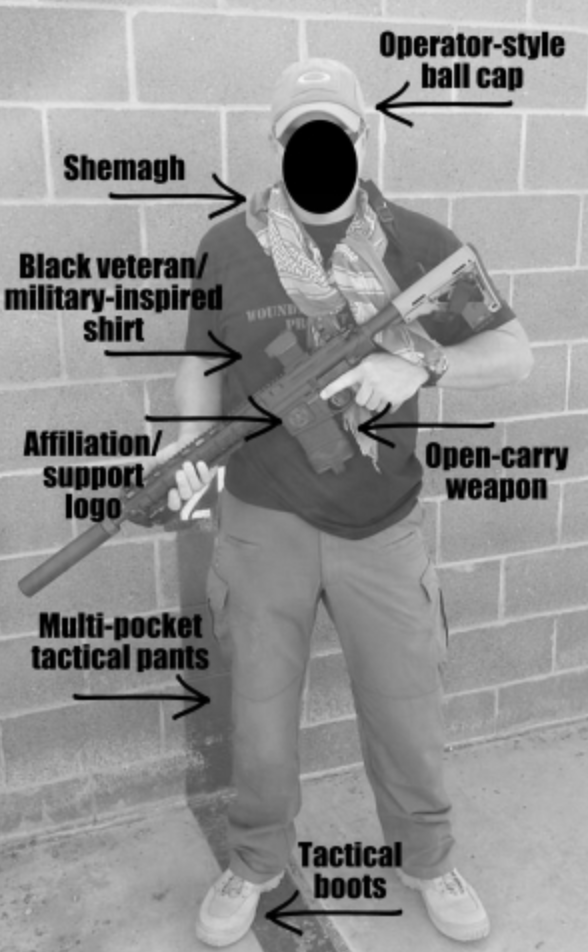
It doesn’t have to be elaborate…and more importantly, DON’T OVERSELL IT. I’ve seen people try to look like a homeless guy because “nobody looks at the homeless guy”….believe me, EVERYONE looks at the homeless guy and unless you are indeed homeless, you will stand out. I can’t stress enough to not try too hard to “fit in” (Think Justin Trudeau and his antics literally everywhere he goes).

Another area of being a gray man is behavior. Certain behaviors are immediately apparent as proof that you are watching people. Being too visibly aware (guilty) of your surroundings is a sure giveaway. Move slowly, stand often, and most importantly, respond exactly like everyone else. The left DEMANDS 100% ideological agreement and if you fail to clap, or nod your head, and chant along, you WILL be spotted. Don’t write notes, use your phone. Everyone else will have their phones in their hands, making videos and taking photos, so fit in, but don’t make it readily apparent what or who you are filming/photographing. Use a note app on your phone. LOCK YOUR PHONE.
Let me be blunt….ANTIFA has a VERY STRONG counter-surveillance and security program. They may not take any action in the beginning, but may follow you to your car. I’ve noted them recording license plate numbers and taking lots of photos. They are a VIOLENT organization. You DO NOT want to be identified.
If you are confronted by their people, resist the temptation to argue or jump into a political discussion “since you’ve been made anyway”. Remember your ultimate goal…gathering information and evidence (more on that in a few) and not being detected. If they ask you to leave, act disappointed, but agreeable. Leave immediately (but don’t go straight to your car). Leave them with a nagging doubt about whether or not you were actually gathering information.
Understand also the legalities of where you are. Are you somewhere you have a legal right to be? Generally, at a protest the answer is yes, but don’t follow people inside to film them looting a store, because you would then first be committing burglary, and second putting yourself in a position where it would not be legal to defend yourself.
This matters, because just the other day, ANTIFA/RevCom security asked the police to make a person taking photos of them (it wasn’t me, I have better Fieldcraft than that) leave the area of the protest, and the police told them squarely that they had no legal right to ask anyone to leave, since they were in a public area.
A side note….Just last night, Steven Crowder (louderwithcrowder.com) had his people identified within the Capitol Hill Occupied Protest Zone because they were livestreaming; resist the temptation to stream or post, until after you’ve left the area. They monitor that.
Your vehicle should also be made as “gray” as possible. I’ve never put political or other stickers on my cars because I’ve always done this kind of work and I want my car to be as nondescript as possible. Take care with what is visible through the windows. I drive an SUV, so I cover up the bags in the back and take care not to leave clipboards or surveillance equipment/radios on the seat. Park a long ways away and walk in; I’ve watched ANTIFA/RevCom security people do sweeps of parking lots looking for occupied cars or signs of surveillance. When parking, always park front end out, facing the parking lot entrance, not necessarily the event.
Several people asked me, so why even do this? First, before you can fight an enemy, you must know them. Sun Tzu said that if you know yourself and know your enemy, you need not fear the result of a thousand battles.
Second, I’ve been involved with a project for three years tracking these groups and developing video evidence and stills from live-streams and photos to tie people to criminal events. The natural extension of that is to get out and make videos of attendees before the ever put their masks on and begin destroying property or assaulting people. We’ve had success at tying people back to photos taken earlier. Below is the current wanted poster for people involved in trying to take down the Andrew Jackson statue. Some are clear screen grabs from surveillance systems, but others are clearly photos taken from people circulating among the bad actors, gathering evidence to later turn over to the police.

If the police won’t get out and do it, it’s incumbent upon the citizens who still care about our nation and our system of government to get out and gather the evidence.
If you want to read a fun set of books that give a bit more detail, check out the Gray Man series (soon to be a movie) by Mark Greaney (markgreaneybooks.com).
I hope this article helps explain some of the basics of the gray man principle, which really boils down to just not standing out at all.
News from the Front

My biggest complaint with those who want to preserve our nation, is that we are completely ceding the ground to the anarchists and leftists who want to destroy our nation.
It’s time for us to get out in the streets as well, and take smart action to preserve the Republic. I’m not saying get out and destroy things, but I am saying that everywhere that citizens have shown up to defend a business or a statue, they’ve been successful without much trouble because the left is counting on zero resistance.
I don’t advocate initiating violence at all, but I do advocate smart responses.
The key to a smart response is to study the opposition and gather intelligence. I began this project locally here in Detroit a few days ago, and I reported on the first operation the other day. Here, I want to share key findings from two other protests I attended.
First, it’s important to give a few ground rules. I didn’t show up in a USA t-shirt, wearing a MAGA hat, and draped in a Trump 2020 flag, nor did I arrive dressed as super tactics-man in all my tacti-cool gear. I wore just jeans, a t-shirt, hoodie (for quick change), a basic ball cap, and a face mask.
Yes, I wore a face mask, despite my feelings about it. Here’s why…try positively identifying a guy in a face mask, ball cap, and sunglasses. You can’t. I assumed a completely different profile simply by removing the hoodie and sunglasses, switching ball caps, and putting on a different color face mask. Total gray man. Backpacks are so common now, that you can carry a couple of complete profile changes, some defensive tools, and first aid supplies unobtrusively. I also used the backpack strap to carry my hidden surveillance camera.
On Saturday, I attended the Black Lives Matter march and Juneteenth celebration in downtown Detroit, and developed some good information, some of which points to a need for further research.
My first observation was that you shouldn’t believe the media hype about hate. The media would have you believe that racial tensions have everyone hating each other. It’s untrue, and before the march even arrived, God proved it to me. I had positioned myself at Campus Martius Park, because there is a Civil War memorial there. As the march approached, three young black men approached me, and formed a circle around me. One of them walked right up to me and said “excuse me sir, there are protesters coming, you might want to move.” These young men were worried about my safety, and the MSM would have you believe that that would never happen. Out of respect for their concern, I moved a bit away.
Second, unlike in Ann Arbor, Detroit BLM had their own security provided by a group of older men from the local Masonic Lodge. In Detroit culture, older men who belong to the Masons are a bedrock of the community and are respected by even the most hardened thugs. This was a smart move. These guys walked on both sides of the crowd, mostly looking inward to watch for agitators.
The same medical staff, provided by the local RevCom group (ANTIFA), that were at Ann Arbor were present. The exact same staff. I also noticed that some of the ANTIFA security team from Ann Arbor were present in Detroit, but not handling security, they were among the crowd, but they were closely watched by the Masons.
The only active agitator started yelling because the group was cooperating with police and he was quickly removed by the Masonic security team.
One person fell to a heat casualty, so I got to see the ANTIFA medics spring into action, which consisted of yelling “medic” and forcing the person to drink lots of water (which is actually contra-indicated in heat cases…small sips only).
I noticed as the march entered the Hart Plaza at the end of the route, all of the ANTIFA/RevCom personnel had Baofeng radios. That was a very interesting piece of information to develop.

As I moved throughout the crowd, I noticed a man trying very unsuccessfully to secretly record me. His picture is below, I’ll let you make your own commentary about his shirt. Almost immediately I noticed that standing right next to him was one of the ANTIFA/RevCom guys I had seen at Ann Arbor the day before. This tells us that the opposition was doing counter-surveillance, and I admit my own field craft error in visibly appearing to be situationally-aware.

Once I noticed the attention, I went around a corner, stripped off the hoodie, took off the sunglasses, and changed my ball cap and mask, reappearing at the other side as a completely different profile. The switch worked, because they never looked my way again.
The crowd was completely peaceful and friendly and I interacted with several of them. The only issue I had was that the speech by the local NAACP President ended up not having anything to do with George Floyd or police brutality and was pretty much just an anti-Trump rally.
Today, I attended a protest against the Canton Police Department. The organizers said that they were protesting the violent arrest of Sha’ Tenia Grady-El by the Canton Police. The only problem with that is that she wasn’t arrested by the Canton Township police, she was arrested in the next county over by the Washtenaw County Sheriff’s Office in Ypsilanti Township, but why let facts get in the way of outrage.
I arrived before the rally began, and was actually surprised to see the EXACT SAME RevCom/ANTIFA security and medic team that I had seen at the last two protests. At this event, as with the Ann Arbor event, the RevCom/ANTIFA personnel were in charge of security and organization for Survivors Speak, who held the rally. What surprised me was watching the security team inspect occupied vehicles in the grocery store parking lot where they held the rally. They openly recorded license plate numbers and stared at vehicle occupants, apparently to intimidate them. At one point, a man was walking around them taking photos, and they tried to get the police to make him leave or stop recording. One of my police contacts let me know that they told the security team that they had no legal standing to ask anyone to leave or stop recording, since this wasn’t their parking lot.
This protest had the smallest turnout so far, less than 100 people. After a few speeches about the usual topics of police brutality, income inequality, and the ever-popular educational racism (holding all students to equal standards is somehow racism), the group then proceeded onto Canton Center Road and blocked the intersection of Michigan Avenue and Canton Center, arguably the second busiest intersection in the township, for 8 minutes and 46 seconds, with the police assisting with traffic control.
The group then continued on to Walmart, where they decried low wages and employment discrimination, despite Walmart having a very diverse workforce. They then marched back the two blocks to the starting point, where they held a dance party. Total march distance: 4 blocks.
The most interesting learning is that three different protest groups in three different cities used the same RevCom/ANTIFA security & medical group. At the two protests in which they handled security, the same man led the RevCom/ANTIFA group while wearing Interceptor Body Armor. At the Detroit Protest, I noticed that he was present, but was wearing a full face mask to prevent identification, but it was clearly him.
My point is this…the opposition is in the streets, far more organized and prepared than we are led to believe, and there is apparently some central authority pointing groups to the RevCom/ANTIFA teams that I’m seeing. It’s not coincidence and it’s not advertising. They are also clearly prepared for and willing to engage in violence, although none has occurred at the protests.
It’s also very telling that while they want the police to recognize their right to peaceably assemble, they are completely unwilling to allow differing viewpoints to do the same, to the point of intimidation and/or forcing them to leave. If there hadn’t been a large and professional police presence, I believe they would have acted against the man videotaping them. They do serious counter-surveillance.
My advice to you is to get out and learn what the opposition is doing.
As it says in the Ultimate Tactical Handbook, the Holy Bible:
The prudent see danger and take refuge,
But the simple keep going and pay the penalty
Proverbs 22:3
If you don’t get out and learn what the opposition is doing, you are being not prudent, and you won’t see the danger because of normalcy bias.
Be prudent….get out there.
What I Learned Gathering Intelligence

Intelligence gathering is the process of developing information that you can use to make decisions and/or be aware of your local situation. It’s an exhaustive topic that I’m not going to get into here, other than to describe how I accomplished today’s mission.
It’s one thing to watch the news and listen to what they are reporting about protests and happenings; it’s quite another to go and observe events yourself. Which do you think will give you the most reliable information?
Today, I attended the Black Lives Matter Juneteenth Celebration and March in Ann Arbor, Michigan to observe first hand what the other side is saying and doing, rather than just believe what the media says. I highly recommend the exercise and I plan on it doing it again soon.
It’s important to note that I didn’t go as a counter-demonstrator or to oppose anything, just to observe and listen, which is important, as the right to free speech is equally valid for both sides.
To conduct this exercise, don’t show up in your super -cool guy tacti-cool wardrobe, or in your American flag T shirt, or your silly “Boog Boi” Hawaiian nonsense, you want to approach this from a gray man perspective. I wore jeans and a plain polo shirt, with a basic (non-tactical looking) ball cap. When wearing a face mask and sunglasses, no one could possibly have described me or picked me out from the rest of the crowd.
Backpacks were very common, so wearing one fit in. My backpack, however, had my bulletproof laptop sleeve from Premier Body Armor in it, just in case (check out premierbodyarmor.com). I also had a hoodie, a different color ball cap, and a different color face mask so that if needed, I could change my total appearance in seconds.
While I was not unarmed, there was not a handgun on me or in the backpack, because I was not there to counter-protest, or defend, but to observe. Having a firearm would have just raised my own stress level while walking among potentially hostile actors, so it would have done more harm than good. There are plenty of other defensive options.
Let’s get on to what I learned.
First, while the protest was indeed Black Lives Matter themed, the group leader quickly pointed out that ANTIFA was indeed present to “organize and provide support”. To hear someone openly say that, was a bit shocking. I had already noticed several of them in their all black gear and red & black bandanas.
They had “Skyler”, the ANTIFA “coordinator” speak. He said that they were there only in a support role. He pointed out that they had medics with red and green crosses on their arms for any health issues, and then he ominously said “our security staff is circulating through the crowd, observing, for your safety”. The left hasn’t even seized power and they’ve already got their secret police in place. That should scare you all. I must have done alright, because they didn’t throw me out.
Next, a series of speeches began, and I was appalled at the amount of disinformation spread by leaders in the movement as well state, local, and federal elected officials.
A speaker claimed that the Emancipation Proclamation was signed in 1867, despite us being there to celebrate the day that people in Galveston, Texas heard about it on June 19, 1865. I guess Galveston is just way ahead of it’s time. That same speaker claimed that the Proclamation only freed slaves in the Confederate States, not all states. While that is technically true, it’s dishonest, as the northern states had already abolished slavery.
Then we got to Debbie Dingell, a United States Representative, whose family has held that seat for 87 consecutive years, but NOW she’s ready to do something about racial injustice. She misquoted Dr. Martin Luther King, Jr., and not one person called her out on it. She said that her favorite quote of his was that “Darkness cannot defeat darkness”, which is crazy, because if it was really her favorite she would know that he actually said “Darkness cannot drive out darkness”. Rep. Dingell then got the crowd all worked up by shouting that Donald Trump shouldn’t be going to Oklahoma City this week, and that Oklahoma City is where the Tulsa Massacre occurred (it didn’t, it occurred, surprisingly, in TULSA). You’d think that her staff would have prepared her remarks with truthful information. I do have good news for Rep. Dingell, I can confirm that Donald Trump is NOT going to Oklahoma City this week.
Dr. Abdul El-Sayed took a few minutes to spread more provable lies. He claimed that the Flint Water Crisis was done intentionally to poison black children, and was proof of systemic racism. Never mind the fact that the Flint City Council who made the vote that caused the crisis was made up of 8 black members and 1 white, and 100% Democratic Party. The crowd cheered on his lies, without bothering to fact check a single bit.
There was a speaker from the local school board who discussed “Educational Racism”. I thought that holding everyone to the same set of standards, regardless of race, was equality, but today I learned that THAT was Educational Racism. Apparently, students of color should be held to lower standards. Fighting Educational Racism sounds to me a lot like, well, racism.
Several of the day’s speakers shouted about defunding and abolishing the police, who despite all the hatred spewed at them, made a Herculean effort to keep the protestors from being ran over by average citizens as they took to the streets.
The group of about 2,000 then began to march. Rather than waiting for the police to secure the end of the street, they jumped out into traffic, walking into oncoming traffic, trapping three vehicles inside the protest, and surrounding them. While there was no violence, can you imagine having been inside one of those vehicles? That’s one reason that I advocate checking every single day for protests in your local area, so that you can plan to avoid this exact situation.
At each intersection, the ANTIFA security had the entire procession stop and block from all directions for a few minutes before moving on. The lead ANTFA security person was interesting….he was wearing an Interceptor Body Armor vest, which indicated to me that they had some intent to potentially engage in violent behavior. Several other ANTIFA personnel were wearing helmets, also indicating a potential for violence.
Once the procession reached the Washtenaw County Justice Center, the crowd knelt and paused for 8 minutes and 46 seconds.
All in all, the crowd was peaceful, although there was an undercurrent that seemed to be wanting an excuse for violence to break out, but the crowd returned to the Diag at the University of Michigan without incident.
I did notice that the lead and follow vehicles were the exact same two vehicles that I observed at another protest in Wayne County, proving that these are indeed NOT spontaneous or grass-roots efforts, but a well-organized campaign by a central group.
I’ll be doing this again, looking for the same outlier personnel and vehicles, and identifying who they are, to increase my knowledge of the local threat.
It wouldn’t be my blog without tying the principles back to the Ultimate Tactical Handbook, the Bible. As far as just keeping quiet in the face of people who refuse to listen to reason, I have two pieces from the Book of Proverbs that will keep you safe when among those who are looking for a fight:
Those who guard their lips, preserve their lives,
but those who speak rashly will come to ruin.
Proverbs 13:3
A fool’s mouth lashes out with pride,
but the lips of the wise protect them.
Proverbs 14:3
I highly recommend you do it too, just make sure you keep quiet and unnoticed, these people are not interested in rational debate.
The Tactics Of Joshua
The book of Joshua is a great story, full of epic battle scenes, spies and spy-hunters, life and death chases, and even evil kings being impaled in front of their cities. The question we ask here is: Can the tactics that Joshua employed in war thousands of years ago, still be relevant today?
Let’s look at two particular tactics from Joshua.
After an all night march from Gilgal,
Joshua took them by surprise.
Joshua 10:9
Joshua marched a massive army under cover of darkness into position to completely surprise an alliance of kings attacking an allied town. These tactical principles can still be applied today to someone looking to be prepared for whatever may come in our troubled times.
- Use darkness to move past potentially hostile forces.
- Take unexpected routes that might not be watched or guarded.
- Appear where least expected.
- Ironically, Sun Tzu also taught this same principle.
- When traveling any distance in potentially hostile territory, movement at night is imminently better.
- Natural patterns of human activity are lower at night, so you are far less likely to encounter anyone else.
- Thousands of years of conditioning has trained the human mind to rest at night, rather than be outside and watchful.
- It is cooler at night, and this will prevent heat injuries.
Joshua was also known throughout the book to use darkness to set ambushes for his enemies.
Darkness is definitely your friend and it’s just as valid today.
As resources for those who want to be prepared, I have a few suggestions that might help.
- Invest in your ability to navigate at night.
- That doesn’t mean spend a lot of money.
- Buy a luminous compass; I personally have a US government issue one.
- Buy paper maps and a flashlight/filter combination that allows you to read them at night, while maintaining light discipline (your 1000 lumen Tacti-Cool light isn’t it).
- A GPS with 24K topographic maps is a good SUPPLEMENT to paper maps, NOT A REPLACEMENT.
- Invest in your ability to see at night.
- Purchase some type of night observation device.
- Again, this doesn’t mean spend $5,000 on the latest Cool Guy night vision, just get something that works.
- Invest in your ability to NOT BE SEEN at night.
- Many people in the preparedness community love their MutliCam uniforms, or Army issue ACU’s, but these are too light in color for nighttime use.
- Similarly, dressing in all-black is too dark for nighttime use.
- I have both midnight digital gear and ATACS-LE gear. These incorporate black, gray, and dark blue, truly making you blend with the dark.
- Take the time to actually train in the dark and use movement techniques IN THE DARK and learn to use your nighttime equipment IN THE DARK.
- Invest some time training in how to shoot in the dark.
…You are to hamstring their horses
And burn their chariots…
Joshua 11:6b
Now, that’s a bit harsh, and we are going to have to translate that today’s context. At the time Joshua was written, a horse was the most common vehicle for moving forces and supplies, and the chariot was the most advanced infantry fighting vehicle available.
If we are to put that into today’s context, it means destroy the hostile force’s ability to move troops and supplies. That’s definitely applicable today, maybe even more applicable, as we’ve become more reliant on transportation.
In Joshua’s context, he not only defeated the enemy in the field, but by destroying their mobility, he eliminated their chance to ever wage war against him again.
In today’s context, we can prevent a hostile force from taking action against us or pursuing us if we destroy their mobility.
It’s also a way to take the initiative away from an enemy, forcing them to pause and reconsider their own security and resupply, giving a smaller force an opportunity escape or take whatever other action they need to.
Outside of a military context, what does this mean for people into preparedness? First, understand the risk that a loss of mobility might cause you. Second, it gives you a tactic to handle a larger force.
On the first point, if all of your preparations rely on your ability to load up a vehicle and drive away, what will you do if someone “hamstrings your horses and burns your chariots”? All of your careful planning is gone out the window.
My plans involve being able to leave the city in a vehicle, but I also have alternate plans (see my other articles) that enable me to leave the area on foot (or by bicycle) if I have to. The point is to consider the possibility and devise a plan to mitigate the risk.
As for the second point, in a without rule of law situation, such as those seen after Hurricane Katrina and being seen in some of the current rioting, groups of looters will be mobile, and the police will not be responding. Having a plan to “hamstring their horses and burn their chariots” might save lives and property and allow time for law enforcement to eventually respond. How you do that is beyond the scope of this article, but it’s something to consider.
As you can see, these principles can indeed apply today by those interested in preparedness.
The Bible is indeed the Ultimate Tactical Handbook.
Review – Highland Tactical Med Kit

When you talk to people about preparedness and readiness, they always want to discuss guns and ammunition, and maybe food. The preparedness item you will use the most, almost daily, is a first aid kit and you will use it long before any major disaster hits. As such, it’s often overlooked.
A while back, in another post, I discussed the bags from Highland Tactical that I use to carry my gear. A staffer from Highland Tactical reached out about the article, and let me know that they have a dedicated medical kit bag, that I might want to check out.
You know me….the bag was ordered immediately.
The bag, shown below, is the Highland Tactical Rip Away Med Pack (hltactical.com). The bag is very sturdy, has MOLLE attachment straps on the back, and MOLLE webbing on the front.

A great feature is the rip-away panel, shown below. I keep the bag attached to another bag in the rear of my SUV, and the rip away panel allows me to undo one buckle and rip the bag away from the velcro backing in an emergency and take it with me.

When you unzip the bag, there are two sides and a center panel that folds out. In the center panel mesh compartment, I keep band-aids of every imaginable size. A note when making your own first aid kit, you’ll need knuckle and fingertip bandages more than often that any other, and most people overlook them.
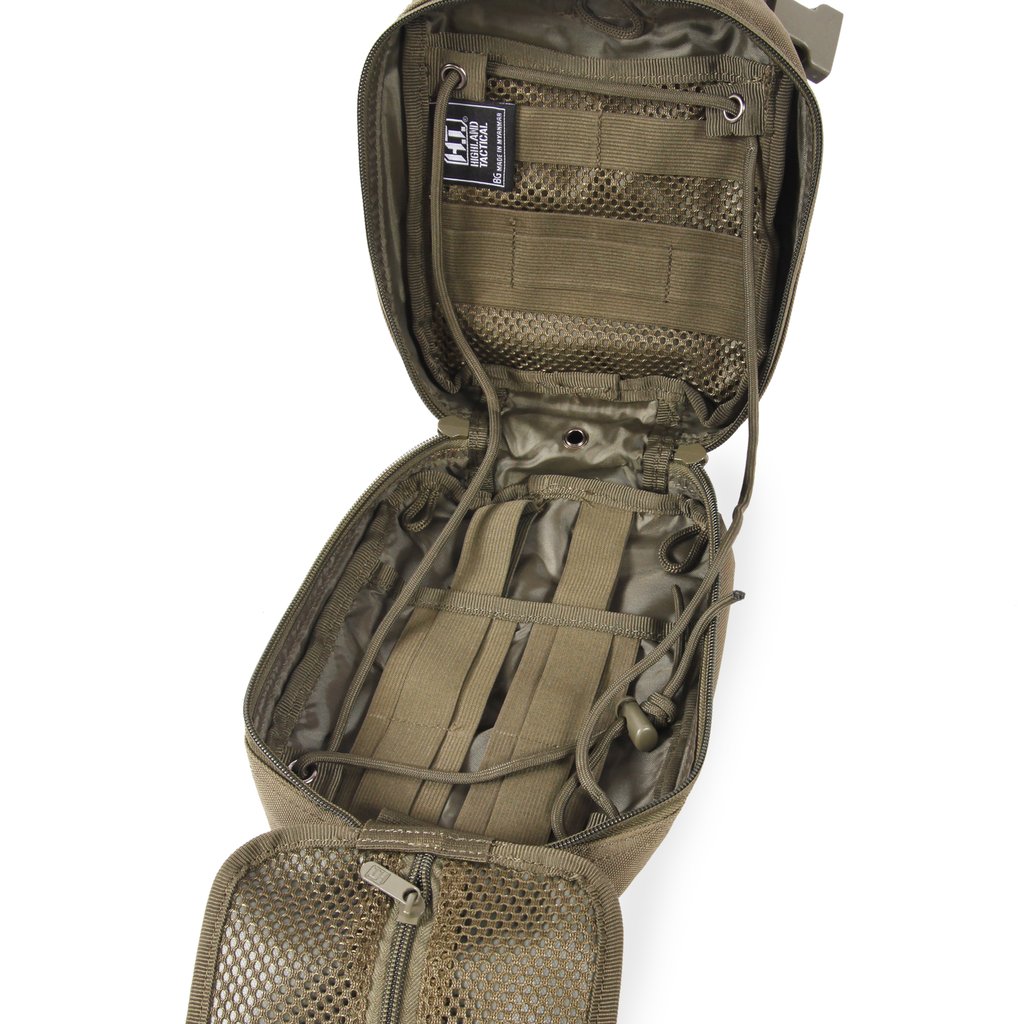
The bag is roomy and has many compartments and elastic bands that can hold a large amount of gear, far more than it looks like it should.
Here’s what I keep inside:
- Tweezers
- Hemostat
- EMT Shear Multi-Tool
- Black nitrile gloves
- CPR mask
- Various size gauze rolls
- Triangular bandage (green, of course)
- Space blanket
- Various size gauze pads
- ABD pads and sterile wound pads
- Trauma Dressing (for gunshot or other major trauma)
- Medical tape (clear)
- Conforming bandage (black)
- Triple Anti-Biotic
There is a drain hole in the bottom, although I’ve never gotten the bag wet.
However, because I believe in redundancy, I keep most of these supplies in either snack or sandwich size ziplock bags, to keep them from getting wet. When storing medical items in plastic bags, use only clear bags and make sure that the label side of whatever is inside is facing outward ON BOTH SIDES, so that in an emergency, a quick glance will let you put your hands on the item you need.
I’ve only found one feature about the bag that I don’t like, and it’s the strap that holds the bag to the rip-away panel. It comes down the center of the front of the bag, rendering most of the MOLLE webbing on the front irrelevant, because to quickly remove the bag, you can’t attach anything to the front.
I overcome this by attaching a tourniquet on one side of the front.
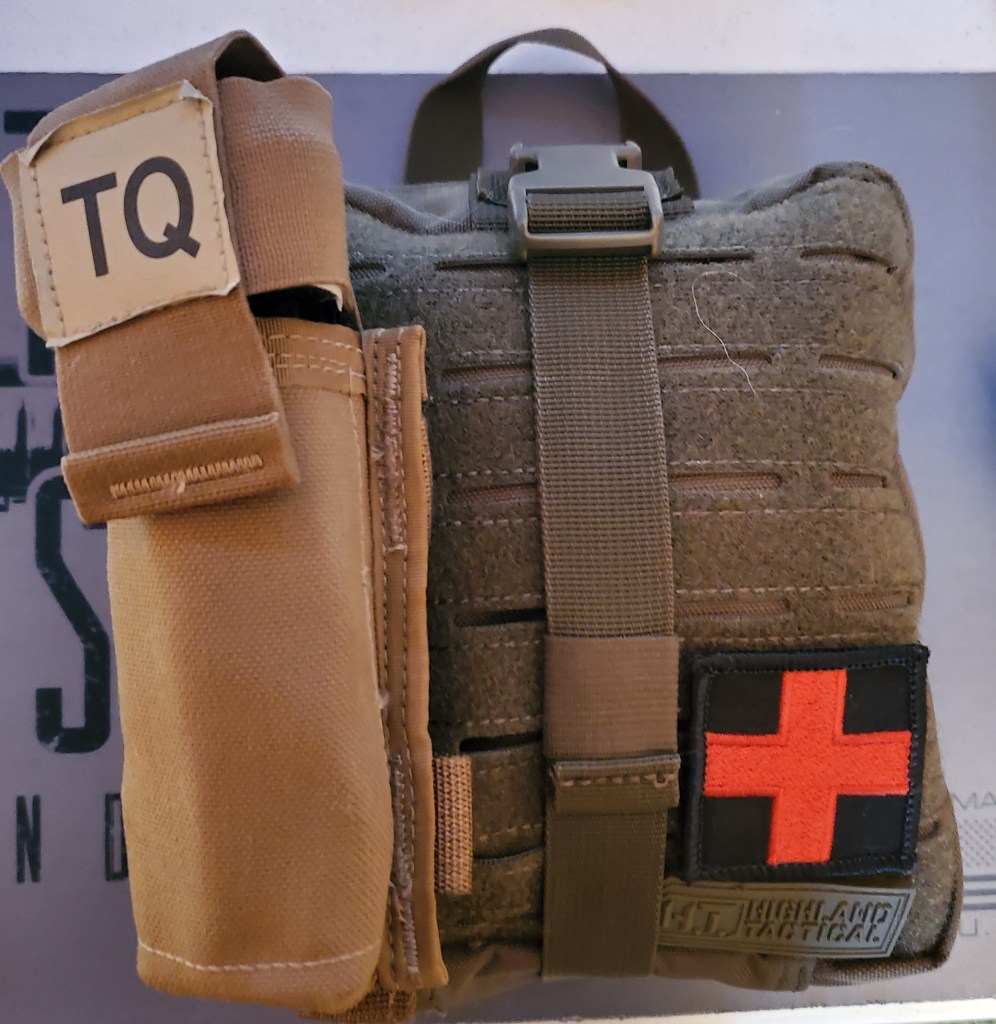
All in all, it truly is an outstanding pack, well-made, and at $24.99, an outstanding value for the price. It’s available at www.hltactical.com.
As a reminder, first aid skills are critical. In a true grid-down, without rule of law situation, a simple cut can quickly become fatal, as can broken bones. Learn first aid skills; they are just as vital as shooting skills, maybe even more. Taking a class one time isn’t enough. I take every first aid and CPR class that presents itself, not because I need more skills, but because practice is what keeps skills fresh.
Buy some small first aid item every week, and add it to your stockpile. There will come a day when you won’t be able to readily find them. I keep mine not in one large stockpile, but in several full first-aid kits kept in several places.
Another point on first aid kits, every time you use an item from it, even a simple band-aid, REPLENISH IT. The tendency is not to worry about it when you just use one or two band-aids, but the day you need it the most, the item you need will be the one gone.
Stay safe, get trained, get aware.
Oaths, CHAZ, & God
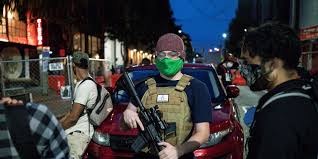
Earlier this evening, the Oath Keepers put out a scathing thread, imploring the President to take action against the Capitol Hill Autonomous Zone, the same thing I’ve called for from day one.
Now, many people argue that we should just let them run out of supplies and go running home to their parents’ basements, but no lesson is learned that way.
These people didn’t stage a sit-in on a college campus, they seized territory by force of arms and declared it a separate nation, outside the laws of the United States. At that point, they violated 18 USC 2383, Rebellion or Insurrection, a ten year felony. The also are violating, every single day, 18 USC 2384, Seditious Conspiracy, in that two or more people are conspiring to, by force, prevent, hinder, or delay the enforcement of US Law, a twenty year felony.
This isn’t something you just let people go home to sulk about.
When I was 18 years old, I swore the following Oath:
I do solemnly swear that I will support and defend the Constitution of the United States against all enemies, foreign and domestic; that I will bear true faith and allegiance to the same; and that I will obey the orders of the President of the United States and the orders of the officers appointed over me, according to regulations and the Uniform Code of Military Justice, so help me GOD.
Contrary to some people’s belief, that Oath doesn’t expire when you are discharged. If you don’t believe me, look up the Individual Ready Reserve, and the Standby Reserve.
I take oaths seriously; everyone should, that’s why they are called oaths.
The President’s Oath contains these VERY SPECIFIC words:
I will faithfully execute the Office of the President of the United States
Article 2, Section 3 of the Constitution states, in part:
He shall take Care that the Laws be faithfully executed
Allowing a group of armed people to establish a nation inside our borders, no matter how silly they are, is NOT faithfully executing the laws.
Don’t get me wrong, I support the President 100%, but this issue goes beyond any individual person; it’s a matter of principal.
If we allow this group to go on, there is a precedent set. Nothing would stop every ethnic group and cause from establishing autonomous zones and homelands, leading to mass conflict. It happened in Yugoslavia, the South Ossetia Region of Georgia, the Nagorno-Karabahk Region of Azerbaijan, and the Ukraine (Donetsk & Luhansk regions). Every one of these led to mass bloodshed.
Currently, there has been a battle raging for four days in Dijon, France, between two ethnic minorities over the city….not a riot, a BATTLE with automatic weapons and explosives. Do you want that here?
Imagine our response as a nation if white supremacists declared a free zone in Boise, Idaho. Our response, as it should be, would be a rapid use of military force to end the rebellion.
What’s different in this case?
Our President is worrying too much about public perception by his enemies, rather than fulfilling his Oath. He has advisors whispering in his ear about the optics, but this is the survival of our Nation.
Regardless of how people feel emotionally, everyone respects a stand on principles,
How does God reflect on us following oaths that we have taken? Joshua 9 gives us a glimpse. People from a small town lied to Joshua and tricked him into signing a treaty. When Joshua found out that they had lied and his advisors told him to break the treaty, Joshua pointed out that an oath had been sworn before God and that if they broke it, the wrath of God would be on them. (Joshua 9:19, check it out)
Now, that’s a little dramatic, but the concept is the same. On January 17th, 2017, Donald John Trump finished his oath with the words “so help me God”, and therefore he is indeed bound before God to fulfill that oath.
Another aspect of his office is found in Article 4, Section 4 of the United States Constitution:
The United States shall guarantee to every State in this Union a Republican Form of Government, and shall protect each of them….against domestic violence.
By not taking action, he is handing the Democratic Party a rock-solid Article of Impeachment for failing to fulfill his office.
I completely understand his position and it’s a tough decision, but Presidents have to make the tough calls, regardless of opinion.
Just like the parent who has to put their foot down about bedtime, it’s time to put the federal foot down on declaring yourself a free nation, to prevent dozens of other new “autonomous zones” from popping up everywhere.
Imagine, the DEA shows up to serve a search warrant, and are met with a sign that says “Meth-Land Autonomous Zone – You are now leaving the United States”. I know, I’m being silly here, but the concept is exactly the same.
To be completely honest, the media and Democrats are going to vilify him either way, and wouldn’t you rather be vilified for standing up on principle, rather than for allowing our Nation to be cut apart into pieces, because you didn’t want to be seen as authoritarian?
Have you ever heard of Gretchen Whitmer? She’s screeching already about him being an authoritarian while she’s busy telling you that you must answer the phone no matter who is calling, that you can’t visit your own second home, and which way you can walk in grocery store aisles. Who is the real authoritarian….the ones imposing illegal rules, or the one upholding the law of the land, as written and voted on by our elected representatives?
Oaths are something to be taken seriously, and in our current crisis, oaths should be a bedrock that we can fall back on. This used to be a Nation where a man’s word meant absolute faith that he would do what he said.
We must uphold our oaths, sworn before God, and end this autonomous zone by government action.
The Battle Of Ai

I’ve long held that the Bible isn’t a stuffy set of rules, it’s one of the coolest action and adventure books every written.
There are epic battle, spies, wars, and even at least one dragon.
In Joshua 8, we are told of the Battle of Ai and how Joshua led his army to victory. We’re going to analyze the tactics Joshua used and discuss how that Tactical Wisdom from the Bible can be applied today, and be just as effective as it was thousands of years ago.
On his first attempt, Joshua sent a small force, but they found the enemy entrenched behind well-prepared fortifications, so Joshua’s force was driven away and fled.
Rather than leave, Joshua prayed about the situation, and developed a plan, with a little help from God.
Joshua decided to emplace an ambush behind the city, and draw the defenders away from their fortified positions, to level the playing field. Joshua studied the terrain and found some restrictive terrain that he could lead the enemy into, but also from which they couldn’t see what happened to their fortifications.
The next night, Joshua dispatched a force to sneak around the city under cover of darkness and set up a concealed position behind the city.
In the morning, Joshua marched the rest of his forces in plain view right up to the city and camped near it.
The enemy, thinking they had another easy victory, came out and prepared to defend the city. Rather than stand and fight, Joshua and his army pretended to flee, and led the defenders down a valley, away from the city. The defenders fell for it and gave chase with nearly all their forces.
As Joshua passed the position where his ambush force was hiding, he raised his spear up as a signal to them. They snuck out behind the pursuers and attacked the fort, quickly overcoming the small guard force left behind.
The ambush force, once they had secured the town, lit a large fire to signal Joshua back, that they had secured the fortifications.
Joshua immediately spun around to offer battle. The defenders, realizing that they had been tricked, turned to flee, only to find Joshua’s forces occupying their strong fortifications. They were trapped.
Joshua attacked and the battle was short and one-sided.
After the battle was won, Joshua took the captured King and impaled him on pole outside the city gate. (I told you it was a cool adventure story – any story that ends with a guy on a spike is cool).
That was an epic battle story and amazing tactics won the day, but can we apply the lessons learned and tactics used today? ABSOLUTELY.
Lets take a look at the Lessons Learned.
MOVEMENT
Conduct movement at night, to prevent enemy observation. That’s 100% as valid today as it was thousands of years ago. I know, we have night vision now, but darkness still offers more concealment than movement in daylight.
The temperature is also cooler than moving in daylight, and there is less human activity, and therefore less risk of accidental compromise of your movements.
TERRAIN ANALYSIS
Conduct a map study or ground recon to pick out the best terrain that offers you more advantages than it does the enemy.
In this case, Joshua picked terrain that would hide the ambush team and prevent the enemy from observing their movement back to the city.
Always analyze the ground you’re going to operate on, even if it is just a map study.
AVOID FRONTAL ATTACKS AGAINST FORTIFICATIONS
Attacking a well-prepared and fortified position is never a good idea and it requires major numerical superiority to make it work.
Whenever possible, draw the enemy out of the fortifications or bypass.
During the Napoleonic Wars, forces frequently surrounded a fort, then moved on, cutting the supply lines, causing the fort to surrender without a fight.
SIGNALS
Joshua had signals worked out in advance for each of elements to let the others know what was happening. In his day, he didn’t have radios and wire comms, but the idea is the same.
On the modern battlefield, having multiple signals and backup methods of communications is required.
Set up prearranged signals and keep them secret.
Have multiple methods of communications planned with your group. I recommend at a minimum radio, with a cell phone backup. Our group uses communications security measures that everyone is aware of, to ensure that even intercepted communications don’t give away information.
As you can see, the Tactical Wisdom from the Bible is exactly as valid today as it was when the Bible was written.
Book Review – Sheep No More
I recently read the book “Sheep No More” by Jonathan T. Gilliam. The book is outstanding and I highly recommend it.
Gilliam (www.jonathanTgilliam.com) is a former US Navy SEAL and a former FBI Special Agent. He applies his experience to helping the average citizen understand how to analyze the critical times and locations in their life where an attack or crime could occur, then how to devise strategies to mitigate the risk or manage a situation.
When I first started reading the book, I grabbed a highlighter and decided to highlight all the best points that I wanted to remember. The book is almost entirely highlighted; it’s that good.
I’m not going to give out too many details, because I think you should buy the book, and the two outstanding workbooks that go with it, for your own use and knowledge. However, I want to discuss a few key points from the book that align with what I teach in my self-defense and active shooter response classes.
First is the nonsensical idea that the average citizen in America has that it can’t happen to them. In the book, Gilliam likens this idea to that of winning the lottery. In other words, the average person thinks that their likelihood of being attacked is on par with that of winning the lottery, but someone ALWAYS wins the lottery and your chances are just as good as theirs.
I teach a similar concept, pointing out that no one wakes up and says, “Today, I’m going to be aware because today an attacker is going to enter the grocery store while I’m there” or “Let’s be careful tonight, because our house is going to be burglarized”. Crimes and attacks happen everywhere, and I urge awareness everywhere, especially in our current crisis, with rioters and looters vowing to “take it to the suburbs”.
A second point from the book that I also teach is that action is faster than reaction, and that if you have already devised a plan, you are able to act quicker and overcome shock. I can assure you that the attacker or criminal has already devised a plan.
The key premise of the book is to break your life into areas and times where an attack could occur, and then apply Gilliam’s process (buy the book to learn it, you’ll love it) to develop strategies to mitigate or eliminate that risk, or at the very least, devise a response plan.
As my readers know, I always compare what I’ve learned to the ultimate tactical handbook, the Bible. How do the awareness principles in Gilliam’s book conform to God’s Tactical Guide? 100%:
Be alert and of sober mind, your enemy the devil prowls around
like a roaring lion, looking for someone to devour.
-1 Peter 5:8
Sounds like awareness is a biblical command, to me.
In the book, Gilliam points out that by simply being aware, you can detect an attack long before one occurs. I also advocate awareness, as you can read in some of my other articles. Awareness may add an extra minute or two to your trips, but it could save your life and the lives of the ones you love.
Gilliam has also produced two workbooks that compliment the book and his “Attack and Defend” philosophy. The workbooks contain a review of the methodology from the book and checklists to apply the lessons from the book.
The book contains a complete methodology for analyzing every area of your life and location you frequent, to develop plans and defenses to keep yourself safe.
Gilliam and I agree on the point that the person most responsible for your protection is YOU. The police do not exist to protect you, as the US Supreme Court has ruled repeatedly. Their role is to investigate what has already happened and prosecute the guilty. That’s why we are currently seeing them let rioters burn and loot, they have no legal duty to protect.
As an example, there was a protest yesterday near my house. Because I am into situational awareness and take responsibility for my own safety, I went to the location and observed the protest. While it was peaceful, because I am aware, I noticed several things. First, several people in the crowd were wearing gas masks and helmets, which indicates that they considered not remaining peaceful. Second, the group had several medics with them, indicating that they had considered that violence may occur. Third, they had their own video team documenting the action. What all of this told me is that the group had intended to take some action worthy of documenting that involved potential violence, but the large police presence and proactive police response didn’t give the crowd an opportunity to engage in whatever their secondary plan was.
Had I just remained unaware, that crowd may have become violent and began a rampage through my suburb without me even knowing it was happening, until they were on my block.
Awareness doesn’t mean paranoid, it means being aware that bad things can indeed happen to you.
The book also conducts case studies of several terrorist and active shooter situations, pointing out how awareness either helped or could have helped.
In closing, I highly recommend that you buy and read not only Sheep No Moore by Jonathan T Gilliam (www.jonathanTgilliam.com), but also both companion workbooks.
Stay aware, stay safe. Be alert and of sober mind…..
The Danger of the Seattle Autonomous Zone
By now, I’m certain you’ve all heard about the “Capitol Hill Autonomous Zone” that ANTIFA has established in the City of Seattle.
Make no mistake, the City of Seattle and the State of Washington are complicit in this act of insurrection and rebellion.
Yes, I said insurrection and rebellion.
Whoever incites, sets on foot, assists, or engages in any rebellion or insurrection against the authority of the United States or the laws thereof, or gives aid or comfort thereto, shall be fined under this title or imprisoned not more than ten years, or both; and shall be incapable of holding any office under the United States.
18 USC 2383 Rebellion/Insurrection
By seizing a 7 square block area that includes a police station and the City Hall, by force or threat of force, ANTIFA has crossed the line from protest to open rebellion.
They have placed signs around the perimeter, announcing that the “Capitol Hill Autonomous Zone” is no longer within the United States. That act is UNLAWFUL.
The Mayor has done nothing, and has essentially ordered the police to stand down. They have taken absolutely no action to retake the city center, City Hall, or the Police Station.
When asked about it yesterday, Governor Inslee decided to pretend that he had no idea that it had even happened. Think about that. He’s either criminally negligent or woefully & intentionally ignorant, neither of which should allow him to be Governor.
Today, the President warned the Governor that if he doesn’t take action, the federal government will. The Governor immediately responded that he won’t allow the federal government to take military action against Citizens of Washington.
I’d say that, by their own comments, they are NO LONGER citizens of Washington, as Washington is in the UNITED STATES, and they claim they aren’t.
Can the President take military action? ABSOLUTELY:
Whenever the President considers that unlawful obstructions, combinations, or assemblages, or rebellion against the authority of the United States, make it impracticable to enforce the laws of the United States in any State by the ordinary course of judicial proceedings, he may call into Federal service such of the militia of any State, and use such of the armed forces, as he considers necessary to enforce those laws or to suppress the rebellion.
10 U.S. Code § 252 – Use of militia and armed forces to enforce Federal authority
Should he take military action: ABSOLUTELY
I know, you’re thinking, “Who cares? It’s 7 blocks in the liberal dump that is Seattle?”. Here’s why you should care: ANTIFA units all over the country are watching to see what unfolds. If no action is taken, you will see these zones pop up everywhere.
I’ve long said that the most likely scenario for the destruction of the United States is not a single catastrophe, but the “Balkanization” of the US into ethnic and social identity enclaves.
You’re thinking: “Yeah, but that couldn’t happen in a modern Western Nation”.
The Balkans were the modern Western nation of Yugoslavia before the Balkan Conflict set it down the path of ethnic cleansing, war, and death.
The Ukraine was a modern Western nation until the events of the Maidan and subsequent civil wars and ethnic cleansing.
Georgia was a modern Western nation until ethnic Russians and Georgians began fighting each other and committing atrocities.
These zones will inevitably lead to ethnic cleansing. If you don’t think that’s possible, I want you to watch MSNBC and CNN for 3 hours tonight, and listen to the racially motivated rhetoric. Major figures are openly talking about justification for racially-motivated violence.
If the federal government doesn’t quickly and decisively end this rebellion, our nation is finished.
Prepare accordingly.
Freedoms Lost Don’t Come Back

Throughout history, this truth has rung true: Whenever a government takes away a right, it never comes fully back.
During the current pandemic, the right to freely exercise your religion was removed. Many people tell me that you can still be a Christian, without going to church. Being a particular religion IS NOT what’s guaranteed in the First Amendment. The Amendment restricts the government from “prohibiting the free exercise thereof”. Telling me that I can’t attend services at my church is indeed “prohibiting the free exercise thereof”.
But, Joe, people say, you can meet online and it’s exactly the same. No, it isn’t. I enjoy meeting with the good people at Northridge and associating with like-minded people.
What does the Bible say about it?
“Not giving up meeting together,
As some are in the habit of doing,
But encouraging one another…”
Hebrews 10:25
Seems pretty clear…actually going to church is part of the exercise of my religion.
Another right that has gone away under the executive orders (particularly here in Michigan) is the “right of the people peaceably to assemble, and to petition the Government for a redress of grievances”.
When people met to exercise this right, they were threatened with government action, and the Governor threatened to extend the lockdown, simply because people exercised their rights. She also told them that they were subject to arrest if they didn’t wear masks and social distance.
Even more draconian was Governor Whitmer’s response specifically to the hair care profession. When they protested her actions, she arbitrarily had a man’s license revoked permanently with no explanation. She also, when she reopened most of the state, forced the hair care industry to OPEN LAST. That was a direct retaliation for their attempt to petition the government for a redress of grievances.
Contrast her response to the protests against her unconstitutional orders, which were entirely peaceful, with her response to the violent and destructive protests against the police currently going on. Not only did she allow them to continue to protest without masks or social distancing, but SHE JOINED THEM.
The difference? Her own opinions, which are never supposed to enter into government actions.
I guess it’s OK if it’s the right kind of protest.
These two may seem anecdotal and local in nature, but they are examples of what is going on all over the nation.
The Fourth Amendment guarantees that you will be secure in your “persons, houses, papers, and effects” from government intrusion. During this pandemic, and now it’s aftermath, that has gone out the window. Contact tracing REQUIRES you to answer questions about your travels, daily activities, health, and friendships, under threat of immediate house arrest for a minimum of 10 days.
Don’t tell me quarantine isn’t house arrest, it is. They say that it will be enforced by home visits, so if a government agent, volunteer or not, is ensuring that you are obeying an order without any court action, you are under house arrest.
Here in Michigan, during a press conference, Governor Whitmer actually told citizens that they MUST answer the phone, no matter who is calling, because it might be a state contact tracer.
Yes, really.
Additionally, there is talk of requiring vaccinations or proof of testing before being allowed full return to activity….think about that.
The 14th Amendment guarantees that no state can deprive any citizen of “life, liberty, or property without due process of law”. What Due Process of Law was there before you were ordered into house arrest for two and a half months? Or here in Michigan when you were told that your couldn’t use your second property?
Your right to privacy regarding your medical records are completely gone. To enter into work every day, most of you (I know I am) are required to report any contacts you’ve had people who might be sick, report any symptoms you might have, and submit to a temperature check, despite many laws saying your health is NONE OF YOUR EMPLOYER’S BUSINESS. And employers are required to fire you if you refuse.
At my office, you must submit as well to an IR Camera image of your face displaying the temperature to prove you actually got checked out.
I read a news story recently about a police chase involving a man trying to avoid a “CoronaVirus Checkpoint”. They reported the story as if a police checkpoint to test your health was a perfectly legitimate government function…it isn’t.
The most basic rights we have as Americans are the right to “life, liberty, and the pursuit of happiness”. Currently, you have just finally, after two months, been told that the government will allow you to leave your home for other than “essential business”, but, you must remain 6 feet from other people, not gather with more than 10 people, and wear a mask anywhere you go.
Does that sound like liberty?
People who disagree with me say “but if you cared about others, you’d just do it”. Thats what people who reported their Jewish neighbors said.
Life as a free citizen entails me making my own decisions about the risks I am willing to bear in my life.
More people will die this year from car accidents than those who actually died from the coronavirus. Every day, I make the decision that the benefits of driving outweigh the risks. It’s the same for every area of your life.
The people who fought and died for this once-great nation are screaming at us from Heaven to take back our country and re-affirm our commitment to it’s original ideals and design.
We are the world’s “last, best hope”, and we must be “that shining light on a hill”.
Our Founding Fathers often spoke of “An Appeal to Heaven”….today they are making “An Appeal from Heaven”.
Make a decision about whether you truly support what America means, and take action. Join like minded people, and make your voices heard.
Don’t let the voices of chaos and destruction be the only ones heard.
What You Should Do Right Now

In light of the widespread rioting and looting in response to the killing of George Floyd, there are several things we should all be doing to protect ourselves.
First, immediately develop a communications plan. Know how to immediately get in touch with friends and family, and develop alternate communication plans. Cell phones can go down due to heavy traffic or a loss of power at the cell phone tower. Having a couple of alternate plans for communications will ensure that you can get in touch with your loved ones.
Radio is an excellent back-up communication plan. An Amateur Radio license is a great idea, but even FRS/GMRS/MURS radios can be used. A national network of preparedness people utilize channel 3 on each of these mediums as an agreed-upon emergency channel to communicate with friends, family, and liked-minded people, even to call for help in an emergency.
Radio communications only work if you have the radio with you at all times, and you have someone to communicate with, so get to work on your network immediately.
Second, immediately collect open-source intelligence (OSINT). Scour the internet for notices of impending protests or events that could affect your day. Follow groups known to organize protests so that you get notified of plans. While I was on lunch just two days ago, I learned of a large protest a couple of miles from where I was, so I quickly developed an alternate route home, that took me farther from the planned protest route. While the protest didn’t turn violent, I wasn’t willing to bet my life on it.
In order for the OSINT collection to be immediately actionable, you need to do it throughout the day, and you need to keep maps available. As you all know, I’m a huge proponent of having paper maps. The internet can go down, or worse, be blocked in a protest area, but paper maps can’t. During recent Second Amendment protests in Virginia, the Navy shut down the GPS system in the area, for an “exercise” that just happened to coincide with the time and location of the protest. If you believe it was a coincidence, unsubscribe now, I can’t help you.
Third, check your supply level of basics at home. You should have at least 14 days of food and water stored, in case you can’t leave the house or the power goes out. Some cities, in response to these riots, have INTENTIONALLY shut off the power.
Next, Make sure you have some emergency supplies in your car. As you may know, I keep an emergency bag full of a change of clothes, boots, and food in my vehicle in case I have to leave the vehicle and walk out of an area. In the event of a riot and blocked routes out of an area, it may be best to leave the vehicle and try to egress on foot, trying to blend in with the crowd.
A fully stocked medical kit should always be in your vehicle, and you should re-check it RIGHT NOW.
The change of clothing I keep in my car consists of all-black clothing, including a black hoodie, because it’s the de-facto uniform of left-wing protestors and makes far better camouflage in a civil unrest situation than Uber-Tacticool Multi-Cam uniforms. The goal is to become a gray man and just walk away. Cars can be replaced.
Additionally, map out where police and fire stations are along the routes you may have to walk out of an area of unrest. I don’t mean as potential safe havens, I mean as areas to avoid AT ALL COSTS as they will be magnets for violent protestors. Also map out and avoid shopping malls or high-end electronic stores for the same reason.
Throughout the day, take breaks from whatever you are doing to assess your local situation. Protests can and do pop up with little to no notice in unexpected areas. The organizers of the current unrest have indicated an intent to “move into the suburbs”, and here in Detroit, we’ve seen that start to happen. Even a few minutes lead time can mean the difference between getting out of the area safely in your car, or having to walk out through a dangerous mob.
While driving home, I listen to a scanner app on my phone for the local area, and just today I heard of a freeway closure near my route, due to protestor activity. While it didn’t directly affect my commute, it could have, and as GI Joe famously said, “Knowing is half the battle”.
A note about protestors on the roadway: Make a decision now that you WILL NOT come to a complete stop. We’ve all seen the videos of what happens if you do. At best, you’ll be inconvenienced for hours and at worse, killed or seriously injured. Make no mistake, someone striking your vehicle and attempting to remove you from it IS A DEADLY THREAT and should be met with an appropriate level of resistance.
However, I saw a video today of a man who stopped his car when someone threw an item at it and got out, challenging the protestors to a fight. That was stupid…you are outnumbered and have no idea what types of weapons the crowd may produce. The man in the video got lucky, because the protestors all ran, but luck is exactly what that was.
Another item to look at is to immediately ensure that all your vehicles are full of gas, and keep them that way. Consider storing extra fuel (securely) at home as well. When riots truly get out of hand, not only will gas stations close, but authorities may order places to not sell gasoline to prevent fires.
Review your home fire plan, and make sure everyone in the house knows the plan.
Also review your home invasion plans and run a drill. If you don’t already have a home invasion plan, ask yourself why not?
Notice that I didn’t mention firearms at all. There is a solid reason for that. The carrying or non-carrying of firearms is a personal choice, and I wanted to reach the most people. But consider this: If you are the only person openly armed with a long gun in a crowd while trying to walk out of an area of unrest, what do you think will happen? Gray man and low-key is the way out in this situation, not Super Tacticool-Warrior.
I hope these few ideas ignite your mind and remind that you should be on a war footing at this point, until the unrest dies down, which is shows no sign of doing any time soon.
Stay safe, and please subscribe.
Applying The Story of Rahab
I’ve said it many times…the Bible is the greatest collection of adventure stories ever known.
In Joshua 2, we are told the story of two spies sent by Joshua to conduct recon in the area of Jericho. While they are conducting their mission, they are found out and government agents traced them to the inn of Rahab, where they were staying. She hid them, and sent the agents on a wild goose chase into the hills, in exchange for the promise of safe conduct later from the spies.
While it’s already a cool action story, complete with spies hiding in the attic under supplies while the police search the building for them, I wondered, what tactical lessons from Rahab’s story are equally applicable today?
The answer: ALL OF THEM.
CONDUCT RECON
The first lesson is of course that before taking any action, conduct reconnaissance first. Joshua was no dummy, and he knew that intelligence won battles, and conducting an operation on ground you don’t know is a sure path to disaster.
Coincidentally, it’s telling that Sun Tzu, in The Art of War, explains the same truth that Joshua knew, and he wrote an entire chapter (Chapter 10), on knowing the terrain.
ESTABLISH SAFE HAVENS
The men made an agreement with Rahab, that she would hide them in return for their protection when the Israelites took the fort.
Establishing agreements among like minded people to provide refuge for each other in an emergency is an excellent tactic and everyone should have these agreements in place now.
As an example, some of my students have a ranch on the way from my suburban home to my bug out location in the north woods. We have an agreement that in an emergency, I can stop at their place and stay as long as I need, as long as I assist in protecting their ranch.
Additionally, we have “mutual aid” agreements with surrounding properties to assist each other in an emergency and to be able field a quick reaction force to anyone needing rescue or protection in the area.
In an emergency, you are your own first responder.
ESTABLISH SIGNALS
In the story, the spies agreed that if Rahab had a scarlet cord in the window, the Israelite forces would bypass her inn, as long as everyone stayed inside during the fighting.
It’s overly simplistic, but it gives rise to the entire idea of having pre-arranged signals.
The AmRron Radio Network has an established “Signal Operating Instructions” set for everyone who belongs to their radio network and have established Channel 3 on any radio system, whether it be CB, FRS, GMRS, or MURS as a national “mutual aid” radio channel during emergencies, with instructions to all members to monitor channel 3 for 3 minutes, every third hour.
You can establish various signals and contact methods with your friends and associates, but KEEP THEM SECRET.
HAVE AN ESCAPE PLAN
Because her inn was part of the city wall, Rahab was able to assist the men in escaping the fort, despite the authorities sealing the city gates by lowering them out a window.
I’m pretty sure, given her chosen profession, that this wasn’t the first time Rahab let a man sneak out the window.
How does that apply to today? Do you have a plan to get out of your immediate area without using major roads or highways, where checkpoints could be established?
Most people say that their “bug out plan” involves “getting out of town” and then the plan starts. If you can’t make it out of town, the rest of your plan is irrelevant.
During our training classes, we frequently hear this and then ask someone how they plan to get out town. The answer is usually the highway. At that point, I ask if them know what the ACTUAL STATED PURPOSE of the highway system is. It’s purpose is to allow unobstructed military and emergency traffic in an emergency. In other words, the highway won’t be open to civilian traffic.
As you enter the highway, you’ll see a sign about “entering a limited access highway”. The fine print explains that they can be closed at any time.
Have routes out from your home and work locations that don’t rely on highways. Ideally, they should also avoid any highway entrance or exit points, as those will be natural checkpoint locations.
DON’T FREELY PROVIDE INFORMATION TO GOVERNMENT AGENTS
I know I’ll get some push back on this, but any time that government agents show up at your home or business, it’s perfectly OK to not let them in. That’s what Rahab did, and while she actively lied, telling them that the men had fled the city, I don’t advocate lying to the police.
What I do advocate is that if you didn’t call them, you are under exactly ZERO obligation to answer any questions or provide any information. In most sates, unless you are the driver in a vehicle stopped for a motor vehicle violation, you are under no obligation to even identify yourself.
Some people feel that out of civic duty, you should cooperate. I have one response: That’s how General Michael Flynn felt when Supervisory Special Agent Peter Strzok walked into his office.
The Constitution exists to limit government action and ensure your freedom. Use it, don’t ever waive it.
I have a good friend who, while in the line of our work, was involved in a struggle that led to a man’s death. My friend and the rest of the staff that day gave statements to the police, in good faith, and while the police agreed with our action in the situation, the politically active prosecutor needed to score some community points, so those statements were used to charge everyone with a crime. All charges were dropped as soon as they were reviewed by a court, but the names and charges were already in the national media at that point, and no media outlet has ever apologized.
Don’t make statements unless guided by counsel, who will tell you not to make one at all.
I hope this review of Joshua 2 and the story of Rahab has led to some critical thinking on your part. The time to put these ideas into action is NOW, before an emergency occurs.
Where is Your Stuff?

When we teach classes on self defense or preparedness, guys frequently show us photos of their mountains of food, guns, and ammo. It’s frequently a room stocked with cartons of food, stacks of ammo, and a safe full of guns. They then proudly say “I’ve been prepping, I’m ready”. I burst their bubble by asking what will happen if they are at work when an event happens. Invariably, they say they’ll make their way home, with no real consideration having been given as to how they are really going to get home, then I open their eyes with this one: What if you can’t get home?
Another scenario that destroys this “stockpile” mentality is a recent news story from the COVID-19 lockdown. A man in New York had the FBI arrive and seize thousands of masks he had LAWFULLY PURCHASED and was selling at inflated prices, using the Defense Production Act as their justification. The DPA allows the federal government to seize any item that they deem you have more than they think you should. When I share this story, people say”Yeah, but they arrested him”, assuming that there was some criminality in his ownership. When you read the case filings, there wasn’t. He was arrested for lying the FBI and denying his ownership, not for anything criminal in his purchases.
In this article, we’re going to discuss two pieces of tactical wisdom related to your own supplies:
- Dispersal
- Secrecy
As we do so, we’re going to consult my favorite Tactical Field Manual, the Bible.
“Give portions to 7, yes to 8,
For you do not know what disaster
May come upon the land”
Ecclesiates 11:2
While most people apply this wisdom to investing, it is equally appropriate in your investments as far as gear and supplies.
In a true Without Rule of Law situation (WROL), both the government and other people will be adversarial to your ownership of supplies. If all your eggs are in one basket, so to speak, one confrontation can lead to you losing everything you have.
Spread out your supplies and gear; don’t keep them centralized in one location.
As an example, I have gear at my house, some stored in my vehicle, some in a wooded area in a public park stash within walking distance of the house, some in my office, and some at the cabin in the woods, several hours away.
In this way, I’ll be able to survive if some portion of the supplies are seized under the DPA or taken by bad actors.
Let’s just discuss food in this example.
- At the house, I have one closet with a couple of boxes of non-perishable, camping type food.
- At the office, I have a drawer with several packages of freeze-dried and canned food stored.
- The car has my emergency bag with 2 days worth of survival food and my backpack with 72 hours worth of food. It’s important to note that I can retrieve this food, even if the vehicle can’t be driven from the location.
- In a deep cache in a wooded trail park near the house, I have additional long-term storage food buried.
- At the cabin, I have both food stored inside the garage, and in a cache in the woods nearby.
As you can tell, no matter what the circumstances are, I’ll have access to survival rations at least for a time. You can apply this same strategy to every type of supply or gear you need (I have).
Now, let’s talk secrecy:
“Those who guard their lips, preserve their lives,
But those who speak rashly will come to ruin”
Proverbs 13:3
As I scroll social media, I’m shocked at the information people put out there, and people into preparedness are no different.
I see guys posting their chest rig, plate carriers, and guns, which is really just a shopping advertisement for criminals to come and steal.
I see posts of guys showing off their “stash room” full of food and ammo.
What keeps the average person from stealing from others? Some say morality, some say fear of prosecution. It’s neither. It’s a LACK OF URGENT NEED. People will make very different decisions when they and their family are on the verge of starvation than they would in good times with money coming in and food readily available.
We are approaching such a crisis in America right now.
If you’ve told everyone in your neighborhood how “prepared” you are, what will stop them from banding together to take your things? I don’t care how much ammo you have, if a mob knows you have things and they want them, they’ll get them.
Best selling author Ivan Throne (darktriadman.com) states it best in his book “The Nine Laws”, when he says “Concealment is the Second Law”. To survive, don’t let the world know what you have or what your plans are.
If no one knows you have food, they won’t come looking for it. This applies to discussions on social media, around the water cooler, and in your neighborhood. Operations Security is a vital and often overlooked aspect of preparations.
Many people are tempted to brag and “out-prep” each other. It’s better to keep quiet and quietly amass your supplies and disperse them.
In a WROL event, don’t flaunt what you have. When the rest of the neighborhood has been living on canned beans, don’t grill steaks outside.
If the government hands out water and food, ACCEPT IT so as not to stand out to either the government or your neighbors. The only exception to this is if they require registration or “vaccination”/“health checks” to receive aid. Never submit to those controls. Another caution in this area is that you should never enter a secured perimeter to receive emergency government aid….that perimeter isn’t really to keep people out.
In conclusion, spread out your supplies to diverse locations so that it can’t all be taken or destroyed at one time, and don’t share information publicly about your preparations/stockpiles.
Be safe, and be READY.
Freedom Is Essential Business

“You, my Brothers and Sisters,
Were called to be free”
Galatians 5:13a
As the nation struggles against the Coronavirus and COVID-19, we are told that we must only conduct “essential business”. Each Governor has given a different definition of what they consider to be “essential business”, and there are criminal penalties for being outside of your home, not on “essential business”.
Who honestly gets to decide what essential business is?
I base my interpretation on the best documents ever written in the history of Mankind: The Holy Bible, the Declaration of Independence, and the Constitution of the United States.
In the Bible, the Apostle Paul pointed out the most basic truth about freedom:
“It is for Freedom that Christ has set us free.
Stand firm then, and do not let yourselves
Be burdened again by a yoke of slavery”
Galatians 5:1
That passage is clear and unequivocal. Being told that you cannot work or leave your home without government approval is indeed slavery. Being told by the government which business you are allowed to run and which jobs you are allowed to hold is NOT freedom.
By allowing this to continue, we are being “burdened again by a yoke of slavery”, and we are allowing it ourselves.
Our founding document, The Declaration of Independence, contains the following passage:
“That to secure these rights,
Governments are instituted among Men,
Deriving their just powers from the consent of governed”
Declaration of Independence
Note that it says that the government derives its power from the consent of the governed, not the other way around. Currently, the governed are being allowed to exercise their rights only with the consent of the government, which is slavery and unconstitutional.
The purpose of the Constitution of The United States is to restrict the GOVERNMENT, not the people.
“Congress shall make no law
Respecting an establishment of religion,
Or prohibiting the free exercise thereof”
Amendment 1 to The Constitution
By banning all in person religious services of greater than 10 people, the Governors have violated this Amendment. They’ve also violated the First Amendment right to peaceably assemble, by banning any public assembly with people not of your own immediate family.
By being ordered into effective house arrest, where you can only leave your home if getting food or things deemed essential by the State, your Fifth Amendment rights are violated. The Fifth Amendment states that no person shall be deprived of liberty without due process of law.
“All persons born or naturalized in the United States, and subject to the jurisdiction
Thereof are citizens of the United States and of the State where they reside.
No State shall make or enforce any law which shall abridge the privileges or
Immunities of citizens of the United States; nor shall any State deprive
Any person of life, liberty, or property without due process of law”
Section 1 of Amendment 14
This clause makes the Constitution and the Bill of Rights applicable to the States, and clearly the Governors are violating the Constitution.
The question I pose is this…are we violating Paul’s admonition to “not let yourselves be burdened again by a yoke of slavery”?
Obviously, the answer is yes.
What are you willing to do about it?
Are you OK with a yoke of slavery?
When Should I Be Ready?

In the self-defense and preparedness community, you always hear discussions about all of the things people have prepared and “ready”, but how much of that can be put into immediate practice?
What sort of readiness should we maintain on a daily basis?
As we frequently do on this site, let’s consult life’s ultimate tactical preparedness handbook, The Holy Bible:
“Be dressed, ready for service,
And keep your lamps burning”
Luke 12:35
Luke advises us to always be ready for action, but what does that look like?
I can’t answer this for you and your situation, but I can provide some information on my readiness.
Always Ready Items
First, I keep three bags always in my car and fully ready, so let’s go over those.
The first is a first aid kit. It’s a fully stocked trauma kit, complete with pressure dressings and a tourniquet, as well as bandaids and bandages for more minor injuries. Your odds of needing a first aid kit are far greater than any other item, so keep this always stocked and ready. If you use something from it, replace it immediately.
The second is an emergency bag. This bag has a pair of tarps in it, a pair of boots, a sweater, a set of tactical pants and shirt (work clothes are not conducive to survival), a fixed blade knife, some fire starting gear, a couple of flashlights, a shovel, and some non-perishable food. With this gear, I can survive for a few days, if needed.
The third bag is my “Go Bag”, my everyday carry patrol backpack. It’s stocked with a few small tools, another first aid kit, more fire starting gear, more emergency food, rain gear, a change of socks and underwear, optics, and other basic fieldcraft gear, including my poncho (as a tent) and poncho liner (sleeping bag).
Inside this backpack, I also keep my laptop inside a Premier Body Armor Bulletproof Laptop Bag, which protects my back from ballistic threats. (www.premierbodyarmor.com)
It’s important to note how these are packaged as well. The first aid kit is in a waist pack, the emergency bag is in an overnight duffel bag, and the patrol pack is a backpack. In an emergency, I can put the first aid kit around my waist, put the duffel bag on cross-wise, and then put the backpack on, and carry all three to leave an area on foot in an emergency, and still have gear.
All three bags are from outstanding gear supplier Highland Tactical (hltactical.com).
The 15 Minute Bag
At home, I also maintain the 15 Minute Bag. The bag is named for the ability to leave with it fully stocked in under 15 minutes, because it’s always kept nearly ready.
My 15 Minute Bag is a USMC-Issue ILBE rucksack, with the assault pack attached.
Inside this bag, I maintain the following items:
- Mummy Sleeping Bag
- Camp Pillow
- Several pairs of socks in Ziploc bags
- Hygiene kit with soap, razors, toothpaste, toilet paper, wipes, and a towel strip
- A set of USMC MARPAT uniforms in a Ziploc bag
- Non-Perishable food for 5 days
- Cold-Weather liner for rain gear
- Changes of underwear/t-shirts in Ziploc bags
- Flushable wipes (bio-degradable)
- A tent and ground tarp
- Camouflage tarp and stakes
- Rope
- Mess Kit
- Camp Shower
The assault pack contains items like a full survival kit in 2 water-tight boxes, optics, fire-starting gear, and tactical gear,
With the 15 Minute Bag and the other items in the car, I could immediately survive indefinitely with about 15 minutes notice.
1 Hour Gear
The 1 Hour Gear is kept in a closet and it’s a couple of totes kept stocked with canned or dehydrated food, a waterproof bags with several sets of camouflage uniforms kept packed and ready.
This also includes 2 full ammo boxes of ammunition, one ammo box of radio gear, a tote of miscellaneous camping supplies, and a siphon kit.
The purpose of this gear is simply that if given enough notice, I can be a little more prepared.
Additional Gear
Given 3 hours notice, I would additionally pack up a stack of books and training manuals that would help, along with plenty of clothes and blankets.
A Final Preparedness Note
An often overlooked area of preparedness or “prepping” is clothing. People just assume that their clothes will last forever.
Always include sewing supplies in your preps.
Also, buy & store extra undergarments….where will you get Fruit of the Loom if the economy crashes or there is an EMP?
BattleBoard Scout
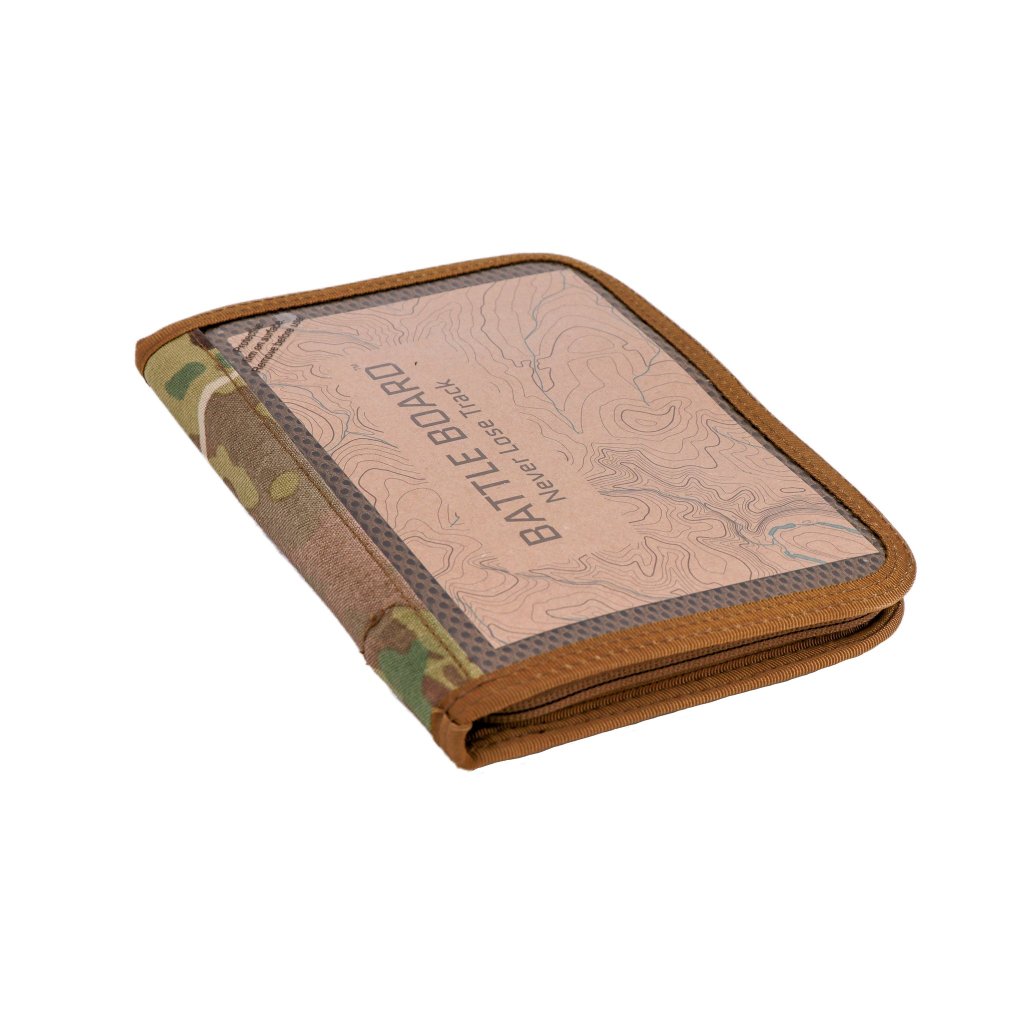
As you know, if you’ve read any of my other posts, I’m a firm believer in keeping paper maps handy for emergencies, and for tactical operations, the ability to “battle-track” on a paper map overlay is crucial.
Just before Christmas, I became aware of the BattleBoard Scout, available at BattleBoard.us.
It’s a small day-planner sized case with a map sleeve that has a polycarbonate cover, so that you can write on a map folded inside. The Scout version is small sized, and optimal for my work as a Certified Fraud Examiner in the private sector, enabling me to carry a map of the area of any surveillance or executive protection detail we are doing and make notes right on it.
Recently, during a major protest event, I used the BattleBoard Scout to battle-track in real time and it was a great tool to understand what was going on during the event.
In this article, first we will discuss the Scout and how I have mine set up, and then we’ll discuss how it was used to conduct tracking.
The Medium Scout is 7×9 inches, which makes it fit perfectly in my Bail-Out Bag or in the front pouch of my backpack.
On the left half inside, there are 7 pen loops. I keep a standard pen, a mechanical pencil, and a Rite In The Rain pen in the loops full time. This area is the only drawback I’ve found, because if you fill all 7 pen loops, with a notebook inside, it doesn’t close evenly. I solved this by only keeping a minimal amount of pens inside, and keeping a pouch of dry erase pens in the bag, next to the Scout.
On the right hand side, there are a few great features. First, there is a lengthwise opening, where you can store documents inside, as well as sliding a notebook back cover in. Inside this pouch, I keep blank 6×8 forms, like Observation Logs for surveillance, Note Sheets, etc. I also keep in here one Rite In The Rain stapled notebook for general note-taking.
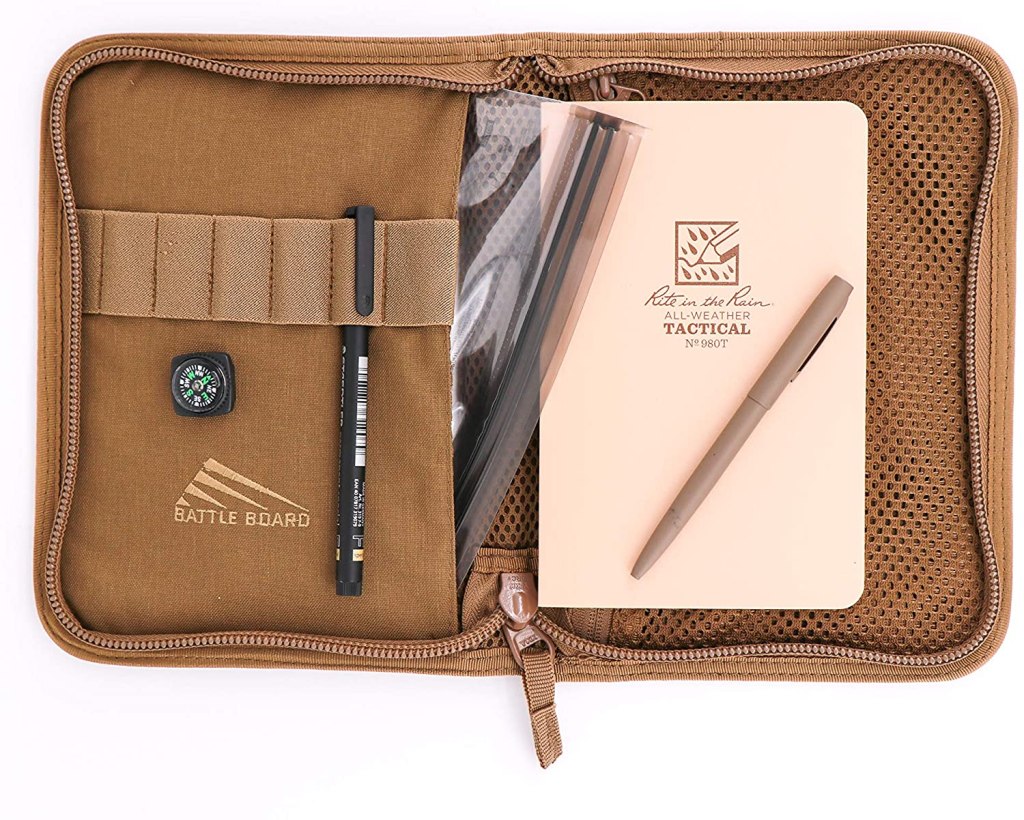
I also slide the back cover of a Rite In The Rain Tactical Fieldbook inside that slot, allowing me to use the book as a general note book as well.
There is also a half-page pouch across the width of the left hand side. Here I store a map protractor and a supply of large index cards for note taking.
The entire Scout is covered in tough nylon, and closes with a durable YKK zipper.
When you are making the purchase, there is an option to add a LokSak, which is a zip-lock waterproof bag to place a map inside. I cannot recommend this highly enough to do it justice. I wavered before making my purchase, but I’m glad that I did. The LokSak makes the map inside more secure from the weather, and makes it easier to slide the map in and out of the polycarbonate window. Also, If you need to view a larger area of the map, you can do that while keeping the map still inside the LokSak, since it fits inside the polycarbonate window folded in half. Additionally, you can write directly on the LokSak with dry erase markers.

I use mine daily as a general notebook, because it’s easy to carry and professional-looking.
During a recent protest event, I put a map of a downtown area inside the polycarbonate window and tracked the event. I was able to list areas of conflict and traffic issues, and relay that data to other team members, maintaining a big picture overview of the situation as the day progressed, using wet erase markers. I chose wet erase so that any markings wouldn’t be accidentally wiped off. At the end of the day, after over 12 hours of tracking, the window was wiped cleaned with nothing more than a paper towel and a drop of water.
Attached is a photo of the completed map. At the beginning of the day, our observation post on top of the parking garage was noted on the map as a blue triangle, and the Capitol grounds were crossed in red to denote the area of the protest. Since the main protest was intended to block traffic, as the event unfolded, I marked off the areas of stopped traffic with red X’s.
Later in the day, as the police began blocking roads leading into the area to reduce the congestion, I marked those areas as black bars with X’s on the map.
The location of the only arrest for the day was marked with a black A.

This map gave us a great situational awareness of how we could get help into the area in an emergency, and on routes out of the area that were not impacted by the protest, in case we needed to evacuate.
In conclusion, on a day when I needed outstanding situational awareness of a potentially volatile situation, the BattleBoard Scout performed admirably and exactly as advertised.
I highly recommend the BattleBoard Scout.
Are You A Good Shepherd?
Shepherds protect those entrusted to their protection.
In the film “American Sniper”, Chris Kyle’s father describes the three types of people in the world: the sheep, the wolves who prey on the sheep, and the sheep dogs who fight the wolves and protect the sheep. That story has spawned a generation of protectors who refer to themselves as a “Sheepdog”, along with a whole line of cool patches about it.
But, what does it really mean?
In the classic film The Patriot, after a stirring speech by young Anne, the Reverend joins the growing American rebellion. When challenged by a townsman, the Reverend replies with my favorite line from the movie: “A Shepherd must tend his flock…and at times…fight off the wolves.”
Reverend Oliver isn’t wrong. There comes a time when we all must decide what we are willing to do to protect those people and ideals that we care about. Each person has to make that decision for themselves.
Fortunately, around 2,000 years ago, Jesus gave us all guidance on what is means to be a Good Shepherd:
“The Good Shepherd
Lays down his life
For the sheep”
-John 10:11b
A true shepherd, a protector of the flock, would lay down their life to protect those entrusted to their care, willingly and without reservation.
Just as important, though, is what the verse doesn’t say. It doesn’t say that the shepherd throws his life away, it says “lays down his life”, implying a conscious decision.
That means making the decision that you will continue the fight, even if it takes your life, not just rashly throwing your life away. It’s a small distinction, that makes all the difference in the world.
Mindset is everything in a life or death struggle. Once you have made the decision to willingly lay down your life for something (even an ideal, such as individual liberty), any set back suddenly becomes a minor issue, rather than a limiting function.
In 1776, 55 men signed a document that concluded with these words:
“And for the support of this Declaration,
With a firm reliance on the protection of Divine Providence,
We mutually pledge to each other our Lives, our Fortunes,
And our sacred Honor.”
-Declaration of Independence
Those men were willing to lay down lives for the protection of the idea that all men are created equal and are endowed by their Creator with certain inalienable rights. Can you image what the world would look like today if those men hadn’t made that decision, when they did?
What things are you willing to lay down your life for? Most of us would say family. The real question is would you lay down your life for an ideal, such as individual liberty? Jesus clearly did, since He laid down His life all of us.
Thousands of men willingly laid down their lives on a June morning in 1944 on a beach in Normandy that most had never heard of, to free people that they had never met, for the sake of an ideal.
A brave King and 300 of his men (yes, I know that truthfully there were more than that) willingly laid down their lives on another stretch of beach at Thermopylae to resist tyranny.
Being willing to die for something doesn’t mean you are seeking death, it simply means that you are willing to pay that price to see the ultimate goal accomplished. I think that is a worthwhile trait.
Too often in our modern society, we “go along to get along” and end up surrendering rights and freedoms, until we are beyond any hope of being able to resist.
This is even a problem in the preparedness community, because so many just focus on how they as a family unit will survive, rather than how a community and its values might survive.
I don’t have the answers, and you won’t find them here.
I am simply encouraging you to look inward, and make a decision today…Am I a Good Shepherd? What am I willing to lay my life down for?
Should I Learn Ground Fighting?
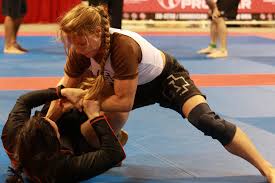
First, let’s dispel the notion of “Ground Fighting”. In real life self-defense, you don’t want to fight on the ground, ever. Fights do end up on the ground, but this isn’t the UFC are you aren’t going for submission.
What you really need to learn is “Ground Survival”, and it’s very different from “Ground Fighting”.
Most ground techniques have their basis in Brazilian Jiu Jitsu or Judo, which are both excellent martial arts. The mistake is confusing either of them with real-life self-defense. Can you use them to defend yourself? Absolutely. Should you rely on always taking a fight to the ground to defend yourself? Absolutely not.
The reason is that even bad guys have friends. It does you no good to take an attacker down and execute a perfect triangle choke from the guard, only to have his buddies take turns soccer-kicking you head.
Also, these systems feature virtually no strikes. Striking is absolutely necessary in self defense.
Don’t get me wrong, both are great martial arts and most other styles steal techniques from them to make up parts of their self-defense curriculum, but studying exclusively ground styles, which are actually sports, will lead to a limitation in a self-defense situation.
I teach a Ground Survival seminar that relies heavily on Brazilian Jiu Jitsu techniques, but rather than focusing on obtaining a submission, I have the students focus on breaking bones, returning to their feet safely, and disengaging from an attacker.
Any attacker who takes you down to the ground is endangering your life and should be treated as a lethal threat. It’s too easy for his accomplices to kick your head, or for him to bash your head on the ground for you to treat it any other way.
Another negative to fighting on the ground is that it severely limits your ability to see your attacker’s hands, and therefore increases the risk of being stabbed or shot.
Many people don’t invest ANY time on learning ground survival, which is an even bigger mistake. I hear it all the time…”I carry a pistol, so I don’t have to roll around on the ground”. That attitude usually results in injury when reality comes calling.
Everyone should learn some ground survival techniques, because you could be taken completely be surprise and end up on the ground. The ability to effect a reversal, damage your attacker, and then safely get up is vital to anyone who is interested in real-life self-defense.
Another important skill that is among the first learned in any ground combat system is the ability to fall safely. I know I’ve said this before, but list the number of times you’ve been attacked versus the number of times you’ve fallen down. The ability to protect your body from damage when falling or being thrown is absolutely essential and saves lives in situations other than just being attacked.
One should train with objective of defeating an attacker, not winning a submission or tap-out. What will happen on the street if you let someone go as soon as they tap out? All your pain compliance is gone and the attacker is able to again inflict damage on you.
Ensure that your goal in training is always to be able to defend yourself and render your attacker unable to inflict further injury on you.
In short, you should never seek to have a real-life fight go to the ground, but you should possess enough ground survival skills to enable you to resist a surprise attack, effect a reversal, inflict damage, and then extend & escape.
Stay safe, train realistically.
How Much Training Do I Need?

The answer to this common question is simple: MORE.
No matter the skill, every physical skill needs practice or the skill will deteriorate over time. This axiom is true whether you are talking about martial arts, gun handling skills, or carpentry.
Don’t take my word on it…Let’s ask Bruce Lee:
“I fear not the man who has practiced 10,000 kicks one time,
but I fear the man who has practiced one kick 10,000 times”
Several thousand years ago, Solomon, the son of King David, wrote in Ecclesiastes:
If the ax is dull and it’s edge unsharpened,
more strength is needed,
but skill will bring success.
Ecclesiastes 10:10
Now, Solomon was talking about swinging an ax to split wood, but the principle is the same.
On average, it takes 25 repetitions just to get the basic mechanics of any physical skill learned. That’s an important point, particularly for those who study martial arts for self defense. In an effort to keep students engaged, traditional martial arts instructors and those who teach self-defense seminars, generally move on after 10-15 repetitions of each technique. The 25 number is just the bare minimum physical muscle memory, not the ability to apply it under stress; that takes THOUSANDS of repetitions.
As a student, practice more repetitions on your own; as an instructor, resist the urge to move on to the next technique until they’ve done at least 25.
A multi-stage technique like a throw or a defensive combination (defense against a front kick, for example), needs that many repetitions OF EACH STEP. For example, for a throw, 25 reps on grabbing the opponent, 25 on unbalancing, 25 on the throw itself, and 25 on the follow-through. Then 25 more repetitions of the whole technique, just to get the basic mechanics down.
As you can see, in order to truly learn to apply martial arts for self-defense (or any physical skill), you need many more repetitions than you are currently getting.
This is where instructors start sending me emails about limited class length. Yes, I know; I’m a martial arts instructor, too. Stop trying to cram so many different things into each class every day. If you slow down the pace and spend more times on repetitions, your students will actually learn more and perform better. You’ll also end up with less complaints from parents, because their children will be performing much better.
A note for instructors about forms training: This applies EVEN MORE here. I can point at entire mornings with Sabomnim Collins of PKSA Karate (www.pksa.com) where I did nothing but 4 steps of one form, until I had it perfect. Stop teaching entire forms in one class.
This idea holds true for gun handling skills. You would never consider taking one defensive firearms class and then carrying a gun every day with no other range time. If you would, I ask that you go turn in your concealed carry license.
If you carry a firearm every day for personal protection, it’s your DUTY & RESPONSIBILITY to continue to train regularly with your defensive firearm. If you don’t, you open yourself up to potential liability, both civil and criminal.
Notice I said “train” and not “shoot”. Shooting implies going to the range, and punching holes in paper for 30 minutes. I can do that at my desk with a 3 hole punch. Training means conducting realistic drills and engaging in scenario based training. For example, rather than just shooting 100 rounds, conduct actual drills. Some examples:
- Failure Drill: Two rounds center mass/one round to the head
- 3/3 Drill: Three rounds into a 3 inch circle
- Response Drill: Partner calls “triangle/circle/square” and you shoot that part of the target
- Emergency Reload: Fire 2 rounds, drop empty mag & insert new mag, then fire 2 more rounds
The possibilities are endless, as long as you use common sense. It’s worth noting that most ranges won’t let you do some more advanced drills, so find somewhere to shoot where you can draw and fire, move and fire, etc.
You can practice tactical reloads standing in your living room watching TV, as long as you aren’t using live ammunition.
A caution about replicating shooting drills that you found on YouTube: ask yourself if this is a skill that you will really use. A friend, whom I love dearly, is always showing me some new drill he’s working on from somewhere like “Uber-Ultra-Super-Tactical Skills” and while they look cool, he will literally never use them. One was shooting while walking on a treadmill at multiple targets. He said “It simulates walking and shooting”. I pointed out that if you are walking in a straight line at a steady pace, you’ll be dead, and that if your attackers are standing perfectly still while you walk at them, they deserve to die. I’m joking and making light, but this is a real problem. Don’t confuse cool things on the internet with real-life physical skills that will save your life.
Another area of physical skills that needs practice is first aid. This is probably the most overlooked skill set in the self-defense and preparedness communities.
Ask yourself this: How times have I have been attacked? How many times have I cut myself or came across a motor vehicle accident? I’m guessing that this will tell you that you’ll use first aid skills more.
I’ve taken probably 20 CPR courses, and I take them every chance I get. Standards change, and some instructor might offer a tweak to my technique that will save a life one day. I have given CPR to someone exactly one time in my life, but it made all of the training worth the time and effort.
If you train in martial arts to defend yourself, it makes sense to learn how to treat common injuries like lacerations or puncture wounds (knife cuts/gunshot), and broken bones. If you carry a firearm for self defense, it’s your responsibility to know how to treat a gunshot wound EFFECTIVELY.
Once you learn the skills of first aid, practice them like every other skill.
At the end of the day, so many people in the self-defense and preparedness community do the bare minimum to develop skills, but that won’t keep the skill at your disposal; constant training will.
Also, so many people allegedly into “preparedness” are really into “buying lots of cool gear”. Gear are just tools; without effective skills, they are a waste of money. I know lots of people who have mountains of gear (that they won’t be able to carry). I like to pick an obscure item from their stash and ask them how it works. They usually have no idea.
Train. Your opposition is.
Know Your Surroundings

An important part of personal safety and tactical awareness is understanding your surroundings and how to find help or refuge in an emergency. That’s our topic today.
What does the Ultimate Tactical Manual (The Bible) say about it? Before Joshua led his people over the River Jordan, he sent out a recon team, telling them:
“…Go, look over the land…
…especially Jericho”
Joshua 1:1
Joshua knew that he shouldn’t just blindly rush into a location with no idea of what was already there, and neither should you. He wanted to know the general area, as well as his specific goal.
Think of the places where you normally go and ask yourself if you can honestly answer these basic questions:
1. How many emergency exits are there?
2. Where is the nearest hospital?
3. What police agency covers the location and where is the nearest station?
4. How do I get out of the parking lot if the main entrance is blocked and what road does that put me out on?
5. In the event of an active shooter, where is there a strong point with only one entrance that I could possibly defend myself and others from?
Knowing the answers to these questions doesn’t make you paranoid, it makes you SAFE. It really doesn’t take long to gather this information and it could easily save your life. In our age of handheld electronic devices, you can literally develop this information in seconds, even on the fly.
Start small; begin with your home, then move on to work and other places you frequent. As you develop the skills, it becomes a fun habit and you get faster at doing it.
Lets talk about how we do it.
MAP STUDY
The first step is called a Map Study. While it can be done on a cell phone, cell service may not be available in an emergency. I’m also not a fan of letting Google know where I am at all times, nor where I plan on going.
I’m a huge proponent of having paper maps. I keep a binder at home filled with paper maps, each opened and folded to an 8 ½ by 11 area of somewhere I frequent. I keep these in sheet protectors, so that they can be written on. This makes it easy for me to grab the applicable map and throw it into my Battle Board (and excellent product that lets you write on maps with dry erase markers – www.battleboard.us) or my clip board with a clear dry-erase cover.
I also recommend buying large-format “gazette” type map books, which are combined outdoor and street maps generally covering an entire state.
Another good source for maps is your local township or county clerk. They generally give free maps to residents of the township or county. I’m not advocating lying to a city official, but I’ve never been asked to produce identification proving that I live or work in a city when getting a free city paper map.
Using the map, learn at least 3 and preferably 4 routes into and out of every area that you frequent, or where you are going. At least one of these routes should avoid major roads and intersections, which will be clogged in an emergency.
While looking at the routes, note any hospitals, fire stations, and police stations along that route. In everyday travels, these are “safe havens” you can use to seek help. In an emergency, they are places where people will congregate and should be avoided.
Maps, especially paper maps, will tell you which police and fire departments respond to the area and where their stations are.
As far as hospitals, note their location and at least 2 routes to the nearest hospital from anywhere you go. Most people say, “An ambulance will take me, why would would I need to know that?”. Review the news coverage from the last few mass shooting incidents; most people arrived at the hospital by private vehicle. I’m not to willing to leave my life in the hands of a government employee, so I’ll ensure that I can get there myself or take others there myself if I have to.
Also study ways you could leave the immediate area on foot; you may have no choice but to leave on foot and come back to your car later.
THE DRIVE-AROUND
When you arrive somewhere, a quick drive around of the building only takes a couple of minutes and you can develop vital information on a drive-around.
First, you can note any graffiti in the rear alley, indicating roughly the propensity for criminal activity in the area.
You can also inspect the fence that surrounds most retail shopping centers – Not because we care about the fencing, but because if you have to escape an active shooter or other threat like fire, it’s good to know that you can get through the fence and not be trapped inside.
You will also see where emergency exits will let you out of the building at. If I escape through an emergency exit, only to be trapped in a locked utility space, I haven’t done myself any good.
You’ll also be able to determine the general security posture of a business by seeing if the back doors are locked & secure, or if they are standing open. You have to decide if you’ll patronize a business that doesn’t even care about their own safety, let alone yours.
Many retail strip centers also have more secure parking for employees in the rear with a walkway out to the main area, which may provide you with a safer place to park with less foot traffic.
PARKING LOT PAUSE
Before getting out of the car to head inside a business, do two things:
1. HANG UP THE PHONE – Also, put it away completely to resist the temptation to scroll social media while you walk, distracting you.
2. Look Around – take a quick panoramic look around the lot before exiting the vehicle. Be honest – you don’t do this right now.
ON SCENE ASSESSMENT
The on-scene assessment is very brief pause you can take anytime you enter a building; it only takes a couple of seconds and could save your life.
As you enter a building, step to the side of the doorway and glance quickly around your surroundings.
1. Note first what people are doing closest to you – people have walked in on robberies.
2. Note the emergency exits (look for the red signs).
3. Note any additional data – for example, in most businesses, a large red dot on a pillar or wall indicates the location of a fire extinguisher.
4. Locate restrooms immediately – not because you need one, but because they are strong points that have a single door, and the walls are generally tile on the inside, giving better protection than drywall.
Remain aware of changes the entire time you are in the location, especially if it’s open to the public.
REMAINING ALERT ON DEPARTURE
Before leaving a building, stop just inside the door and look outside first (there’s a reason the door is made of glass), to make sure that you aren’t blindly stepping out into a bad situation.
Try to see the entire route to your car.
While walking, resist the temptation to check your phone or make phone calls.
Remain alert the entire way to your car.
Stop in the driving aisle, before stepping between your car and the one next to it. Take a look between the cars before stepping in to that enclosed space. If you don’t and someone attacks you between the cars, you can only get away in one direction. Stopping in the aisle, you have many other escape options.
Once inside the car, lock the doors before doing anything else.
A side note on the remote unlock feature on your car – set it so that one press unlocks only the driver’s side door. Many default to unlocking all doors, but that’s unsafe, especially if you’re alone.
CONCLUSION
Planning ahead is smart, only takes a few minutes, and is a good habit to get into.
Take a few minutes to plan ahead, and you may well save your life.
Guarding Your Information

Our modern social media landscape has convinced us all to share every small detail of our lives with people we haven’t spoken to in person in years. Think about the implications of that.
Samuel Culper, of the outstanding website Forward Observer, has this to say about Social Media: “We should farm data from it, but never plant”.
Reaching back even farther, to the times of Solomon, the best advice book ever written has this gem for us:
Those who guard their lips preserve their lives,
but those who speak rashly will come to ruin.
Proverbs 13:3
As my friend best-selling author Ivan Throne says, “Concealment is the Second Law”. Every time you are tempted to reveal some personal data, do a risk assessment on it. What is the benefit of sharing this information, versus the risk that exposing it will cause. It doesn’t have to be just about safety. Consider this….you make a social media post about opening a business, what are the chances that your competition will then start actions to thwart your plans? A vindictive neighbor? A government bureaucrat?
It’s perfectly fine to want to share information with your friends, but think about all of the information that you are putting out there. Many people essentially “narrate their lives” on social media, which can put your property and your safety at risk.
It’s not only social media that is a risk, but so is social engineering and general conversation.
Elicitation is a technique that spies use to get information from people without them knowing it, and it happens every day by criminals, too, they just don’t use the fancy name.
Let me give a quick example from an investigation I was involved in. A restaurant chain in a heavily Middle-Eastern community in Detroit had their waitresses engage in conversation with customers, learning their travel plans back to the Middle East. When they found a customer who was leaving the country soon who paid with a credit card, they used a spare credit card machine to lift the “third track” off the magnetic stripe on the credit card. This track contains name and address data. The leaders of the ring would then conduct a burglary while the customer was out of the country and not only steal high value things, but they would also sell the furniture and decorations online.
Social engineering is tricking you into giving up information that can be used to guess your online passwords. The most common variation can be seen on Facebook dozens of times every single day. It goes like this….”Let’s see who will do this with me” and it then proceeds to ask you to complete a series of seemingly innocuous questions about your life. Within those questions, you’ll find commonly used “forgot your password” security questions, and you are WILLINGLY giving everyone the ability to hack into your life.
I’ve seen a variation with one Twitter user who claims to be randomly asking questions like “What’s you favorite food” and “Where would you like to go on vacation”. Intermixed every so often is a security question type question. He’s counting on you getting used to commenting on the random questions and blindly answering security question answers.
Another area that invites risk is “checking in” or “tagging” yourself in locations. If I tag myself at a movie theater, I’ve just told the world exactly where I can be found for the next couple of hours. More importantly, I’ve told them where I’m NOT, such as my home. The best strategy in this area is to not do it all, but if you feel that you must, tag yourself as you are leaving the location.
We all want social media to portray our lives as fun-filled and happy, so many people spend their days posting photos of their activities. Just like tagging or checking in, you’re telling the world where you can and cannot be found in real time. I understand that you want the world to see your awesome cruise experience, but you can post those photos as soon as you get home instead of telling everyone that you are in Belize with no plan to get home for several days.
Have you ever noticed how after you go somewhere or you discuss something with friends, you instantly start getting ads about what you discussed? It’s called surveillance capitalism and it’s a huge business. Open your phone’s settings and check “app permissions”. You’ll be surprised at how many apps can access your location for no other purpose than to sell that data. Yes, they are selling surveillance reports on everywhere you go. Turn these settings off, or to “only while using the app”. There is no reason for you to let some random company profit off your location data and there is absolutely no reason why your Scrabble game ever needs to know your location or record audio.
At this point, many people I advise tell me “But I have location turned off on my phone”. I laugh at that comment. Your travels are Google or Apple’s biggest money-making product…do you really think they’ll let you turn it off? Tucker Carlson ran a segment where they took a phone that had location turned off and another phone that was TURNED OFF COMPLETELY and traveled around Washington DC for a day. At the end of the day, they checked the phones, and both were sending location data to Google, despite the settings and the one phone being turned off.
During the current CoronaVirus pandemic, Governor Gretchen Whitmer said during a press briefing that she had received location data from Google about the movements of Michigan residents to determine if residents were abiding by her Stay Home Order. Do you remember giving your consent to that government search of your private data? You didn’t have to , because Google violated your 4th Amendment rights, and they aren’t bound by the Constitution.
The only way to be sure that a phone isn’t sending location data is to remove the battery. Did you notice that you can no longer remove the battery? That’s on purpose; your location data is their biggest money-making product.
Have you noticed that whenever you get a text message or an email now, you get a list of suggested responses? That’s not for your convenience; it’s because they are reading your messages looking for information to sell.
Try this experiment: open your photo gallery and click “Search” type in anything you’ve taken a photo of and hit enter. If you typed dogs, it will show you every dog photo. Again, this isn’t for convenience, it’s because they are analyzing your photos to see what they can market to you.
Check Facebook. Look at your security settings for a tab call “Off Facebook Data”. It’s default setting is “on”, allowing Facebook to capture all your data on your phone, including your location data, for them to sell. Change it to “never” and delete the history.
The only way currently to ensure that your phone isn’t recording your audio (they really do, read the fine print), video (yes, that too), and location, is to store it turned off in a Farady cage except when you are actually using it.
Privacy should be a major concern to you. Many of my clients say “I have nothing to hide, so I don’t care”. Your personal, physical safety is worth protecting and if the data can be sold to advertisers, it can be hacked and downloaded by bad actors.
Guard not only your lips, but also your digital data as well.
Fiercely guard your private information. Share online sparingly.
Mindset – Should I Train In Unarmed Self Defense?
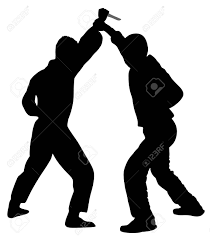
In this modern era of “Shall-Issue” Concealed Carry Licenses, a common question that arises is, should I train in unarmed self defense?
The answer is a resounding yes for a few reasons:
- You can’t carry a gun or a knife everywhere, even with a permit.
- Not every threat justifies the immediate use of deadly force.
- Just because I “can” use a firearm in a situation, doesn’t mean I “should” (crowded area/neighborhood).
- You’ll never never leave you arms and legs at home or in the car.
But just as important as these considerations, is the consideration of “mindset”. In his book, “Tactical Manual”, Max from Max Velocity Tactical lists unarmed self-defense skills as among the areas you need to develop in order to obtain a Warrior Mindset. You can find his outstanding book on Amazon or at http://www.maxvelocitytactical.com.
Similarly, Israeli Krav Maga Association Chief Instructor David Kahn, whose books & videos I highly recommend (Amazon), quotes that age-old Tactical Manual known as the Bible in his book, “Krav Maga – Professional Tactics”:
“Blessed be the Lord, my rock,
who trains my hands for battle,
and my fingers for war”
Psalms 144:1
To me, that sounds like a Biblical command to obtain and, more importantly, retain unarmed self-defense skills.
But, how one obtains these skills is critically important. A YouTube search will get you hours of videos on self defense skills. Nearly every second of it will be unrealistic garbage that has exactly no relavence to real-life skill.
I recommend taking a course from QUALIFIED instructor. Most martial arts have organizations that certify instructors and require some sort of standards. Beware of the guy who has created his own system and declared himself the 10th-Degree World Supreme Grand Dragon Master. Find a reputable organization and seek out reviews.
Books are a great source, but you must practice the skills and you really need a knowledgeable instructor to help ensure that you are actually applying the techniques correctly and realistically. Many martial arts schools teach complicated and great-looking self defense techniques that will never actually work because either you won’t remember it or you won’t be wearing a martial arts uniform.
Video training with a qualified instructor is a great idea and again, make sure that the instructor is qualified. This training will also most likely require a training partner.
It’s important to realize the difference between theoretical training and real life. Let me give you a quick illustration. I once hired a martial arts Master I had trained with to work with me as a retail loss prevention investigator. Once faced with an actual suspect resisting arrest and truly trying to assault him, he learned that there was a huge difference between performance in a controlled class environment and on the street. Now, the two men who trained us (recently featured on the cover of a major martial arts magazine) made sure that our training would stand up on the street, but the street is less forgiving than a classroom.
The point is that you should train for the street, not for belt tests. Ironically, training for the street will improve your performance on belt tests, but the opposite will get you hurt.
Another reason to train in unarmed self defense is that in a self-defense situation, you may not ever get the chance to draw a gun or a knife, if your attacker has surprised you. Having skills will enable you to be able to deal with the immediate attack and develop time and space to introduce a defensive tool.
Unarmed self defense skill also develops awareness. That awareness will keep you looking for threats and hopefully avoiding or mitigating them before they can harm you or anyone else.
Another area that unarmed self-defense skills develops is self confidence. Once you are aware that you can defend yourself against attacks, you will feel less afraid and project confidence. Criminals profile their victims, and one who appears aware and projects confidence will not be targeted.
A criminal’s goal at the end of the day is to go home, and if he is confronted by someone ready, willing, and able to defend themselves, he will most likely move on to another victim.
As it says in the Tactical Handbook of Life (the Bible)…
“Resist the Devil and he will flee from you”
James 4:7b
An important self defense skill everyone needs to know is how to fall properly. That skill is the most commonly used self protection skill. Answer this question: How many times have you been attacked versus how many times have you fallen down? I’m betting that you’ve fallen down many more times. Nearly all martial arts and self-defense schools teach falling, because it’s such an essential skill and the odds are that you will fall down at some point in your life. Having the skills to protect yourself from injury while falling will help everyone.
In short, you should develop unarmed self defense not just because they might come in handy, but because they fully develop you into the Warrior Mindset.
As Supreme Grand Master Hwang Kee (Tang Soo Do) said, “When there is preparation, there is no fear”.
Having What You Need, When You Need It
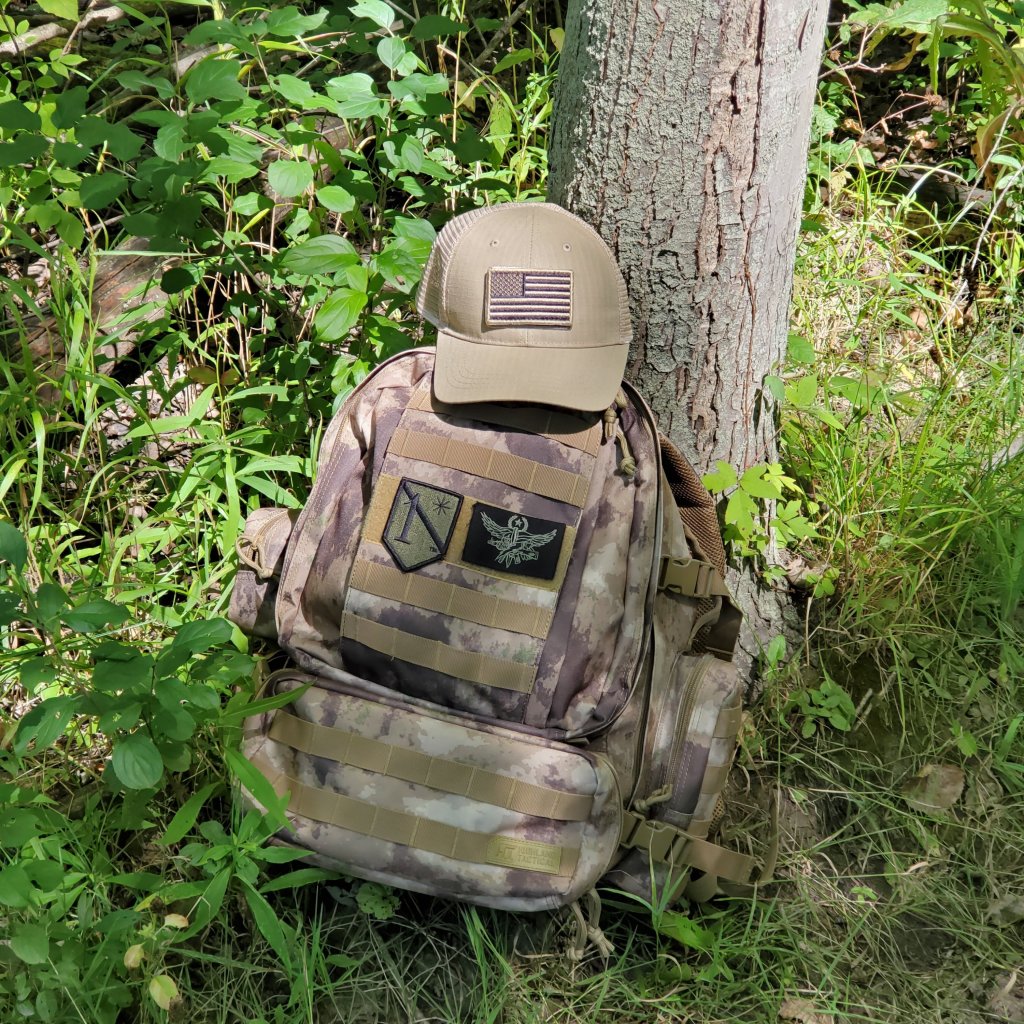
David asked Ahimelek, “Don’t you have a spear or a sword here? I haven’t brought my sword or any other weapon, because the King’s mission was urgent”
1 Samuel 21:8
Have you ever needed something and not had it? Gotten to a meeting and realized you left your notes or your laptop at home?
The same thing can happen to us in an emergency. I know many people who are into preparedness and readiness, but never take an emergency bag with them, because they aren’t planning on having an emergency.
Here’s an actual conversation I had recently:
Her: “Why do you have a tourniquet in your backpack?”
Me: “In case I get shot. What are you going to do if you get shot?”
Her: “I don’t plan on getting shot.”
Me: “No one PLANS on getting shot.”
As funny as this is, this mindset prevails in daily life. People prepare and organize gear, but then leave home without any extra gear, because there is no emergency at the time.
Today, I want to go over what I carry everyday, in a backpack in the rear of my SUV. This is my EDC bag, and, for my fellow veterans, it would also double as my patrol/assault pack. I carry it when I go hunting, and it’s actually part of my fitness routine, as I ruck carrying it.
The bag itself is from Highland Tactical (www.hltactical.com). I use the Apollo backpack. Their gear is great and reasonably priced. I also use their Ranger Duffel as my outdoor-gear bag, a Squad 1.0 Duffel as an overnight bag, and their Mobility Waist Pack as a first aid kit (because it attaches to the other bags easily).
In a molle-attached pouch, I have a first aid kit. Inside this kit, I carry some band-aids, gauze, antibiotic, a pressure dressing, some gloves, and a CPR mask. Additionally, because I’m allergic to bee stings, I carry a small packet of Benadryl. Behind the first aid kit, I have a pair of EMT Shears secured.
Below that pouch, there is another small pouch, and in that I have a pistol cleaning kit, insect repellent, and a camouflage face paint compact (you never know).
On the opposite side of the pack, there is a large pouch. Inside that pouch, I carry a few basic tools, wrapped inside a green camping towel strip, to reduce noise. The tools are a small hand shovel, a folding saw, and a pair of small multi-tools.
There is a pouch at the bottom of the main pack and I keep gear I might need quick access to in there. It contains:
- Shemagh: Can be used as a face cover, a scarf, or a bandage
- Gloves
- Rifle Cleaning Kit
- Wet Start Strikable Tinder: Great product made by Uco (www.ucogear.com)
- StormProof Matches: More Uco gear
- Ferrocerium Rod & Striker: Yet another great Uco item
- Beverage Powder/MRE Sandwich: Emergency food that has a long shelf life
- Sanitizing Hand Wipes
- Camouflage Face Mask
- Knife Sharpening Stone
- Cooling Towel: In Realtree Camouflage
The side zip pouch on the back of the bag is also used for items that may be needed quickly:
- One cut-down MRE: Removed from the original package & taped together to save space
- P-38/P-51 Can Openers: Two sizes to open any can
- USF Tactical Spork: Any eating utensil is better than none, and this has a bottle opener, can opener, a screwdriver, and 3 small wrenches.
- 2 pouches of USCG approved emergency drinking water
- Package of Flushable Wipes: Incredibly useful and biodegradable
- Lensatic Engineering Compass
The smaller compartment contains:
- Rite in the Rain Notebook and Pen
- Several pens
- Index cards in a Zip-Lock baggie
- MRE cheese & crackers
- Small penlight
- 10-inch notebook tablet
Inside the main compartment, there is plenty of space for day or mission specific gear, but the permanent items in the main compartment are:
- Esbitt Solid-Fuel Stove: Several fuel tablets are stored inside the stove
- USMC Issue Poncho-Liner: A great emergency blanket
- Propper H2O Waterproof Pants: Rain Gear
- Propper H20 Waterproof Parka Outer Shell: Rain gear
- Spare Under Garments: Extra T Shirt, underwear, and socks stored in a Zip-Lock, these can prevent hypothermia in an emergency
- USMC Issue Poncho: Makes an excellent emergency shelter if needed
- 75’ of Paracord: Paracord is handy in all kinds of situations
- Spare trauma kit
- 2 MRE Protein Shakes: Perfect emergency food source
Attached to the outside I have three carabiners, a solar phone charging bank, and a whistle/thermometer. There is also a fixed blade knife that is attached to the large side pouch.
Attached to the shoulder strap on the left side (my weak side) I have a Jobsmart high-intensity angle head flashlight from Tractor Supply. It also has a magnetic base.
The weight of the pack is very manageable at 25 pounds or so, and it contains the bare essentials to survive in most situations for at least 72 hours.
Imagine being at work on the other side of a metro area when the power goes out, and cars don’t start (EMP Scenario). This backpack could very well be the difference between making it home alive or not.
The most important note though, is that you must carry it in the vehicle EVERY DAY. It’s easiest just to leave it in the car, but I bring it inside every night, because you don’t really know when you’ll need it.
Check the contents regularly, especially any emergency food (expiration dates). I sometimes change out the items seasonally, like adding a sweater or the parka’s liner, although I usually wear the liner as a jacket year-round.
Don’t be like David in the verse above and rush out to accomplish an urgent mission, yet not have the gear you need to handle the situation.
Should I Train to Fight With A Knife?
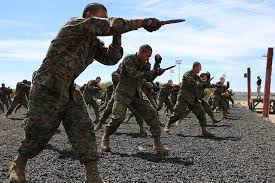
This question comes up often in the current climate of concealed firearm permits…Should I train to fight with a knife, since guns are so common?
The answer is a resounding yes, for a few reasons. Let’s discuss why first, then I’ll give some practical exercises and resources.
Reasons to train with a knife:
- There are many places that you can’t carry a gun, but that you can carry a knife.
- Knives don’t jam or run out of ammunition.
- Knives have a multitude of other uses and are generally good to have around (for example, whether your evening involves cutting cheese or stabbing an attacker, a knife is HANDY).
- Knives can be found in many places to pick up and use for self-defense.
- Knives are psychologically frightening to attackers.
- Skill with a knife, like unarmed defense skills, builds self-confidence and a warrior mindset/ethos.
The Three Blade Rule
A common tactical precept is the “Three Blade Rule”. Generally, you should have these three tools available at all times. There aren’t many situations which one of these three can’t solve for you.
- Folding Knife – Generally a pocket folder, used for everyday tasks, but can be used for self defense. Carried in your pocket.
- Multi-Tool – Also great for everyday tasks, and has limited self defense utility, but it could be used. I carry two Gerber multi-tools in my EDC laptop bag, along with a second folding knife.
- Fixed Blade Knife – A full sized fighting knife. I use a Gerber LMF Infantry knife or a KaBar USMC Fighting Knife. I keep this in my emergency backpack in the back of my SUV.
Training
First, the very best defense against an attacker who has a knife is a firearm.
Second, any attack with a knife is deadly force, so respond accordingly.
Take a real knife course from a real knife instructor. There are thousands of videos on the internet about the topic, and nearly all of them are garbage.
Go and attend a knife fighting course at a professional facility, or find a school that specializes in it, like Filipino Martial Arts schools.
Another good source of instruction are Krav Maga Instructors, as they have a reality-based knife fighting program, born of necessity for Israeli soldiers.
A great book on the topic with outstanding techniques is the Complete Michael Echanis Collection. It is based on the Korean Martial Art of Hwa Rang Do, and the book includes knife defense, knife combat, and stick combat.
Solo training is possible, once you’ve learned the basics with an instructor.
Don’t work on fancy defense against a knife moves, because if you’re ever really in a knife combat situation, OFFENSE is the ONLY way to win. Keeping the opponent on defense keeps him from sticking the pointy end in you. Learn the 8 basic slashes and 9 basic thrusts and you’ll be able to develop hundreds of offensive combinations.
Again, don’t get stuck in systems that train exclusively on responding to the attackers attack…If you miss the block and he stabs or slashes you, you’ll never be able to show off that cool deflection/jump spinning crescent kick combination because you’ll be too busy bleeding out.
Learn to attack with a knife because action is faster than reaction and if I can keep my attacker focused on defending, he can’t think about attacking me.
One knife skill I will mention, however, because a lot of schools don’t due to liability. I’m more interested in your survival. Cutting out refers to, once you’ve conducted a thrust into an opponent, twist the blade 180 degrees. If you inserted the blade palm down, twist til your palm is up, and vice-versa. This creates a larger wound channel, causing more bleeding and pain, and prevents suction from holding your knife. I don’t say this because I want you to give grievous wounds to your attacker, I say it because a larger wound may end his attack before he gets hurt worse, or you do.
Drills
I’m not going to go into the 8 angles of attack or 9 basic thrusts, because you need instructor interaction to learn those, but there are some basic drills you can use with a kicking bag to develop your skills.
Buy a good training knife that resembles your EDC knife.
When building combinations, it’s easiest to put the next technique where the last one ended. For example, after a slash attack, thrust (stab) at the end of the slash. Conversely, after a thrust, drag the blade in a slash from where the thrust was. Combine two or three techniques.
- Practice slashing and thrusting combinations on the bag while keeping your empty hand covering your body, static at first, to develop muscle memory.
- Advance to stepping to the outside and parrying with the weak hand across your whole center-line, followed by slash and thrust combinations from a 45 degree angle to the bag, to simulate stepping outside of the attack.
- Once you’ve mastered that, incorporate low-line kicks to the knee, thigh, or solar-plexus between the parry and knife combination.
Again, see an instructor to learn actual physical skills (no, not YouTube).
Laws
It’s vital that you completely understand the local knife laws where you live and where you work. They can vary widely from city to city.
In conclusion, knife training should absolutely be a part of your training regimen and you should learn those skills at first from an actual instructor who knows what they are doing. Keep training to retain those skills.
Anyone interested in self-defense should strive, as they say in the Marine Corps Martial Arts Program, to become a “Master At Arms”, knowing the use of every defensive tool from empty hands and feet out to a rifle at 500 meters.
The Importance of Outdoor Skills

“…Go out into the hill country and bring back branches from olive and wild olive trees, and from myrtles, palms, and shade trees to make temporary shelters…”
Nehemiah 8:15b
If you were stranded in woods and had to build a shelter, could you? Could you build a fire?
Just a couple of generations ago, every person in Western Civilization would be able to say yes. Not so today.
Just over 10 years ago, I went along with my son’s Boy Scout troop on a camp out, expecting a nostalgic return to the woods, like in my youth. These “Scouts” could only cook on a modern grill and were mostly worried about battery life on their electronics.
After some soul-searching and a long tirade by me, the Scout Master and I decided that the next camping trip would be a “When the old guys were Scouts trip”. Despite the complaints at the outset, the boys had a great time once they learned real outdoor skills like cooking with no modern conveniences and what a true backwoods hike with map and compass was like.
The point of this is that in our current situation, what would you do if the power and gas stopped working? Could you cook, ensure your water was safe, and prepare a shelter? For the majority of Americans, the answer is a resounding no.
With a little reading, a lot practice, and a sense of adventure, everyone can return to these roots. You’re here because for millennia, humans could do all these things.
An excellent book to get started learning basic skills is the SAS Survival Handbook, by John “Lofty” Wiseman.
The first exercise in this is something I first saw on Viking Preparedness, by Pastor Joe Fox (an outstanding resource and a good author as well). Pack a backpack, walk out one hour into the woods (not a park). Once you are there, make a fire and prepare a meal. After the meal, pack up your waste and walk the one hour back. Simple, right? But do you think the average person would ever consider it? This simple test is a first step to self-reliance and self-confidence.
When you first learned how to drive, how did you get more comfortable driving and develop skills? By overcoming your fears, getting out there, and driving. Outdoor skills, or as we called it in the Marines to sound even tougher, rough country skills, are learned through practice.
The basics everyone should strive to learn are:
- Fire Building – The ability to build a fire gives warmth, light, a way to dry things, and a way to cook.
- Water Procurement – Not just how to find water, but also how to make it safe to drink. Even tap water, if the power grid is down, should be made safe before you ingest it.
- Shelter Building – The ability to build a shelter to keep you out of the elements is critical. As Nehemiah pointed out in the verse, natural materials should be used, and they’ll not only keep you dry & warm, but hidden as well.
- Land Navigation – Even avid outdoor people have become over-reliant on GPS. I’ve heard the argument that even if the power goes out here, the satellites will still work, but the truth is that if the ground stations don’t have power, you’ll get false readings. Learn how to navigate using a GOOD compass and a paper map. Paper maps are invaluable.
- First Aid – Yes, first aid. There is really no excuse for not knowing advanced first aid in our modern society. The learning resources are there and are generally free. The resources are widely available. I’m not a nurse or an EMT but I know how to treat most common and many uncommon injuries, including how to reduce tension pneumothorax, and how to run an IV. Get quality training and build a first aid kit.
After learning the basic skills, develop an “emergency bag” for yourself and carry it everywhere (mine is in my SUV). In my emergency bag I have:
- A USMC issue wool sweater – This will keep you warm even when wet.
- Rugged outdoor pants and shirt – If I’m dressed for work, I’m not dressed for survival.
- Boots – Dress shoes are not practical anywhere but the office.
- Rain Gear – Both a poncho and a rain suit…the poncho has many uses.
- An entrenching tool – collapsible shovel. Mine also has a knife and saw blade.
- Two tarps and Paracord – I can make a pretty deluxe shelter with 2 tarps held up by paracord.
- Shemagh – Can be used as a scarf, a bandage, a signal flag, or a mask.
- Fire Starting Gear – Storm-proof matches, tinder that lights when wet, and a ferrocerium rod/striker.
- Fixed Blade Knife – Always useful.
- Food – I keep a few non-perishable and canned items (usually backpacking food) in the bag.
- State-Wide map book and compass.
I also keep a separate first aid kit in back of the SUV, along with my personal ruck (another emergency/tactical kit, but that’s another article….).
Once you’ve built the kit, it does you NO GOOD unless it’s always near you. Just like carrying self-defense tools, you don’t know what day a disaster may strike and the coolest gear bag ever won’t save you if it’s at home and you’re at work.
Frequently recheck the bag and adjust spare clothing seasonally. Watch expiration dates on food.
Get started today, learning these skills will be fun, build self-confidence, and just might save your life.
As Nehemiah said, “Go out into the hill country”….
Solo Training During Quarantine
Maintaining your self-defense skills is important at all times, and it’s critical during the current Stay-At-Home Order situation. Police departments have advised that they are limiting services and avoiding non-essential public contact, so you are truly on your own.
Training without a partner can be just as effective as training with a partner.
When we are talking about physical unarmed defense skills, muscle memory is the most important thing, and that can be maintained with solo training.
What are the best solo training drills? I don’t claim to be THE authority, but let’s use history as our guide. For thousands of years, martial arts students have used forms training to learn unarmed defense skills.
But, what is forms training? Is it only practicing traditional forms? In his classic book “Knife Fighting For Combat”, Hwa Rang Do Master Michael D Echanis said that a form is any preset or pre-planned movement. Using this definition, every combination or self-defense technique can be considered a form. Yes, using a partner develops timing, but the actual mechanics and muscle memory can be developed by “free-form” solo training.
Let me present a couple of techniques to illustrate this:
1. Leg Sweep Takedown (Osoto-Gari)
- This technique is generally taught as a defense against a punch, so the first step in solo training is stepping inside of the attack and blocking (either a high block or in to out block).
- Simulate seizing the attacking wrist and opposite shoulder.
- Simulate pulling the seized wrist and pushing the opposite shoulder as you simulate sweeping the leg – but exaggerate the leg lifting behind you after the sweep, to ensure that in actual combat you remove the attackers foot from the ground.
2. One Step Sparring – defense against a single punch
- All One-Steps lend themselves easily to free form training, and that is generally the first step in learning them.
- Begin with the defense – In this example, stepping outside with the left foot, while executing an in to out open hand block with the right hand.
- Simulate grabbing the attacking wrist while executing a right leg roundhouse kick to the solar plexus.
- Simulate an open hand forearm attack with the left hand to the attackers elbow joint.
- End with a reverse elbow across strike with the right elbow to the attackers face.
As you can see, both are very practical self defense combinations that can be trained without a partner very effectively.
The examples also show that you can take any martial arts technique and break it down into it’s component parts, and practice them as “free forms”, allowing you to maintain your skills.
The next issue is repetition. Most people in self-defense training do far too FEW repetitions. Some who knows 75 techniques, but only does 5 repetitions of each once a week, won’t be able to use any of them in real life. Modern McDojo schools encourage this by trying to fit too many different techniques into a single 45-60 minute class, hoping not to lose the classes attention. Every time you train on any technique, 25 repetitions should be the bare minimum. For instructors, imagine how much better your students would be at leg sweeps or a one-step technique (Il Soo Sik) if you spent an entire class period on just one technique, rather than teaching four. For a technique to become instinctive, you need over 1000 repetitions… doing them 5 at a time, you’ll never get there.
Visualization is an essential skill. Visualizing every free form combination as a defense against an actual attacker will indeed develop the skills for you. In Korean Martial Arts, visualization is referred to as Che Myun Sul and involves visualizing every repetition as an actual attack. Your mind is an amazing tool and it will treat these solo repetitions as with a partner.
I’m not advocating replacing partner training, just the opposite. The two compliment each other, not contradict. Solo training is not a substitute for training with a partner, but it is a way to maintain your skills and some fitness during these times of “social distancing”.
Since many have become used to my tying tactical training to the Bible, let’s remember Psalm 144:1:
Praise be to the Lord my Rock,
who trains my hands for war,
my fingers for battle.
Train. Your opposition is.
Surrendering Freedom
It is for freedom that Christ has set us free.
Stand firm, then, and do not let yourselves be burdened again by a yoke of slavery.
Galatians 5:1
Paul wrote those words just under 2,000 years ago, and today, as I sit at home because the government has ordered us all to, they are equally relevant.
Our ancestors came here because they were oppressed at home. They were told that they couldn’t worship as they wished and that they must do the bidding of the state.
The men who first established colonies here were Men of God, Warriors of the Spirit, looking for the freedom to worship and to live as they pleased.
As the years wore on, the Imperial government began restricting rights of the colonists. They banned public gatherings, limited freedom of movement, and even attempted to confiscate firearms. Does any of this sound familiar?
We threw off the yoke of slavery to our imperial masters then and established a nation based upon the rights of the PEOPLE, rather than the powers of the GOVERNMENT, which was unheard of at that time.
Some 60 years later, we had an internal struggle. Most modern teachings state that we were trying to fight slavery, but that was only part of the larger issue. The Civil War was caused because of the Federal Government increasing it’s control over the authority of the states, using the guise of fighting slavery, a noble and just cause, to trample State’s rights.
I’m not disputing slavery…It was a vile practice that God detests and was ended by Western Civilization first. It is still practiced in Africa, the Middle East, and Asia to this day.
What I am saying is that the government began taking control over many aspects of everyday life, in the name of lofty social causes (sound familiar?).
Today, Americans are no longer the brave men who fought for their own freedom in the 1700s, fought against Muslim slave traders and against slavery here in the 1800s, or even the brave men who stormed Pacific Islands and Normandy, to free those held under oppression and slavery.
We’ve become so accustomed to our modern conveniences that as our state Governors are issuing unconstitutional orders, trampling our rights, half of the country is cheering them on, and the other half is too lazy to resist, other than with snarky tweets.
There is no Constitutional authority for the government to order businesses to close or to order you to stay home. The orders to not assemble and to not attend church both are SPECIFICALLY prohibited by the Constitution.
The government is now also using the Defense Production Act to seize LAWFULLY purchased items if they deem that you have more than you need. Now, I’m aware that the first cases were people who were price gouging, which is immoral. However, you have to see how this can impact people who planned ahead and are sitting on a stockpile of food. That Act allows the government to seize your property NOW and give you due process (fair market value) at some point in the future.
Many will argue that laws being used have to be Constitutional because they are on the books…but that isn’t true. No law is inherently Constitutional, that’s why we have a Supreme Court.
In Marbury v Madison, the Supreme Court stated that “act of the Legislature, repugnant to the Constitution, is void” and that “the Constitution is superior to ordinary act of the Legislature”. These orders and emergency laws banning church, free movement, right to assemble, and allowing the seizure of your property, all violate the 14th Amendment:
“…No State shall make or enforce any law which shall abridge the privileges or immunities of Citizens of the United States; nor shall any State deprive any person of life, liberty, or property, without due process of law…”
Ordering me to remain in home seems to violate the whole thing. I understand that there is indeed a deadly virus out there, but we don’t surrender our freedoms out of fear that something MIGHT happen to us. I don’t see a clause about “unless there is a virus” in the Constitution.
Paul warned us 2,000 years ago not to take up the yoke of slavery again….yet here we are, sitting in our homes, not attending church, not gathering in groups of more than 10.
Everyone should consider Paul’s warning and ask yourself…Where will I draw the line? What am I willing to do to ensure all of our freedom?
On Being Ready – Nehemiah

Nehemiah is one of my favorite characters and one of the first people to live a tactical/preparedness lifestyle. He was appointed as the governor of Jerusalem and was sent to rebuild it by the King.
There was just one problem though….Jerusalem was surrounded by people who didn’t want to see it rebuilt. Does that sound familiar?
How did Nehemiah and his people keep safe? With today’s piece of Tactical Wisdom From the Bible:
From that day on, half of my men did the work, while the other half were equipped with spears, shields, bows and armor…
Nehemiah 4:16a
This principle is still used today by most modern military forces…half the force engaging in security, while the remainder works or rests.
How can we apply this to our daily lives?
First, ensure, like Nehemiah did, that your home is secure to begin with. Good locks, lighting, proper landscaping, and maybe even a few cameras are a good start. Having a safe and secure storage method for defensive firearms, while keeping them readily accessible in an emergency is also a good start.
For example, when I’m home, if I’m in the home office, a firearm is either in a holster on my hip or in a top desk drawer. At bedtime, it moves to the secure nightstand. That simple, and I’m armed 100 percent of the time while at home.
If leaving the home, all firearms are securely locked up.
Second, ensure that wherever you go, you are as armed as you lawfully can be. How that looks depends on your lifestyle and the local legal environment.
It may mean a concealed pistol license (did you know I offer that class?) and a handgun. Know your state’s odd quirks of gun laws before doing this. As an example, in Michigan, you can’t carry a concealed gun into a bank, even if licensed, but if licensed to carry, you CAN open carry a handgun into the bank, but an unlicensed person can’t (I know, it makes zero sense).
Most state and local government offices and all federal offices (including the post office) ban guns, but you can generally carry at least a pocket knife inside them. Invest in a good knife, not a cheap one, you are betting your life on it. Know local knife laws as well.
Airports, airplanes, and courthouses poses problems in that knives are banned in them as well. Solution…get a tactical pen and know how to use it. A caution here, though, don’t get the ultra-tactical looking ones… a simple, solid metal pen is sufficient. While I’ve never had one of any type seized, and I’ve flown a lot, I did have one spirited discussion…so keep it low-key.
When leaving the house, if you have a concealed carry license, your minimum standard should be a firearm and at least one spare magazine, a quality pocket knife, a high-intensity tactical flashlight, and a tactical pen.
A note about flashlights…buy a high quality one. Many places sell what they call “tactical high-intensity flashlights”, but they aren’t designed for self defense or use with a firearm. I only use Surefire, Streamlight, or Smith & Wesson lights myself, but there are many other brands. You’re betting your life on it, make an INVESTMENT, not a purchase.
Also, if you truly believe in a preparedness or tactical lifestyle, a well-stocked first aid kit is an absolute requirement EVERY SINGLE DAY. I’ve used the first aid kit more than any other item.
Many people say, “Aren’t you being paranoid?” or “What do you need that for?”. My first answer is that it’s no one’s business but mine. The best answer is that you can’t possibly know where or when you’ll have to defend your life (or that of someone else).
It’s easy to say, “But I’m just running to the gas station” and not go to the trouble, but you are statistically more at risk at the gas station than at home.
Also, the worst possible tool to need, is the one you don’t have with you when you need it. If you forget a credit card, or a set of keys, you can can run back home and get it, but you’ll be seriously injured (or dead) if you need a self defense tool and left it at home because it’s a hassle.
Take the thousands of years old advice of my friend Nehemiah, and always have your sword, spear, and shield at the ready.
Having a Team
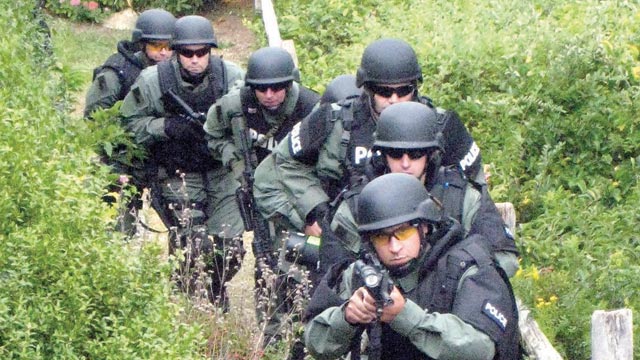
“Though one may be overpowered, two can defend themselves,
a cord of three strands is not easily broken”
– Ecclesiates 4:12
Many people in the preparedness and tactical training community train to defend themselves as a single entity in a Without Rule of Law (WROL) situation, such as a disaster, rioting, or emergency.
While that mindset is perfectly OK for normal life, going to work, running errands, etc, once the ability for rapid police response goes away, as in a WROL situation, you’ll quickly find that you need friends.
While you certainly can defend YOURSELF effectively as one person, you can’t defend a home, or property, or your family. You need allies for that.
This piece of tactical wisdom has been around since Solomon walked the earth, and the name of the Bible book “Ecclesiastes” means “Teacher” in English. The passage is no less relevant today.
Let’s first take the example of protecting your own home or neighborhood in a WROL situation. If you alone are protecting it, you have to sleep at some point. With 2 people, you double the amount of rest, and with 3 you triple it.
Even going out in public in an emergency situation (like our current pandemic) requires more than one person. If you’re going to the store alone, you’re focused on what you’re looking for. If you go as a 3 person team, one can look for what you need to buy, the second protect the first in close and the third can protect the vehicle (which probably is filled with supplies) and provide overwatch.
You can use the three-person method effectively for nearly any task, and remain relatively safe.
For those who only intend to work as solo operator, understand that the opposition, criminals, will be working as teams. Your odds of successfully defending yourself against a group working together, no matter how much you train, drop significantly if you’re alone, and rise dramatically with a team.
However, you can’t just grab two other people and instantly meld into a cohesive team. It takes training time and experience to work together effectively, especially when firearms are involved.
An excellent resource for small team training is Max Velocity’s book “Small Unit Tactics”, available on Amazon (no, I don’t get a commission from MVT).
If you are going to work as a team, a good suggestion is to have common gear and equipment. The crew I work with every day, all use the same sidearm and carry their spare magazines in the same place. Similarly, we all carry the same backpack, with additional magazines in the same place. In an emergency, you don’t want to have to search for something. As far as rifles, we all use the same style, in the same caliber, using the same magazines, so that we can share and redistribute if needed.
Our team trains together at least once a month on individual tactics as well as team tactics. The ability to move and reload while the rest of the team maintains a volume of fire, while also not straying into their line of fire is a skill set only obtained through training together. You will develop an instinctive feel for your teammates.
The Tactical Wisdom From the Bible that I share is always just as applicable as it was at the tme it was written, thousands of years ago.
Find teammates, plan, and train together. As the Teacher (Solomon) said in Ecclesiastes, “two can defend themselves, a cord of three strands is not easily broken.”
Comment below.
Adapting Forms Training to Self Defense
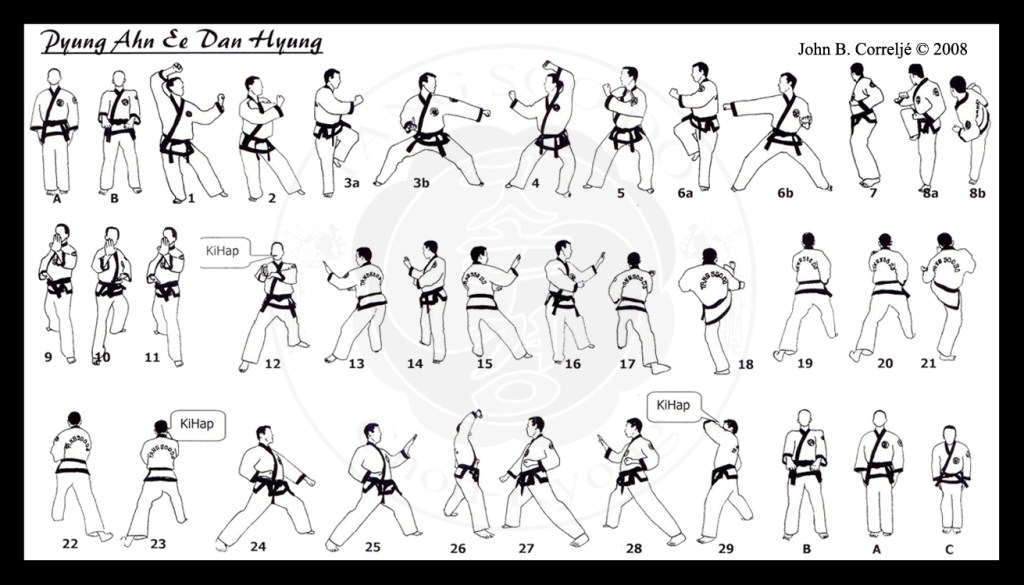
Many proponents of so-called “real-world self-defense” downplay the value of traditional forms training, saying that it’s outdated or “too rigid” to be used for self defense.
I say that depends on how you train.
Now, if you go to a McDojo and everyone learns forms just because it’s needed to advance to the next level, then you’re right; you might as well be at dance class, because that’s what you’re learning.
Some instructors say that it teaches how to move and combine basic actions into combinations. I agree completely, but, if you only practice those combinations in the context of the form, it has no value for self defense.
How do I teach them and then apply them? By pulling out each combination and defense in the form and having the students learn it as a stand-alone combination or technique. They learn it first without partner as a simple combination, then they progress to defending against the actual attack.
As an example, in the Tang Soo Do form Pyung Ahn Ee Dan (one of the Pinan/Heian forms for other styles), there is a reverse in-to-out block, followed by a front kick/reverse punch combination. Rather than only practicing it during forms training, practice it as a combative combination. A great way to train this and make it realistic is that rather than stepping FORWARD, as the form dictates, have the students (or yourself for solo training) step BACKWARDS as you apply the block, then come forward with the counterattack, like you would in real life.
Take that one example and use it for every usable combination in every form you know. I don’t get hung up in the “But my Master says that it is supposed to be…”, each combination in a form is used for WHATEVER WORKS BEST FOR YOU. The true purpose of martial arts training is development of self, so do what works for YOU.
Forms training is just like everything else, you’ll get out of it whatever you put into it. If you approach it with the attitude that it’s just something you have to do, you’ll get nothing out of it. Come at it from the attitude of it’s teaching me combat movement and combative combinations, and you’ll get far more out of it.
Let me make a note about tournament competition in forms. If you train in forms to win tournaments, good for you, but then understand that tournament performance in forms has nothing at all to do with real-life applications. Generally, the method in which people perform tournament forms and win is softer and more free-flowing than those who train in forms for self defense. I don’t want my forms to be pretty, I want them to be powerful.
By the way, if you’re truly into TRADITIONAL martial arts, power and real-world applications is the key, not competition. The Hwa Rang knights of the Silla Kingdom didn’t defeat the other two kingdoms in a tournament, they defeated them in battle with their martial arts skill. They used forms training to prefect their combative techniques. Train with the goal of the ability to defend your life.
I hope this helps you in your training. Post your comments/favorite forms and combinations below.
Preparation Wisdom from Proverbs

In the current environment of social distancing, closed restaurants, and quarantines, we are facing shortages everywhere and unprepared people are panicking. If they had followed simple wisdom that has been around for thousands of years, they would be calm.
The wise store up food & olive oil, but the fool gulps theirs down.
-Proverbs 21:20
Now, toilet paper isn’t exactly olive oil, but the concept is the same.
What can a person with limited means do to prevent such a shortage in the future and be ready, while following the tactical wisdom from the Bible?
For food, each trip to the grocery store, I bought two or three items of canned or long-term storage food and stored them completely separate from the day-to-day food supplies that we use. In a relatively short period, you’ll have weeks of food stored up, long term. Remember to rotate food from the storage to regular use, to ensure that stored food doesn’t expire before you use it.
When buying long term storage food, it’s better to buy it in smaller cans rather than larger ones, because if there is no power, you won’t have a refrigerator to store the unused amount. Also, smaller cans be carried in backpacks for local patrolling/foraging trips, and is more portable if you have to leave the area.
The same thing can be done with most household goods that you might need.
Let’s consider toilet paper, in light of the current situation. Buy double your normal amount for a couple of shopping trips, then set aside the extra. Once you have a 3 to 4 week supply of extra, you can set it aside and never use it, except in an emergency.
You can do this with any staple supply. I also do it with batteries, because you’ll always need batteries. I’ve also done it with candles, flashlights, medical supplies, and clothing.
Yes, I said clothing. Many people consider ammunition, food, and toilet paper, but they never consider clothing. Have you considered where you will buy underwear if stores are closed long term? Or pants? Clothing doesn’t begin to wear until you put it on. You can buy a few extra packages of underwear or other clothing, and store them away. From a health perspective, it’s a vital element that often gets overlooked and it never goes bad.
Historically, humans used to gather all year in preparation for the winter, when there was less forage to be found. Our modern society has made us lazy and allowed us to put ourselves at risk. Most houses in the 1800s had about 8 months worth of food stored, today it’s generally 48 hours.
By going back to Biblical principles, we can prepare ourselves to weather any disaster.
Martial Arts Weapons & Self Defense

I frequently get asked, “Can martial arts weapons be used for self defense?”
The answer is both yes and no, and there are some caveats to consider before launching into a program.
First, understand that most schools that teach weapons are teaching things that look great in TOURNAMENTS to WIN MEDALS, not self defense. Even with a useful weapon, like a bo staff , which could be very useful for self defense, most schools only teach flashy forms that look cool, but have absolutely no real-world application.
Second, realize that not every cool-looking weapon is something you need to learn to defend yourself. For example, the Naginata is wicked-cool looking and I could lop off heads with it, but am I ever going to actually carry one? Never.
Third, learn BASIC ACTIONS before launching into forms. The coolest form won’t help me if I don’t know how to execute a block or a strike.
With these ideas in mind, let’s look at which weapons have real-world value. As always, check with local laws, because some states have silly restrictions.
- Fighting Stick: 2 ½ to 3 feet long, the most applicable…you can always find a stick, an expandable baton, etc.
- Bo Staff: You can adapt this to a broom handle or a long stick/closet bar.
- Nunchaku: Easily concealable, but be careful as most forms aren’t realistic. Many police departments use a variation of these.
- Tonfa: A great tool, but again focus on basics and not forms. Many police departments use the tonfa, calling it a “side-handle baton”.
The ones with the least:
- Kama: Although, some kama skills do translate directly to the tomahawk, you won’t exactly be attacked for your wallet while out harvesting the wheat with a sickle in your hand.
- Sai: Not something you’d ever carry or find.
- Double Sword: You’ll rarely in every day life have one sword, let alone two.
You’ll notice that the knife isn’t listed. Knife fighting is an entirely different and absolutely essential skill set only marginally associated with traditional martial arts. Stick fighting skills are most closely related to knives.
To adapt forms training to self defense, pull out the usable combinations and train on them incessantly, because you’ll use a high block/strike combination for more naturally than the really awesome “drop to a knee and spin the bo staff like a helicopter over my head” part (sorry Master Martin and Master Seegert…you’re both still awesome).
I have a rule that before my students can learn a tournament form, they have to understand the history of the weapon and be able to defend themselves with it against basic attacks first. Then, with each form, they have to be able to describe the combative combinations inside the form and demonstrate them in a self defense context. That was the original purpose of forms training, anyway, but that’s another blog post entirely…
There are some who believe that for true self defense weapons, only firearms are needed. That’s absolutely and unequivocally untrue. Many times, a firearm isn’t legally appropriate. There are other times when it’s more dangerous to insert a firearm. Having additional tools is a plus.
For the true end of the world, power-grid-down situation, you will eventually run out of ammunition and/or spare parts for your firearms, but traditional weapons will still be usable and there won’t be any instructors, so learn now.
An under-considered weapon is the cane. Hapkido and Hwa Rang Do, both traditional Korean Martial Arts, have extensive cane-fighting techniques. Can you think of anywhere that you can’t take a cane?
In short, a true warrior trains in any weapon that he could conceivably use, and the time to learn those skills is BEFORE they are needed.
I hope this helps answer the question for all of you.
Awareness Vs. Panic

In our current environment regarding the CoronaVirus, people are generally at one of two extremes. First, there are people buying into the media’s abject panic. On the other hand, there are people at the extreme other end, saying this is nothing to worry about and that to say otherwise is “fear-mongering”.
What should we do?
Proverbs 27:12 has the answer.
The prudent see danger and take refuge, but the simple keep going and pay the penalty.
Nearly the identical verse appears at Proverbs 22:3:
The prudent sees danger and hides himself, but the simple go on and pay for it.
Which seems to be more prudent, in not just this situation, but in any:
A) Taking precautions and being overly careful, when you didn’t need to be.
B) Taking no precautions and being careless, when you should have been cautious.
Seems fairly obvious, once you remove the “Twitter Mania” and politics from the situation, doesn’t it?
If I am cautious and careful, and didn’t need to be, then I’ve got a few extra cans of food that I was eventually going to eat anyway and I’m healthy.
If I’m careless and not cautious, but the disease does turn out to be bad, I’m sick or dead.
I know which side I’ll err on.
Taking the Biblical advice, I can ensure that I have some basic household supplies (not 36 packages of toilet paper) and some non-perishable food & water on hand, while not running around screaming that the sky is falling, and not berating people who are legitimately concerned.
Decide what “take refuge” means to you…it’s different for each person or family.
I have always had hand sanitizer on hand, because it’s ALWAYS been prudent to do so. I’ve always carried some in my car, had some in my desk at the office, and had some at home.
As far as masks, I generally don’t allow people close enough to me to make that a concern. I don’t use public transportation, because I don’t intend to give anyone else control over my movements, so I don’t end up closer to people than I’d like. In my laptop bag, I’ve always carried some type of bandana to use a dust mask or a bandage, so no new steps needed to be taken.
Yes, some people are over-panicking and buying up supplies, but if you’ve been prudent as the Proverbs advise all along, you already had some supplies on hand.
If you’ve been prudent all along, you didn’t need the government to tell you to wash your hands and teach you how to do it. Besides, letting the government tell you what to do leads to the orders to get on the rail cars at some point.
A good friend of mine (and my Korean Martial Arts instructor) said just yesterday, regarding the panic at Costco, “Did these people not wash their hands or use toilet paper until now?” Everyone wants to make fun of people who choose to be prepared, but at the first sign of trouble, most people became “last-minute preppers”.
You know who WASN’T at the warehouse stores over the weekend, freaking out? PREPPERS. They had already stocked up on supplies before an urgent need, and therefore had what they needed. There’s a lesson in there somewhere.
Trust in yourself, take prudent measures to “take refuge” and don’t buy into either the panic or the over-carelessness.
Adapting One Step Sparring for Realistic Self-Defense
One-Step Sparring, or Il Soo Sik in Korean martial arts, is a common training segment for all martial arts. It incorporates a pre-planned defense against a punch, usually from a formal ready stance.
Many people say it’s outdated and no longer relevant to real-world self defense. If you only train it from a straight punch and always from a formal beginning, I agree.
Again, the use of the formal bow and ready stances, and the letting the partner know when you’re ready is for having structure to obtain muscle memory and learn the mechanics.
In order to transition to making one-steps realistic self defense techniques, after learning them formally, abandon the ready stance (except for testing, of course) and practice the technique free-form, with the partners moving in relation to each other.
- Begin with the same basic attack, a straight punch. Then apply the defensive response as trained, but without worrying about stances and without warning.
- Once that has been mastered, begin defending against hook punches or wild punches, with no warning.
Once you’ve done this with at least 100 reps, you’ll see that one-steps are just as valid today as when they were developed, and that the formalized positioning traditional martial arts schools use is nothing more than a teaching method.
On a serious note, if you don’t practice the one-steps the way I just described, the free flowing, real-world self defense application, ask yourself why you are training.
You’re not… You’re doing interpretive dance with a partner.
In Combat Hapkido or Hapkido, you won’t find forms training. What you’ll find is twice as much Il Soo Sik, or one-step, training to learn how to defend yourself against common street attacks.
In Tang Soo Do and Tae Kwon Do, you’ll also find Ee Soo Sik, or two-step Sparring, which involves defending against a kick followed by a punch. Follow the exact same guidelines as for one steps (learn the mechanics formally, then begin free-flowing training and defense).
You’ll find that this method multiplies your ability to learn and UNDERSTAND martial arts and then apply it to real world situations.
Please consider subscribing below.
Being Ready – Nehemiah
When the Jews returned to Jerusalem with Nehemiah, they were returning to a destroyed city, completely surrounded by enemies. The lessons taught in the Book of Nehemiah are just as valid today in either a Without Rule of Law (WROL) situation, or even in everyday life.
Nehemiah 4:23 says “Neither I, nor my brothers, nor my men took off our clothes, each had his weapon; even when he went for water.”
This isn’t bad advice, no matter what century.
The point of the advice is to remain aware and ready to defend yourself at all times. This was referred to by the legend Jeff Cooper as “Condition Yellow”. It means remaining engaged and being aware of the people around you, your environment, and potential issues that may develop, rather than being distracted by your phone or daydreaming.
When I approach a commercial building, like a store or gas station, I glance through the door or windows first, then as soon as I enter I take in the whole scene, noting all potential exits. It only takes two seconds and could potentially save your life.
In a true WROL situation, this becomes even more important. Nehemiah’s admonition to always be armed takes on special significance in the wake of a natural disaster, mass quarantine, power grid failure, or economic collapse.
In urban areas, the average house has about 48 hours worth of food in it. After the ability to quickly restock food from the corner store has gone away, hungry people will get desperate and remaining armed at all times can be the difference between safety and injury, or worse.
In that situation, you and your team should be fully armed and in “full kit” (sidearm, fixed blade knife, long gun, spare ammunition, and RADIO) at all times. When sleeping, be clothed, like Nehemiah suggests, with all your gear within arms reach. Luke 11:21 says “When a strong man, fully armed, guards his house, his possessions are safe.”
I also recommend highly the “3 Blade Rule”. You should always have available in everyday carry (EDC) and on your body in a WROL situation, 3 blades. First, a folding blade knife, which can be carried in a pocket for EDC or on your gear otherwise. Second, some type of multi-tool. For EDC, my Gerber Suspension and my Gerber M600 are in my laptop bag and in WROL, they have pouches on my web gear. The third blade is a full-size fixed blade knife. For EDC, the fixed blade knife is in my “Emergency Egress” backpack in the rear of my SUV (I carry either a Gerber LMF Infantry or my trusty USMC Ka-Bar). With these three blades, you can solve nearly any emergency, self-defense, or survival need.
As far as EDC carry of a firearm, Nehemiah said they carried their weapons everywhere, even to get water and it’s solid advice. There is no purpose is obtaining a Concealed Pistol License and then not carrying a pistol. I recommend carrying whatever your EDC gear is, whether it’s a handgun or a knife (and it should be both) everywhere that you legally can. You can’t possibly predict when evil or flawed ideology will touch your life, so it’s your responsibility to always be ready.
One more point about EDC: Whether or not you choose to arm yourself for EDC, you should ALWAYS carry a first aid kit. If you do choose to lawfully carry a firearm or knife, you MUST carry a first aid kit. Carrying first aid supplies really isn’t hard and can save lives in any emergency. I’ll do a full post on these, but here’s a recap of what I carry and where:
- Laptop bag: Ziploc bag of various band-aids, some gauze, a pressure bandage (for gunshot wounds or any penetrating trauma), a tourniquet, and a CPR mask/gloves.
- Emergency Egress Backpack: Full kit with band-aids, wipes, antibiotic, gauze, pressure dressings, triangular bandage, Cellox, EMT shears, gloves, CPR mask.
- Trunk of SUV: Full Size med kit with multiple pressure dressings, tourniquet, band-aids of every size, combine pads, gauze, triangular bandages, tape, wipes, antibiotic, conforming bandage, EMT shears, minor medications, CPR mask, and gloves.
- IFAK (moves between bags): Full kit like above, but also with Cellox for blood clotting.
The first aid kits may seem to be a bit much, but I’ve been blessed to be able to help injured people at accident scenes many times in my life. Having the right gear and never needing it is FAR better than needing the gear and NOT having it.
Thanks for reading!
The Battle of the Valley of Berakah
In 2 Chronicles 20, we are told the tale of the Battle of the Berakah Valley. King Jehoshaphat was warned by his spies that a vast army from three different nations was advancing. The King immediately sent out recon teams to keep watch and determine the enemy’s avenue of approach. The King sought guidance from God, and decided to set an ambush at the very far end of the Berakah Valley, where the advancing army had to pass through the narrow Pass of Ziz.
The King put his recon elements out to watch the enemy approach up the gorge while he set up an ambush on the high ground.
Before the King could spring his ambush, the enemy groups began fighting each other, eventually to the last man. The invading army had defeated itself and Israel was victorious without losing a single man.
What sort of tactical wisdom can we glean from this story, aside from the fact that it’s always helpful to have the Creator of the Universe on your side?
The Value of Intelligence
The King was only made aware of the enemy approach because he had an active intelligence network.
How can we as citizens have our own active networks in place? Monitoring the media, including social media, talking to people, joining a network of like-minded people, and cultivating sources. Get on your local police and fire department notification services, as well as the local health department warning network.
Advance knowledge is the key.
A caution about social media though…I recently heard a great quote, “We should harvest data from social media, not plant it”…In other words, gather information, but be careful what information you post on social media.
Recon is Key
Once you know specifically where an actual threat is, you need to keep eyes on it. Bad people left unobserved can slip around you and attack from an unexpected direction.
Anytime you know where a KNOWN hostile element is, you should have someone from your network or group keeping an eye on them and reporting back, even if it’s as simple as having one member assigned to watch a social media page or spot check a known trouble house in the neighborhood.
As GI Joe famously said, “Knowing is half the battle”.
Use Terrain to Your Advantage
Once you know the enemy’s “Avenue of Approach”, your defenses should dominate the key terrain facing that avenue, yet also able to observe alternate approaches from the same direction.
Anytime you analyze terrain, use “KOCOA”:
- Key Terrain
- Obstacles
- Cover & Concealment
- Observation
- Avenues of Approach
Don’t Interfere When the Enemy Makes Mistakes
Here, when the King heard they were attacking each other, he could have easily ordered an attack and won the battle while the enemy was distracted, but he risked losing lives. Waiting was the better option.
As Sun Tzu said, “Never interrupt your enemy when he is making a mistake”.
Another Sun Tzu truth exposed in this story is “The Supreme Art of War is to subdue the enemy without fghting”.
Conclusion
The Battle of Berakah Valley, as told in 2 Chronicles 20, teaches us to have intelligence gathering in place ahead of time, conduct reconnaissance when a threat is detected & maintain observation, dominate the key terrain, and (most importantly) never interfere when an enemy is making a fatal mistake.
Why Do They Still Teach Wrist Grab Defense?
 A common question I hear is why do traditional martial arts schools teach wrist grab defenses?
Is there some epidemic of bad guys running up and grabbing people by the wrist?
Is there any value at all in modern self defense to learning wrist grabs?
The answer is a resounding YES. Here’s why: if I’m attacked and attempt to deploy a defensive tool (knife, gun, flashlight), what is the very first thing my attacker is going to do?
GRAB MY WRIST.
It may be a same-side wrist grab, a cross-grab, two-on-one…. It’s going to be something to attempt to stop my deployment of the tool.
Where students go wrong is on ALWAYS practicing them the way that they are taught in traditional schools. They are taught with two students facing each other from a ready stance and they follow a pre-set pattern where one side grabs, then the other defends.
Learning that way has VALUE. It’s a standardized way to learn the mechanics of a technique, and develop muscle memory. Once you have enough repetitions in that way (at least 100… Yes… 100), then you can move to more realistic training.
Both partners should start from a realistic stance, such as a bladed defensive posture. There should be no forewarning, just a sudden grab of the wrist and an IMMEDIATE defense, without worrying about stances. Yes, hip and shoulder twist matter, but stance doesn’t in the real world.
Once you’ve practiced it empty handed, move on to a training knife or a training gun, practicing to execute wrist grab defenses while retaining an object in the seized hand. Go ahead and do a few reps using your tactical flashlight.
Obviously, in this training, any wrist grab defense that involves a hold with the seized hand can’t be used, but throws and holds using the free hand can.
This will get you to appreciate that there is indeed a real world value to wrist grab defenses, and hopefully better prepare you to face evil in the real world.
WELCOME!
Can Traditional Martial Arts Help?
There are a lot of people who say that Traditional Martial Arts are too outdated to be useful for self defense.
That’s both true and untrue… It’s all in how you train and what you do AFTER CLASS.
For example, if you always practice self defense techniques from some formal stance and with pre-determined steps, you’ll not be able to apply it to real life.
After you’ve gotten the basics of a technique down, if you and your partner then practice the technique from a more realistic stance and from different angles, without prearranged timing, it can become a powerful tool.
We’re going to be discussing how to apply traditional techniques to the real world here in our self-defense blog, so stay tuned.
I’m a KyoSaNim (certified instructor) in Tang Soo Do with an Ee-Dan black belt degree, as well as an instructor in Krav Maga.
What is Tactical Wisdom?
This is a site where we discuss preparedness, self-defense, tactical ideas & training, and gear. It’s NOT a cool-guy, shoot-em-up, unrealistic site. Here, we will discuss real world applications and what true preparation means…. Skills, not just the coolest guns and gadgets.
All the coolest gear in the world won’t help you if you get attacked while packing your car or if you don’t have the skills to apply those tools.
We’ll address unarmed self defense skills, which are really an absolute requirement for self defense, confidence, fitness, and a Warrior mindset.
We’ll also review some of the gear that can help you with a focus on real world uses, not the specialized high-level high-speed stuff that has no real world use for the average person.
We’ll also address tactical knowledge from a couple of angles. First, we’ll discuss tactics that a small group of people can apply to defend and secure their homes. We’ll also discuss everyday carry and self-defense.
A unique area we’re going to dive into as well is Tactical Wisdom from the Bible. There is a wealth of advice and skills discussed in the Bible, aside from basic Christian beliefs, that are just as applicable today as they were when it was written.
I hope you’ll join us on our journey.
Who is JD?
Welcome. Have a seat.
My name is JD and I’m a professional investigator in the corporate security world. I’m also a KyoSaNim in the Korean Martial Art of Tang Soo Do. When I’m not doing those things, I’m an NRA Defensive Firearms Instructor, and a Krav Maga defensive tactics instructor.
I’ve worked as an investigator, an executive protection agent, and a US Marine.
What I’m hoping to do is share some tactical lessons learned, share some self defense tips, some defensive training tips, some gear reviews, and even some biblical tactical wisdom (yes, really).
Some many people focus their preparations on all their fancy cool-guy guns and the latest night vision gear, that they’ll NEVER USE IN REAL LIFE.
I’m hoping to share some real world knowledge with realistic people.
I’ll hope you’ll join me on this quest.

